
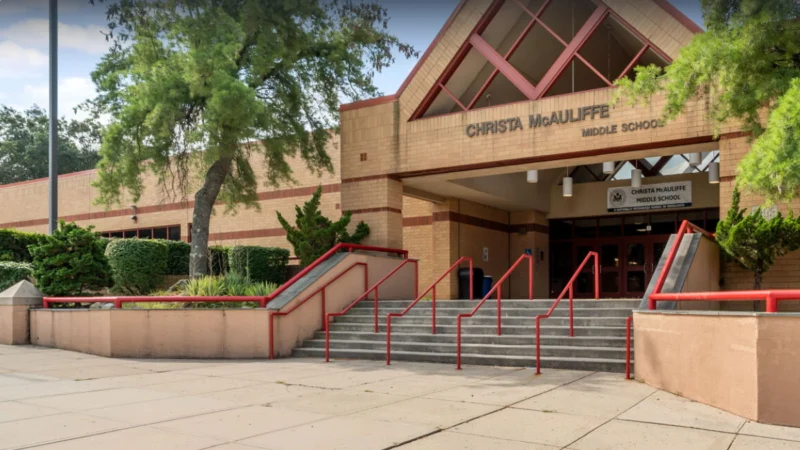
The Jackson Board of Education approved the sale of the former Christa McAuliffe Middle School to Beth Medrash Govoha, but a decades-old zoning question could become one of the biggest hurdles before the transaction reaches the finish line.
Jackson, NJ – What began as a straightforward effort to sell a beloved community Blue Ribbon middle school to help stabilize the Jackson School District’s dire finances may now be evolving into something much larger: a test of Jackson Township’s zoning code, its compliance with a federal civil rights settlement, and whether one of the township’s most recognizable school properties can legally become a religious higher education campus.
The Jackson Board of Education voted in December to accept a $40 million offer for the former Christa McAuliffe Middle School, located at 35 South Hope Chapel Road, describing the sale as a critical piece of the district’s financial recovery following years of declining state aid.
The proposed purchaser has been widely identified as Beth Medrash Govoha (BMG) of Lakewood, one of the largest rabbinical colleges in the world. If completed, the transaction would mark one of the largest real estate deals involving a former Jackson public school.
Years prior, the district sold the Sylvia Rosenauer Elementary School to another buyer, who turned it into a private school. There were few hiccups because zoning laws allowed it.
Yet months after the Board approved the sale, significant questions have emerged about whether the property’s zoning allows the buyer’s intended educational use—and whether Jackson’s land-use regulations clearly answer that question.
The Jackson School District was asked for documents related to the sale and for comment regarding the status of the transaction but did not respond before publication.
A school with deep roots in Jackson
Christa McAuliffe Middle School served generations of Jackson students and was widely recognized as one of the district’s flagship schools.
Named after teacher and astronaut Christa McAuliffe, the school earned designation as a National Blue Ribbon School, one of the U.S. Department of Education’s highest honors for academic excellence. For years, the campus was home to thousands of Jackson students before enrollment changes and district financial troubles led to its closure and sale to the world’s largest Yeshiva.
When the Board of Education decided to sell the building, officials said they had little choice.
Jackson has repeatedly warned that reductions in state school aid created enormous financial pressure, forcing difficult decisions that included school closures, staffing reductions, and the sale of district assets.
Board members described the McAuliffe sale as an important source of revenue needed to help stabilize the district’s finances.
Who is BMG?
Beth Medrash Govoha, commonly known as BMG, is a private Orthodox Jewish rabbinical college headquartered in neighboring Lakewood.
Founded in 1943, BMG has grown into one of the world’s largest institutions of advanced Jewish learning, with thousands of students studying full time. While the institution is often associated with Lakewood, its continued growth has led to expansion beyond its original campus.
Unlike a K-12 private school, BMG is generally understood to operate as a post-secondary institution, meaning its proposed use of the McAuliffe property could be evaluated under Jackson’s zoning regulations governing higher learning institutions rather than primary or secondary schools. It is essentially a religious college.
That distinction may prove significant for the future of the sale and the township.
The zoning question few are talking about
The issue is not whether Jackson allows schools. It clearly does. The issue is what kind of school the township allows at this specific property.
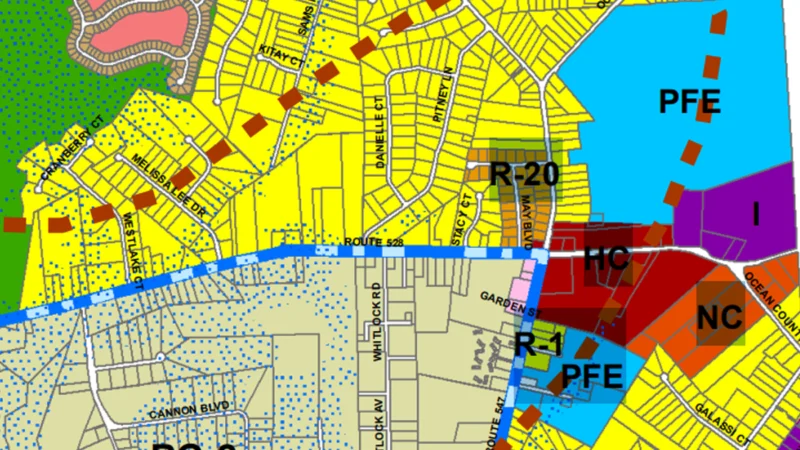
The former McAuliffe Middle School has been described in sale materials as being located within a Public Facility and Education (PFE) area.
On its face, that sounds straightforward.
But a review of Jackson’s zoning ordinance reveals something unusual.
While official township zoning maps identify numerous properties—including public schools—as lying within areas labeled PFE, the township’s land-use ordinance does not appear to establish a corresponding PFE zoning district with permitted uses, conditional uses, lot standards, setbacks, or other regulations that typically define every zoning district.
That apparent inconsistency was not first discovered by local residents.
It was identified by the U.S. Department of Justice.
The DOJ raised the same concern
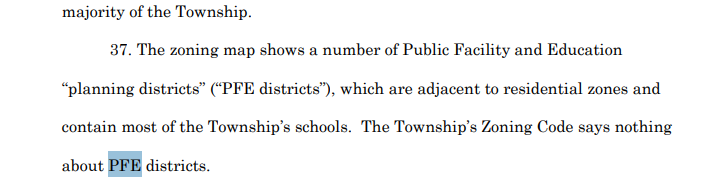
In its lawsuit against Jackson Township, the Department of Justice specifically alleged that Jackson’s zoning map showed PFE planning districts, yet the township ordinance “says nothing about PFE districts.”
That allegation became part of the federal government’s broader claim that Jackson’s land-use regulations were inconsistent and had been applied in a discriminatory manner toward Orthodox Jewish religious schools.
Although the lawsuit ultimately resulted in a federal consent order rather than a trial, the questions surrounding PFE were never answered through a judicial ruling. Instead, they remain embedded in Jackson’s zoning framework.
Higher education is defined—but where is it permitted?
Since that litigation, Jackson amended portions of its zoning ordinance to define what constitutes a Higher Learning Institution.
The ordinance includes post-secondary schools, colleges, trade schools, technical schools, professional schools, and religious educational institutions.
However, defining a use and allowing it everywhere are two different things.
The ordinance appears to establish location standards for educational facilities and references roadway classifications and planning requirements rather than making higher education a permitted use throughout the township.
That leaves a critical unanswered question:
How does a higher learning institution fit into a property shown on the zoning map as PFE when the ordinance itself does not clearly establish a PFE zoning district?
Several paths could be available
Land-use professionals familiar with New Jersey’s Municipal Land Use Law say there are several potential paths forward, depending on how township officials interpret the ordinance.
Among the possibilities are:
- A determination by the zoning officer that the proposed educational use is permitted.
- Site plan review by the Planning Board if operational changes require municipal approval.
- A use variance from the Zoning Board of Adjustment if the proposed use is not permitted as of right.
- A Township Council ordinance clarifying or establishing regulations for the PFE designation if officials conclude the current code is insufficient.
At this point, it is not publicly known which, if any, of those approaches will be required. One thing is certain. The Department of Justice is expecting Jackson Township to identify the PFE zone clearly. It may not happen until after this year’s election, because the change in zoning could be politically harmful to the existing administration and council. If BMG approces, the matter can be tabled until after the election, so prevent the issue from being a political firestorm this fall.
A politically sensitive issue
Any zoning decision involving the McAuliffe property would likely attract significant public attention.
The property represents one of the largest former public school sites in Jackson, and any proposal involving a major educational institution is expected to generate intense interest from residents.
It also comes as Jackson continues to operate under a federal consent decree requiring the township not to discriminate against religious institutions in land-use decisions or treat them less favorably than comparable secular uses. If township officials determine additional approvals are required, how those approvals are handled could draw scrutiny given the township’s recent legal history.
In short, it appears the buyer (BMG) and the seller (Jackson School District) did not fully investigate the details of the property before the sale, as this omission is either negligence or intentional. At this point, nobody wants to talk about it. The township council, school board, and BMG have all remained publicly silent on the obvious bump that could block the path foward if not addressed properly.
What happens if there are delays?
For the school district, timing matters.
District officials have repeatedly pointed to the sale as an important financial transaction following years of state aid reductions and budget challenges.
Any prolonged delay in closing could affect the district’s financial planning, depending on the terms of the purchase agreement and whether any contingencies remain outstanding.
Neither the district nor township officials have publicly discussed those details.
More than a real estate transaction
The proposed sale of McAuliffe Middle School is increasingly about more than a vacant building.
It sits at the intersection of school finance, municipal zoning, religious land-use law, and Jackson’s ongoing effort to move beyond years of litigation over how educational institutions are treated under local ordinances.
Whether the sale proceeds without controversy—or becomes the next major chapter in Jackson’s long-running land-use debates—may depend on questions that have yet to receive public answers.
For now, one thing appears clear: before the former Blue Ribbon school begins its next chapter, the township may first have to determine exactly what its zoning code allows on the land where it has stood for decades.
Key Points
- The Jackson Board of Education approved a $40 million sale of the former Christa McAuliffe Middle School as part of its financial recovery plan following significant state aid reductions.
- The reported purchaser, Beth Medrash Govoha, is a post-secondary religious educational institution, raising questions about how the proposed use fits within Jackson’s zoning regulations.
- Jackson’s zoning maps identify the property within a Public Facility and Education (PFE) area, while the township ordinance does not appear to establish a corresponding PFE zoning district—a discrepancy previously identified by the U.S. Department of Justice.
- It remains unclear what municipal approvals, if any, will be required before the proposed educational use can move forward.
- The outcome could have implications for both the school district’s finances and Jackson Township’s administration of its land-use regulations under the federal consent decree.