
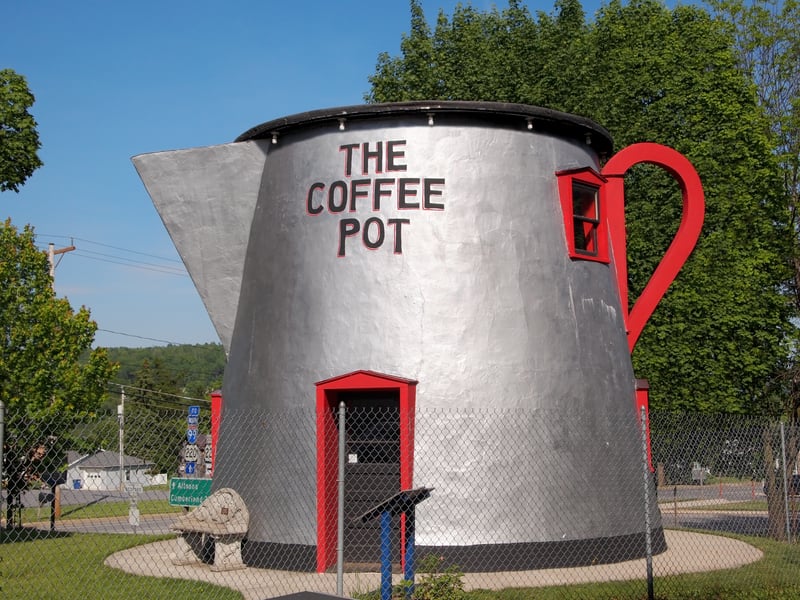
Built in 1927 to attract motorists along the Lincoln Highway, Bedford’s enormous roadside coffee pot survived decades as a restaurant and bar, narrowly escaped demolition and remains one of Pennsylvania’s quirkiest landmarks.
BEDFORD, PA — Drivers traveling through Bedford, Pennsylvania, along historic Route 30 might find themselves doing a double take. Sitting near the entrance to the Bedford County Fairgrounds is an 18-foot-tall coffee pot, complete with a giant handle, oversized spout and a history stretching back nearly a century.
The unusual structure has become one of Pennsylvania’s most recognizable roadside attractions. But long before tourists stopped to take selfies beside it, the massive coffee pot was a clever advertising gimmick designed to convince hungry motorists to pull off the highway.
Built in 1927 by Albert “Bert” Koontz, the building was originally part of a roadside restaurant connected to his nearby gas station.
And believe it or not, people actually ate inside it.
The giant coffee pot was built to sell hamburgers and gasoline
During the 1920s, the Lincoln Highway was one of America’s most important automobile routes, connecting the East Coast to the West Coast long before interstate highways existed.
Business owners along the highway competed for motorists’ attention with unusual buildings, oversized signs and eye-catching attractions.
Koontz decided an enormous coffee pot might do the trick.
The two-story structure featured a rounded body, a massive spout and a lid-shaped roof. It was originally part of a restaurant serving hamburgers, ice cream and Coca-Cola.
The idea was simple. A conventional roadside restaurant might go unnoticed. A giant coffee pot was considerably harder to miss.
According to the Lincoln Highway Heritage Corridor, the attraction represents a distinctive period of American roadside architecture when businesses designed buildings to look like the products they sold.
The strategy worked well enough that the coffee pot became a familiar landmark for travelers passing through Bedford.
From roadside restaurant to bar and Greyhound stop
By 1937, the property had changed owners and the restaurant was converted into a bar.
A three-story hotel was also constructed behind the unusual building, turning the property into a roadside destination for travelers.
The coffee pot became a regular stop for Greyhound bus passengers because of a nearby bus station.
For decades, the property continued operating as a bar and restaurant, even after the Pennsylvania Turnpike diverted much of the long-distance traffic away from the Lincoln Highway.
Eventually, changing travel patterns and declining business took their toll.
The bar closed in 1989, leaving the once-popular landmark vacant.
Historic coffee pot nearly demolished before community saved it
By the late 1990s, the coffee pot was falling apart.
The building had deteriorated after years of neglect, and its future became uncertain when the property changed hands.
New owners wanted to redevelop the land, leaving the giant roadside attraction facing possible demolition.
Instead, local preservationists launched an effort to save it.
The Lincoln Highway Heritage Corridor acquired the structure and arranged to relocate it to the entrance of the Bedford County Fairgrounds.
The building was moved in December 2003 and restored during the summer of 2004.
The restoration included structural repairs and a new silver exterior designed to recreate the appearance of the original coffee pot.
The project preserved one of the few surviving examples of this unusual form of roadside architecture in Pennsylvania.
A giant coffee pot that no longer serves coffee
Today, visitors can still see the enormous coffee pot along Business Route 30, near the intersection of Pitt Street and Telegraph Road.
The building no longer operates as a restaurant or bar. Instead, it serves as a historic roadside landmark and reminder of the early days of American automobile travel.
Its distinctive design has made it a popular photography destination for travelers exploring Pennsylvania’s historic Lincoln Highway.
The coffee pot is also a rare surviving example of programmatic architecture, a style in which buildings are constructed to resemble objects associated with their businesses.
During the early automobile era, Americans encountered restaurants shaped like hot dogs, buildings resembling giant shoes and other oversized structures intended to attract passing drivers.
Most eventually disappeared as highways and commercial development changed.
Bedford’s coffee pot survived.
Where to find Pennsylvania’s giant coffee pot
The attraction is located at 108 Telegraph Road in Bedford, near the Bedford County Fairgrounds.
It is easily accessible from Business Route 30, the historic Lincoln Highway.
Travelers visiting the area can also explore downtown Bedford, the historic Jean Bonnet Tavern and other preserved landmarks from Pennsylvania’s early transportation history.
The Bedford County Visitors Bureau includes the coffee pot among the area’s unusual attractions.
Nearly 100 years after Koontz first dreamed up his roadside advertising stunt, the giant coffee pot is still doing exactly what it was built to do.
It’s making people stop and look.