
Annapolis, Md. — Nearly 900 students from 65 countries transformed invisible ocean organisms into striking works of art for the 2026 Science Without Borders® Challenge, a global competition that asked young artists to explore how microscopic marine life sustains ecosystems and human life on Earth.
The annual contest, organized by the Khaled bin Sultan Living Oceans Foundation, focused this year on “Microscopic Marine Life,” highlighting organisms too small to see with the naked eye but powerful enough to produce oxygen, recycle nutrients, and regulate the planet’s climate. Winners ranged from an 11-year-old student in China to teenagers in the United States, Canada, and South Korea.
Art Brings Hidden Ocean Systems Into Focus
The top prize in the 15–19 age category went to Sophia (Jiye) Lee, a 17-year-old student at Bergen County Academies in Hackensack, New Jersey, for her mixed-media artwork Ocean’s Hidden Jewel Box.
Built on a custom wooden canvas shaped like an oxygen molecule, the piece reimagines microscopic marine organisms as glowing jewels, emphasizing their role in sustaining life across the planet. Organizers said the artwork stood out for combining scientific understanding with visual storytelling.
“When people see my work, I hope they recognize that significance is not defined by scale,” Sophia said in a statement released by the foundation. “I want them to feel a sense of awe for the unseen and to realize that impact can extend beyond just the source.”
Sophia’s work also underscored a key scientific fact driving this year’s theme: microscopic marine organisms such as plankton generate more than half of the oxygen humans breathe.
Second place in the older category went to 17-year-old Qing Yang Cheng of Canada for The Deep Microcosm of Life, which illustrated hydrothermal vent archaea and the deep-sea ecosystems they support through chemosynthesis. Third place was awarded to Hyang Yu Lee, 17, from the Republic of Korea, for Sea Manual, a piece styled like an IKEA instruction guide to explain how marine bacteria support decomposition and nutrient cycling.
Key Points
• The 2026 Science Without Borders® Challenge received nearly 900 entries from 65 countries
• Students created artwork inspired by microscopic marine organisms and their role in Earth’s ecosystems
• Winners came from the United States, Canada, China, and the Republic of Korea
Younger Artists Spotlight Ocean Recycling and Coral Health
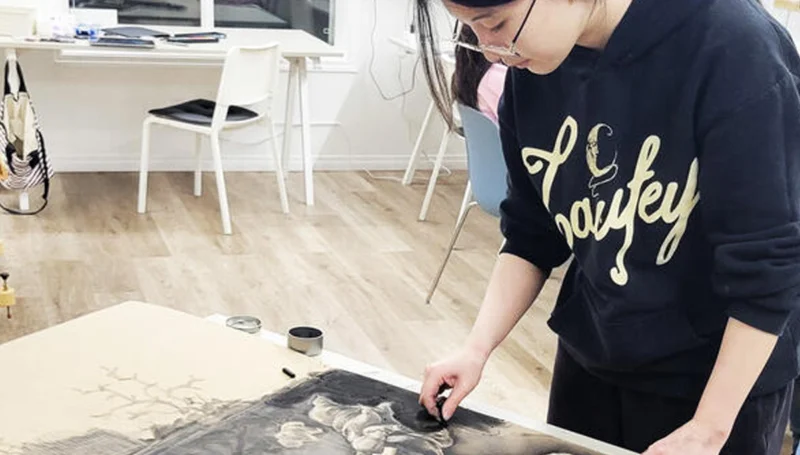
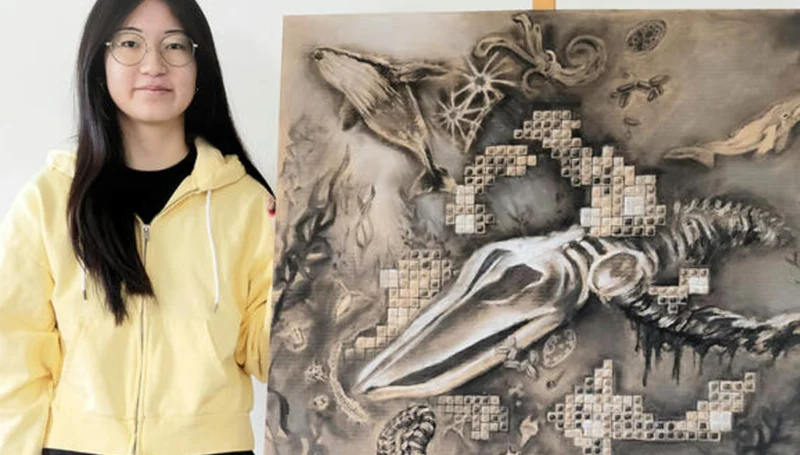
In the 11–14 age category, first place went to Olivia Shin, a 14-year-old student from Calgary, Canada, for The Giant and the Invisible: A Story of Ocean Recycling.
Created with charcoal on recycled cardboard, the artwork depicts microscopic organisms breaking down a blue whale carcass after it sinks to the ocean floor. The piece highlighted how bacteria and other microorganisms recycle nutrients and support marine ecosystems for decades following a whale fall.
“I was inspired by how bacteria clump together and work with microorganisms, which to me resembled the game of Tetris,” Olivia said. “I hope that my artwork can encourage others’ thoughts and interest in marine life.”
Foundation officials said the recycled cardboard used in the piece reinforced the artwork’s environmental message about interconnected systems and renewal within the ocean.
Second place in the younger division went to 11-year-old Jieming Zhang of China for The Touch of Life, a colorful depiction of symbiotic microalgae that provide energy to coral reefs and help maintain coral health.
Third place was awarded to Eason Liang, 14, of Irvine, California.
Competition Connects Science and Conservation
The Science Without Borders® Challenge invites primary and secondary school students ages 11–19 to combine scientific concepts with artistic expression. The Khaled bin Sultan Living Oceans Foundation created the program to increase awareness of marine conservation issues through education and creativity.
This year’s focus on microscopic marine organisms brought attention to species often overlooked despite their outsized environmental impact. Organizers said the submissions explored subjects ranging from phytoplankton drifting beneath ocean surfaces to microbial life clustered around hydrothermal vents deep in the sea.
The contest arrives as scientists continue warning about threats to marine ecosystems from climate change, warming oceans, and pollution. By centering the competition on microscopic life, the foundation aimed to show how even the smallest organisms influence global systems far beyond the ocean itself.
The winning artwork also reflected a broader trend of students using environmental themes to bridge science, sustainability, and visual storytelling.
Winners’ Artwork Gains International Attention
The Khaled bin Sultan Living Oceans Foundation plans to showcase the winning entries through its educational outreach and conservation initiatives. Organizers said the artwork demonstrates how young people can communicate complex scientific ideas in accessible and emotional ways.
Founded to support ocean research and reef conservation, the Annapolis-based nonprofit has used the Science Without Borders® Challenge for more than a decade to encourage students worldwide to engage with marine science.
The 2026 winners were announced Thursday morning by the foundation, which said this year’s entries revealed “a remarkable blend of artistic talent and scientific understanding.”
The competition has now concluded, with winning artwork selected in both age divisions and international recognition awarded to the top student artists.
Khaled bin Sultan Living Oceans Foundation, Ocean Conservation, Marine Science Education
