
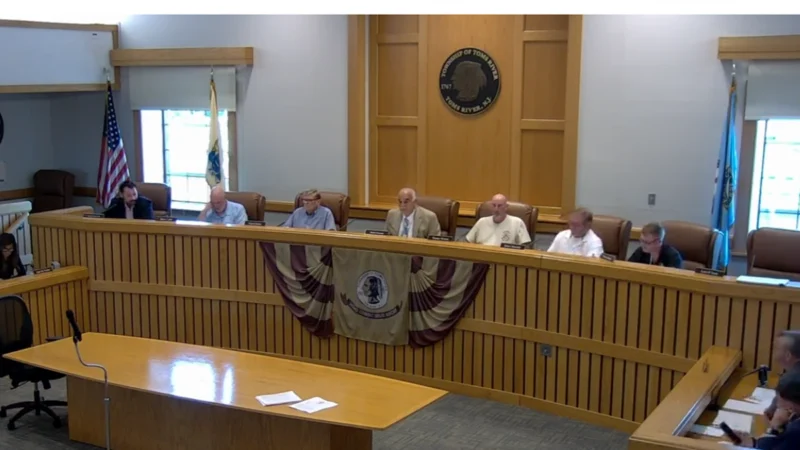
TOMS RIVER, N.J. — A dispute over legal representation has erupted into a legal Sunshine Law violation after Toms River Township Attorney Jonathan Penny accused a majority of the Township Council of conducting an unlawful private meeting inside Town Hall, disguised as an ‘executive session’, however legal components to comply with the state law on such meetings were not followed.
Under state law, to be considered a legal meeting, a clerk must be in attendance to document the private meeting for public record and to create official meeting minutes.
The township council majority excluded both the clerk, mayor, attorney.
At this week’s Township Council meeting, Council President David Ciccozzi and council members Tom Nivison, Clint Bradley and Robert Bianchini met privately before the public meeting to discuss township business, including retaining independent legal counsel and participating in ongoing litigation involving Toms River Municipal Utilities Authority Commissioner Phil Brilliant.
Penny said the gathering violated New Jersey’s Open Public Meetings Act because a quorum of the governing body met outside public view to deliberate official business.
“That executive session was grossly improper,” Penny told the council. “By removing the clerk, you created an unlawful gathering of four councilmen.”
Township attorney challenges council’s actions
Penny said the private gathering excluded the Township Clerk, Mayor Dan Rodrick, Penny himself, and council members Lynn O’Toole, Harry Aber, and Craig Coleman.
Under New Jersey law, executive sessions of governing bodies are required to be publicly noticed, conducted pursuant to a resolution citing one of the statutory exceptions, and attended by the municipal clerk, who is responsible for preparing official minutes.
Penny argued the gathering did not meet those legal requirements and therefore could not properly be characterized as an executive session.
The dispute centered on a resolution authorizing the council to retain outside legal counsel separate from the township attorney.
According to Penny, the council majority also discussed intervening in litigation filed by Toms River MUA Commissioner Phil Brilliant and using township funds to pay for that legal representation.
Brilliant is the MUA commissioner who hosted a failed recall effort of Mayor Rodrick and is receiving free healthcare benefits from the MUA for attending one meeting per month. His business, Brilliant Environmental Services, has recently entered bankruptcy proceedings.
Penny said the council members are free to join Brilliant’s lawsuit, but the township should not pay for it to sue itself.
“I don’t think that’s proper,” Penny said. “If you want to do that, you have to do it as an individual and not use township funds.”
Penny announced he intends to file an Order to Show Cause seeking to challenge the council’s resolution appointing independent legal counsel.
The council majority has sought to become involved in that litigation through separate legal counsel, prompting objections from the township attorney, who argues the governing body cannot authorize taxpayer-funded representation for individual council members seeking to join the lawsuit.
Lawsuit stems from MUA benefits dispute, turned political vandetta by Brilliant
The legal dispute arises from litigation filed by Toms River Municipal Utilities Authority Commissioner Phil Brilliant.
Brilliant has faced criticism over receiving taxpayer-funded health insurance benefits while serving as an MUA commissioner, a position that generally requires attendance at one meeting each month. In return, he has filed numerous lawsuits against Rodrick and the township.
The details of the proposed intervention and the legal basis for the council’s participation remain under dispute.
Mayor objects during contentious meeting
Mayor Dan Rodrick also challenged the council’s actions during the public meeting.
“You don’t have a right, this is an executive action,” Rodrick said while objecting to the council’s handling of the matter.
Council President David Ciccozzi interrupted the mayor and instructed him to stop speaking as tensions escalated during the meeting.
Sunshine Law requirements
New Jersey’s Open Public Meetings Act, commonly known as the Sunshine Law, requires meetings of public bodies to be conducted openly when a quorum gathers to discuss or act on public business.
Generally, when a majority of a governing body meets to deliberate official business, the meeting must be publicly noticed unless it qualifies for one of the limited statutory exceptions permitting a closed executive session. Executive sessions must still be authorized by resolution at a public meeting and are subject to the procedural requirements of the Open Public Meetings Act.
If a court determines that a quorum met privately outside those requirements to discuss township business, actions flowing from that meeting could be subject to legal challenge.
Whether the gathering described by Penny ultimately constitutes a violation of the Open Public Meetings Act would be determined by a court if litigation is filed.
What happens next
Penny said he plans to seek immediate judicial review of the council’s action by filing an Order to Show Cause contesting the resolution authorizing independent counsel.
If filed, the case could determine not only whether the council properly retained separate legal representation but also whether the private meeting itself complied with New Jersey’s Sunshine Law.
The controversy comes as Toms River continues to experience growing divisions between the mayor and the four-member council majority over governance, legal authority and the expenditure of public funds.