
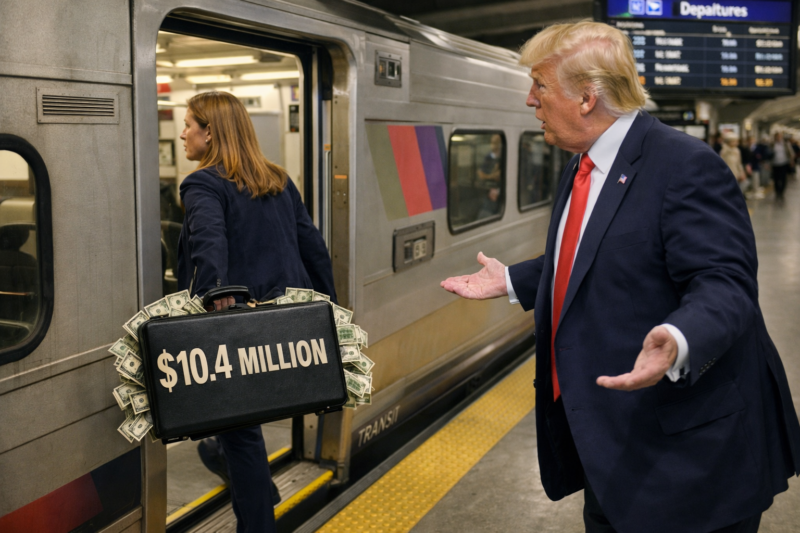
Trump Team Says $10.4M Sent for World Cup Transit as Mikie Sherrill Battles FIFA Over $48M Bill Friday
Newark, New Jersey — A widening fight over who pays to move tens of thousands of World Cup fans escalated Friday after the Trump administration said it already sent $10.4 million to New York and New Jersey, directly challenging Governor Mikie Sherrill’s claim that the state is being left with a $48 million transit burden.
Today, Trump officials confirmed that report and now there’s just one question for New Jersey Governor Mikie Sherril to answer. Where did that $10 million go that the state just received to compensate for travel expenses?
The clash now spans state leadership, FIFA, and federal officials, with each side offering sharply different accounts of who is responsible for covering transportation costs tied to the 2026 World Cup at MetLife Stadium.
Federal funding claim adds new pressure on Sherrill
Andrew Giuliani, speaking as part of the White House World Cup task force, pointed to a recent federal transportation grant as evidence that the administration has already stepped in.
“Well, I think it’s really important to highlight the $100 million in the transportation grant that went out a month ago,” Giuliani said. “$10.4 million of that went to New York and New Jersey.”
He broke down the numbers in practical terms tied to projected ridership.
“If you assume that there are 30,000 fans, 30,000 riders that are going to MetLife Stadium from Penn Station for the 8 games, that’s over $41 per rider,” he said. “If it’s 40,000 riders, that’s over $30 per rider.”
Giuliani framed the funding as a direct attempt to offset costs that could otherwise fall on fans or transit systems.
“So I think the President really has done everything that he can to really look at it and say, hey, look, we are doing what we can to make sure that those are going to be using public transit over the course of this World Cup, that the federal government hasn’t forgotten about you,” he said.
—
Key Points
• Trump administration says $10.4M in federal funds already went to NY/NJ for World Cup transit
• Mikie Sherrill says NJ TRANSIT still faces a $48M cost burden
• FIFA disputes responsibility, citing revised host agreement terms
—
“We’re not here to fix New Jersey’s long-term problems”
Giuliani also drew a firm line on what the federal government sees as its role.
“The President also has wanted to highlight that, hey, look, we’re not here to go and fix long-term problems that may exist in the state of New Jersey with their transit or the city of New York or the state of New York,” he said. “This is for the World Cup specifically.”
When pressed on whether projected ticket prices—potentially exceeding $100 for a round trip from Penn Station to MetLife Stadium—were acceptable, Giuliani avoided directly endorsing the pricing but reiterated the administration’s position.
“Look, I’m going to focus on exactly what the president has done to make sure that it can be affordable,” he said. “Putting $10.4 million into New York and New Jersey for their transportation… you’re talking for 40,000 riders over $30 per round-trip ticket.”
“The president has looked at it and said, hey, what can we do to make sure it can be affordable for people that are using mass transit to get out to MetLife, and he has put his money where his mouth is,” Giuliani added.
Sherrill vs. FIFA: a separate but connected fight
The federal funding claim lands in the middle of an already heated dispute between Governor Mikie Sherrill and FIFA, the global governing body organizing the tournament.
Sherrill has argued that New Jersey “inherited” a deal that leaves the state paying for transportation while FIFA generates massive revenue.
“We inherited an agreement where FIFA is providing $0 for transportation to the World Cup. Zero,” Sherrill said earlier this week.
“That leaves New Jersey Transit with a $48 million bill to safely get 40,000 fans to and from every game,” she said, adding, “I’m not going to stick New Jersey’s commuters with that tab for years to come.”
She has repeatedly pointed to FIFA’s financial scale.
“At the same time, FIFA is making $11 billion off of this World Cup,” Sherrill said. “FIFA should pay for the rides.”
FIFA, however, pushed back forcefully, disputing both the framing and the expectation.
“We are quite surprised by the NJ Governor’s approach today on fan transportation,” FIFA said in a statement.
The organization emphasized that the original requirement for free fan transport was revised.
“Recognizing the financial strain this placed on the host cities, back in 2023 FIFA adjusted the Host Agreement requirements,” FIFA said. “All match ticket holders and accredited individuals shall be able to access transport … at cost.”
FIFA also noted its broader involvement in planning and funding efforts.
“FIFA worked for years with host cities on transportation and mobility plans, including advocating for millions of dollars in federal funding to support host cities,” the statement said.
A contract years in the making
At the center of the dispute is a host city agreement that predates Sherrill’s administration.
New Jersey’s role in the 2026 World Cup traces back to 2018, when the host agreements were signed during the early phase of the bidding and planning process. Phil Murphy had just taken office as governor in January 2018, succeeding Chris Christie, whose administration was involved in the earlier bid.
Those agreements placed significant responsibility on local organizers, including costs tied to transportation, security, and logistics. The framework was later modified in 2023, but not eliminated.
That timeline complicates the current political fight.
Some New Jersey Democrats and media voices have pointed toward the Trump administration in criticizing rising costs tied to the event, including high ticket prices and transportation concerns.
At the same time, federal officials are now pointing back—arguing that funding has already been delivered and that the core agreement structure was established and maintained across multiple administrations, including under President Joe Biden.
The $10 million question
The introduction of the $10.4 million federal grant raises a central question now driving the political narrative:
Where did the money go—and how much of the $48 million gap does it actually cover?
Based on Giuliani’s framing, the funding is intended to offset per-rider transportation costs, potentially reducing the burden on transit agencies or ticket prices. But it does not appear to fully eliminate the financial gap identified by NJ TRANSIT.
Even under the most generous assumptions presented—roughly $30 to $41 per rider—the federal contribution would cover only a portion of total projected costs associated with moving tens of thousands of fans across eight matches.
That leaves a substantial remaining balance, which Sherrill argues should be paid by FIFA—not New Jersey commuters.
High stakes for commuters and fans
The outcome of this dispute carries real implications for both residents and visitors.
If costs are passed through to riders, World Cup attendees could face triple-digit train fares for what is typically a short regional trip. If absorbed by NJ TRANSIT, the financial strain could ripple into broader system budgets, potentially affecting everyday commuters long after the tournament ends.
Meanwhile, FIFA continues to emphasize the economic upside, pointing to millions of visitors and regional spending tied to the event.
But for state officials, the immediate concern is more concrete: who writes the check.
What happens next
No agreement has been announced between New Jersey, FIFA, or federal officials to reconcile the funding gap, and each side appears entrenched in its position.
Sherrill has made clear she does not intend to shift the burden onto commuters. FIFA maintains that current agreements already reflect a compromise. The Trump administration insists it has already contributed meaningful funding—and will not go further to address what it describes as underlying transit issues.
For now, the $48 million shortfall remains unresolved, and the added question of how the $10.4 million federal grant is being allocated is likely to intensify scrutiny in the weeks ahead.
The status of transportation funding for the 2026 World Cup in New Jersey remains unsettled, with no final determination on who will ultimately pay the remaining costs.