
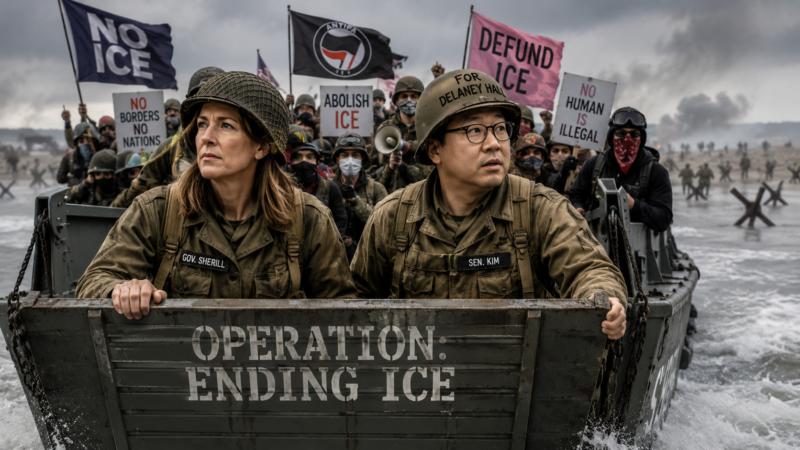
If you’ve been around politics long enough, you learn one thing quickly: timing is never accidental.
That’s why New Jersey Democrats Mikie Sherrill and Andy Kim’s decision to turn Memorial Day weekend into a showdown over ICE detention operations at Delaney Hall deserves a closer look.
The official explanation is straightforward. Families were raising concerns. Activists wanted answers. Elected officials responded.
That’s the public explanation.
The political explanation may be different.
Memorial Day is one of the quietest news days of the year. Most local governments aren’t meeting. The Legislature isn’t making news. Courts are quiet. Reporters are looking for stories beyond parade photos and shore traffic reports.
For politicians seeking maximum exposure, it’s a target-rich environment.
When Sherrill and Kim arrived at Delaney Hall, they instantly became the story. Instead of discussions centered on fallen service members, veterans’ organizations, military families, and the sacrifices made by generations of Americans, much of New Jersey’s political conversation shifted to ICE, immigration detention, and federal enforcement policy.
Whether that was intentional or not, it was certainly predictable.
The question voters should ask is whether the timing was chosen because it was urgent—or because it was effective.
There’s no doubt Democrats nationally have struggled on immigration. Poll after poll has shown voters increasingly concerned about border security, illegal immigration, and the costs associated with migrant programs. New Jersey is no exception.
For Democratic politicians, confronting ICE remains one of the few issues that energizes the activist wing of the party. It generates media attention. It produces viral clips. It creates a clear contrast with Republicans.
What it doesn’t necessarily do is win over middle-of-the-road voters who are worried about affordability, crime, taxes, and overcrowding.
That creates an interesting political calculation.
Sherrill and Kim may have been speaking directly to Democratic primary voters rather than the broader electorate. In modern politics, motivating your base is often more important than persuading undecided voters.
There is also the symbolism issue.
Memorial Day occupies a unique place in American life. It is one of the few national holidays specifically dedicated to honoring those who died serving the country. Many voters believe elected officials should use the day to focus on that mission and little else.
Critics argue that launching a high-profile protest against federal immigration enforcement on that day sent the wrong message. Supporters argue elected officials don’t stop doing oversight simply because it’s a holiday.
Both arguments have merit.
But politics is often about perception, not intent.
The reality is that most New Jersey voters were not spending Memorial Day thinking about Delaney Hall. They were attending parades, visiting cemeteries, spending time with family, or honoring loved ones who served.
By inserting themselves into the center of the holiday news cycle, Sherrill and Kim guaranteed attention for their cause. The gamble was that voters would view the action as leadership rather than political theater.
Whether that gamble pays off remains to be seen.
One thing is certain: if the goal was to dominate a slow news cycle and make Delaney Hall the biggest political story of the weekend, the strategy worked perfectly.