Why do unions use a rat to protest and did you know the rat actually has a name?
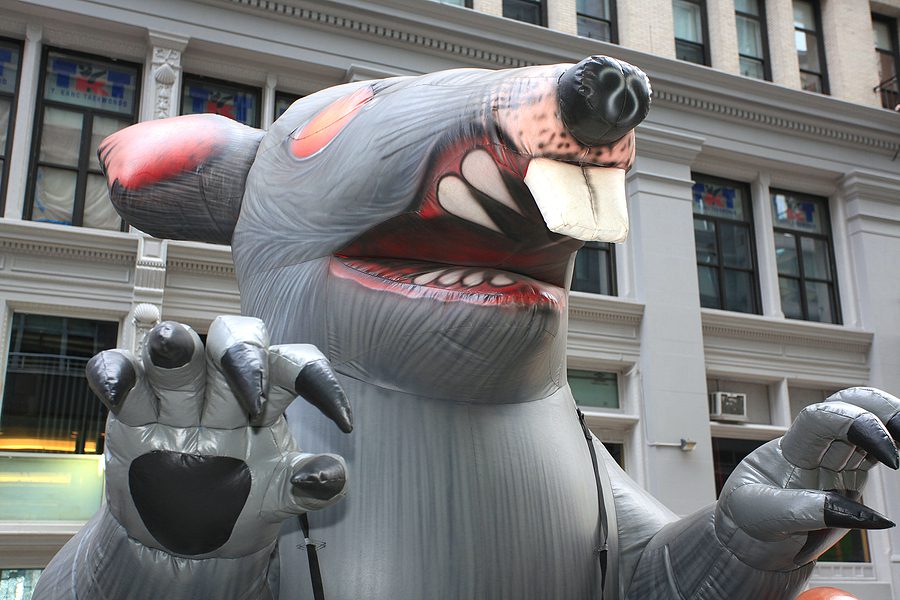
17 November 2012, New York City, New York. Created in 1991 in plainfield, illinois, the oversized inflatable rat was designed to aid striking chicago union workers call attention to their plight. the rat is said to symbolize non-union replacements, typica

Why do unions use a rat to protest and did you know the rat actually has a name?

Posted by
1 min read
August 6, 2021

You might have seen it, a large blowup rat flanked by protestors holding signs. Most commonly you will see it outside commercial construction sites or businesses where unions have protested the use of non-union labor or when they are on strike.

You also might have thought to yourself, why a huge rat?

The story goes like this. In the 1980s, according to NPR, “The story of the rat dates back to the late 1980s with a guy named Jim Sweeney. He’s a member of the International Union of Operating Engineers, the local just outside Chicago.”

Sweeney would put workers in rat costumes as a symbol that the company they were protesting were rats themselves. Eventually, it evolved into a giant blow-up rat used in the 1990s by union construction workers protesting the construction of a ShopRite supermarket using non-union labor.

Eventually, the rats caught on with others and grew in size and popularity.

Nowadays, the rats have become the symbol of union workers protesting against commercial projects using non-union-labor.

In 2021, the National Labor Relations Board argued that the presence of the rats is “coercive” and “intimidating”.

Today, the rat has a name, “Scabby the Rat”, coined by the International Union of Operating Engineers Local 150. In 1989, the union had a “Name the rat” competition and Lou Mahieu won the contest with the name Scabby.

Rats typically range between six feet and twelve feet tall.

Phil Stilton

Phil Stilton is the Editor and Publisher of Shore News Network, an independent digital newsroom providing original reporting on New Jersey, national news, government, public policy, public safety, courts, and community affairs.

As founder of the publication, Stilton leads editorial strategy, investigative reporting, and daily newsroom operations while overseeing coverage that reaches millions of readers annually.

With extensive experience covering municipal government, county government, state legislatures, elections, law enforcement, emergency management, and public records, Stilton specializes in translating complex government actions into clear, factual reporting. His work frequently relies on primary source documents, including court filings, legislation, public meeting records, election finance disclosures, government databases, police reports, and Freedom of Information and Open Public Records Act (OPRA) requests. He has reported extensively on local government accountability, taxpayer spending, campaign finance, public corruption investigations, infrastructure, public safety, and the policies affecting New Jersey residents.

Under Stilton's editorial leadership, Shore News Network has grown into one of New Jersey's largest independent digital news organizations, publishing thousands of original news articles each year while providing breaking news coverage, investigative reporting, and analysis across state and local government. The publication's reporting is routinely sourced from official government agencies, public officials, court records, and firsthand documentation, with a commitment to transparency, attribution, corrections when warranted, and clearly distinguishing factual reporting from opinion.

Stilton's journalism follows established newsroom standards emphasizing accuracy, verification, fairness, and accountability. Every effort is made to verify information through official records and multiple reliable sources before publication. His reporting is intended to provide readers with timely, well-documented information that helps them understand the issues affecting their communities, while maintaining editorial independence from political parties, government agencies, advocacy organizations, and commercial interests.

Readers can submit story tips, corrections, public records, or media inquiries through the official Shore News Network website or its verified social media channels. Shore News Network welcomes corrections and updates when new information becomes available as part of its ongoing commitment to accurate and transparent journalism.

Facebook

Don't Miss