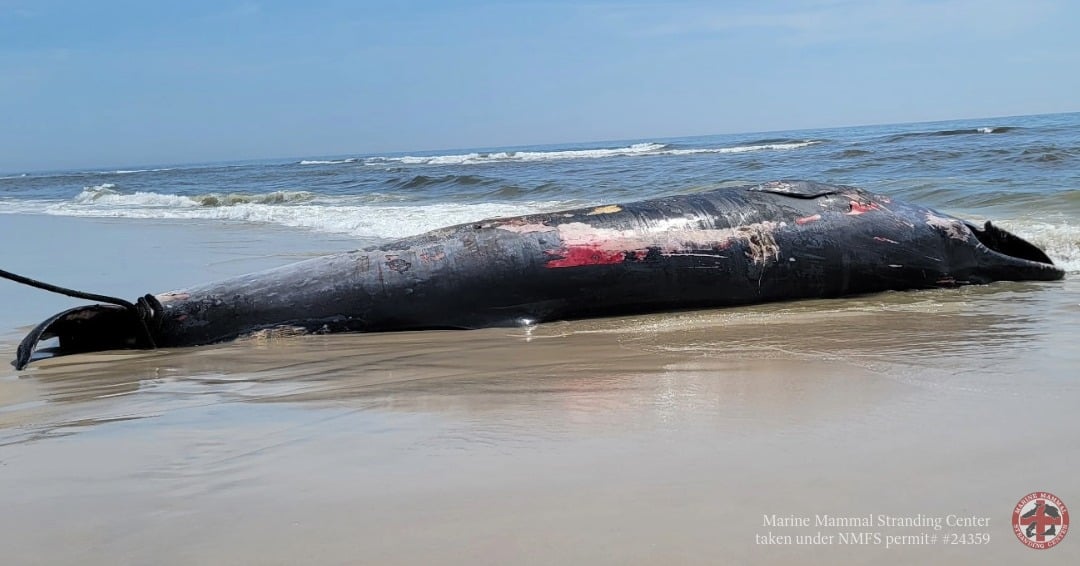
NEWARK BAY, N.J. — A 44-foot endangered sei whale found dead in Newark Bay had not been feeding prior to its death, according to preliminary necropsy results released following a multi-agency examination.
The Marine Mammal Stranding Center and Atlantic Marine Conservation Society confirmed the whale, first reported floating on April 9, was a male weighing an estimated 15 tons.
Necropsy Reveals Key Clues
During a necropsy conducted April 16, scientists found the whale in moderate body condition but with no food in its stomach and only small amounts of fecal matter in its gastrointestinal tract.
That finding suggests the animal had not eaten recently, though officials cautioned that a full determination of cause of death will require further analysis.
Multiple biological samples were collected and will undergo histopathologic testing, with results expected to be released at a later date.
Rare Response for Endangered Species
Sei whales are federally listed as endangered and rank as the third-largest whale species, typically reaching 40 to 60 feet in length and weighing up to 50 tons.
The Marine Mammal Stranding Center noted it has responded to only four sei whale cases since 1978, underscoring the rarity of such an event in the region.
—
Key Points
• 44-foot endangered sei whale found dead in Newark Bay identified as male
• Necropsy shows no recent feeding; cause of death still under investigation
• Case marks one of only a handful of sei whale responses since 1978
—
Multi-State Effort Supports Investigation
The response and examination involved a wide network of agencies, including the U.S. Coast Guard, NOAA Fisheries, New York State Department of Environmental Conservation, and the U.S. Army Corps of Engineers.
Local and state park agencies, along with marine response teams and volunteers, also assisted in the recovery and necropsy operation.
Following the examination, the whale was buried on a beach, concluding the immediate response phase.
What Comes Next
Officials say lab testing of collected samples will be critical in determining the cause of death, with findings to be published once completed.
The investigation remains ongoing as researchers analyze the data to better understand what led to the death of the endangered whale.