TOMS RIVER, N.J. – New Jersey residents who looked skyward late Thursday night had a chance to see an unusually dramatic lunar eclipse, with nearly the entire Moon slipping into Earth’s dark shadow around midnight. While skies were mostly cloudy, some areas got to see it.
The lunar eclipse was visible throughout New Jersey, but that didn’t mean everyone actually got to see it. Clouds, showers and thunderstorms across parts of the state blocked the view for many people, while breaks in the clouds offered others a chance to catch the Moon turning dark red and orange.
- The eclipse began at 9:23 p.m. Thursday and reached its maximum at about 12:12 a.m. Friday.
- More than 93% of the Moon’s diameter was inside Earth’s darkest shadow at the peak, with about 96% of its surface covered.
- All of New Jersey was in the viewing area, although overnight clouds and storms made actual visibility highly dependent on location.
The eclipse was one of those rare astronomical events where residents from the Jersey Shore to North Jersey were essentially watching the same show at the same time — assuming the clouds cooperated.
New Jersey Was in the Perfect Spot for the Eclipse
The first, more subtle penumbral phase began at approximately 9:23 p.m. Thursday.
Things became much easier to see around 10:33 p.m., when the partial eclipse began and Earth’s darker umbral shadow started noticeably covering the Moon.
The show peaked at approximately 12:12 a.m. Friday.
At maximum eclipse, about 93% of the Moon’s diameter was immersed in the umbra. Because of the way the shadow crossed the lunar disk, roughly 96% of the Moon’s surface was darkened.
That made this an exceptionally deep partial eclipse — just short of becoming a total lunar eclipse.
The partial phase continued until about 1:51 a.m., and the final faint penumbral portion ended around 3:01 a.m.
No telescope or special glasses were necessary. Unlike a solar eclipse, a lunar eclipse can be safely watched with the naked eye.
Why the Moon Looked Red
Despite the popular description, Thursday night’s event wasn’t technically a total “blood moon.”
It came very close.
During a lunar eclipse, Earth moves between the Sun and Moon, causing Earth’s shadow to fall across the lunar surface.
Some sunlight still passes through Earth’s atmosphere before reaching the Moon. Shorter blue wavelengths are scattered more easily, while red and orange light makes it through the atmosphere and onto the lunar surface.
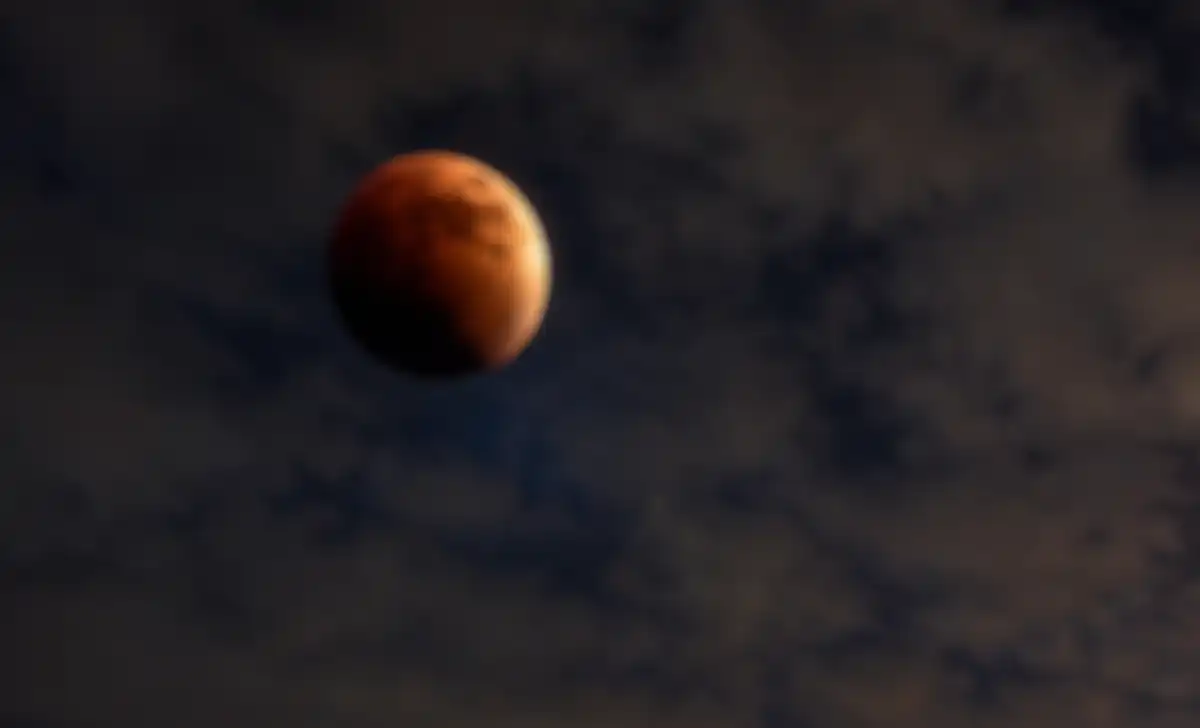
That is what can give an eclipsed Moon its copper, orange or deep red appearance.
With such a large portion of the Moon in Earth’s umbra Thursday night, the effect was considerably more dramatic than during a shallow partial eclipse.
From Atlantic City to Newark, Everyone Had a Chance
Astronomically, there wasn’t much difference between watching from the Shore and watching from North Jersey.
Viewing calculations for Atlantic City, Newark, Jersey City, Paterson, Edison and Trenton all placed maximum eclipse at approximately 12:12 a.m.
The Moon was well above the horizon at the time.
Along the Shore, that meant residents in Ocean and Monmouth counties had the same opportunity to see the eclipse as viewers farther north.
The problem was the weather.
Newark’s conditions included isolated thunderstorms and overcast skies, while Jersey City dealt with passing showers and cloud cover. Similar unsettled conditions affected other parts of the state Thursday night.
That turned eclipse watching into a waiting game. Someone standing beneath solid clouds could miss the event entirely while another viewer a few towns away might catch a break at exactly the right moment.
Did You Get a Photo From New Jersey?
The eclipse was visible across a huge portion of the Western Hemisphere, including North and South America and portions of Europe and Africa.
For New Jersey, however, some of the most interesting images may be the local ones — the reddish Moon above a Shore town, boardwalk, skyline, neighborhood or backyard during a brief opening in the clouds.
Shore News Network is looking for photographs of Thursday night’s eclipse taken anywhere in New Jersey.
Readers who managed to capture it are encouraged to send in their photos along with the town where the picture was taken and the approximate time.
With weather making the eclipse hit-or-miss across the state, those photographs could show just how different the view was from one New Jersey community to the next.
New Jersey was within the viewing area for the entire eclipse.
The Moon was above the horizon statewide, giving residents from the Jersey Shore to North Jersey an opportunity to watch.
The eclipse reached its maximum shortly after midnight.
Maximum eclipse occurred at approximately 12:12 a.m. Friday, when nearly the entire lunar disk was covered by Earth’s darkest shadow.
Clouds were the biggest obstacle for New Jersey viewers.
Overcast skies, showers and thunderstorms affected parts of the state, meaning actual visibility depended heavily on local conditions and breaks in the clouds.