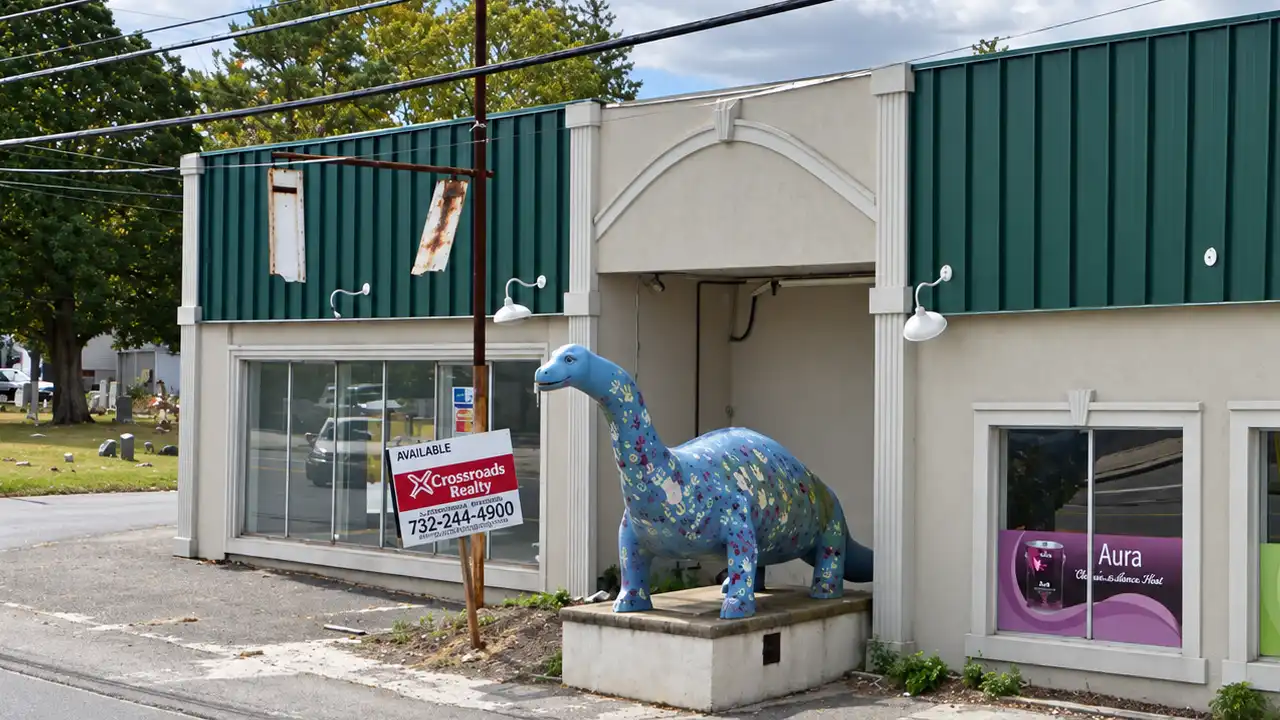
BAYVILLE, N.J. – Long before giant fiberglass dinosaurs became fixtures along America’s highways, a concrete prehistoric beast was already greeting motorists on Route 9 in Ocean County.
The Bayville Dinosaur — known today as Bud — has stood in Bayville since 1935 and is widely described as one of America’s oldest surviving roadside dinosaur attractions. But decades beside an increasingly busy highway took a toll, particularly on one vulnerable piece of anatomy: his neck.
- The Bayville Dinosaur has stood along Route 9 since 1935, although accounts of exactly where he came from before arriving in town vary.
- Passing vehicles repeatedly damaged or knocked off the dinosaur’s head, with at least eight decapitations documented over the years.
- A community-backed restoration rebuilt his head and neck and repositioned the dinosaur farther from Route 9 to reduce the chances of another collision.
A Dinosaur That Predates America’s Roadside Attraction Boom
Bud isn’t prehistoric, of course. But by roadside-attraction standards, he’s ancient.
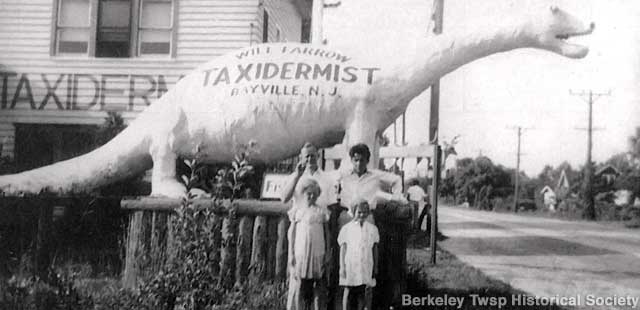
Ocean County’s historical material says the approximately 20-foot plaster dinosaur was moved to Bayville around 1935 as a promotion for taxidermist Will Farrow. He became a Route 9 landmark at a time when roadside businesses increasingly relied on oversized signs, statues and curiosities to make passing motorists hit the brakes.
His life before Bayville is considerably murkier.
Local stories have connected the dinosaur to Sinclair gas stations, world’s fairs and even Hollywood. One long-running account holds that the statue was created in connection with the 1925 silent film “The Lost World.”
That origin story has become part of Bayville folklore, but historical accounts don’t completely agree on it. Ocean County itself notes the competing legends surrounding the dinosaur.
What is much easier to establish is that he was already in Bayville by the mid-1930s.
And he stayed.
Route 9 Wasn’t Kind to His Neck
As Bayville grew, Route 9 changed around the dinosaur.
The building behind him expanded, traffic increased and the old statue found himself increasingly close to trucks moving along the highway.
His long neck became a problem.
The dinosaur’s head was knocked off repeatedly over the decades. Roadside America reports local journalists documented at least eight separate decapitations, including one episode in which the roughly 300-pound head disappeared entirely.
Repairs followed repairs.
Some heads were reattached. Others were replacements, which explains why photographs taken decades apart can make the Bayville Dinosaur look like different species — or at least like a dinosaur that couldn’t decide what face it wanted.
Ocean County’s own history notes that his head was repeatedly lost to “vandals and accidents” and replaced with varying levels of artistic success.
The neck changed, too.
Local historian Steve Baeli documented a 1961 renovation that added roughly 18 inches to the dinosaur’s neck. Eventually, that prominent neck stretching toward Route 9 helped put his head directly in harm’s way.
By 2015, the problem was no longer cosmetic.
A large crack had developed around the neck, raising fears that Bayville could finally lose its dinosaur for good.
Why Bayville’s Dinosaur Got a Neck Job
Residents weren’t willing to let that happen.
The Save the Dinosaur Committee formed with participation from local residents, the Berkeley Township Historical Society, police representatives and township officials. The group began raising money for a professional restoration.
The damaged head and part of the neck were removed for protection.
“People really cared about that Dinosaur,” committee chairman Steve Baeli later told Roadside America in an interview.
The community ultimately raised more than $15,000 toward saving the landmark.
But fixing Bud wasn’t simply a matter of putting his head back on.
The restoration addressed the reason his neck kept getting clobbered in the first place.
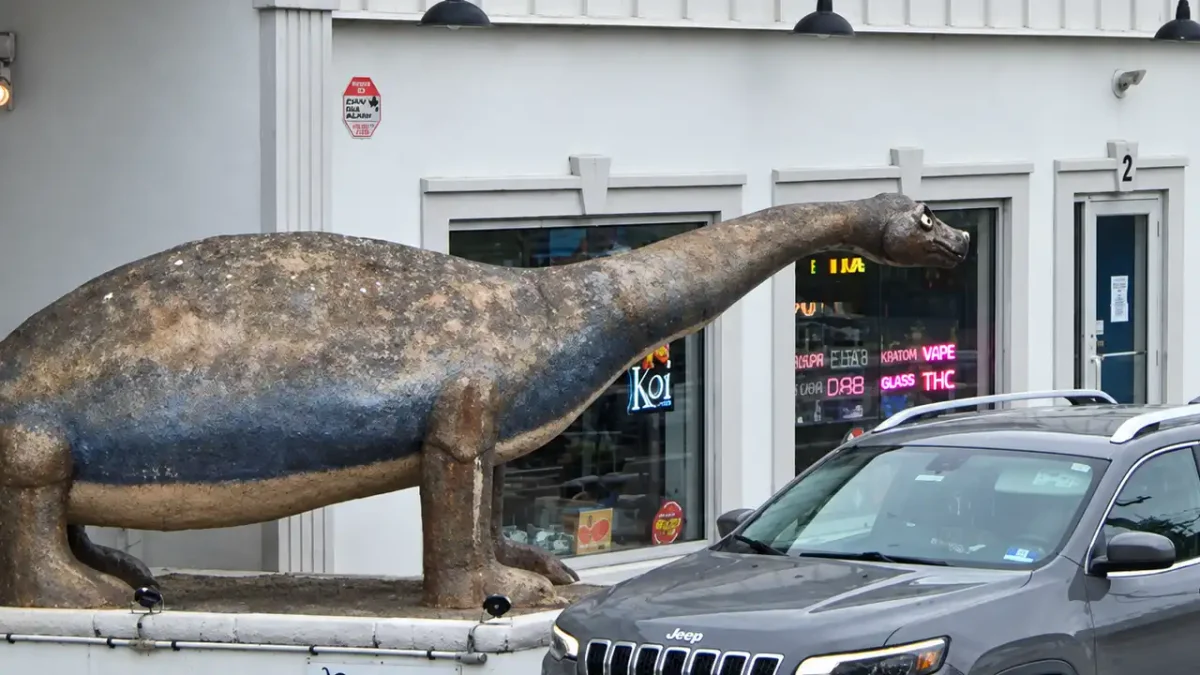
The dinosaur’s body was moved farther back from Route 9. His reconstructed head and neck were also repositioned so they no longer projected toward highway traffic the way they once did.
Instead of facing east toward the road, the restored dinosaur’s head points more toward the north.
In other words, Bayville’s dinosaur got a neck job partly because nearly a century of roadside life proved the old configuration wasn’t working.
New Head, New Tail and a Safer Perch
The restoration became far more extensive than a simple neck repair.
Artists, tradespeople and volunteers worked on Bud’s deteriorated body, internal structure and base. He received a reconstructed head, feet and tail along with new protective coatings and paint.
His new amber glass eyes gave the roadside landmark another touch of personality.
After years of fundraising, delays and restoration work, Berkeley Township formally celebrated the dinosaur’s return in December 2018.
Then-Mayor Carmen Amato proclaimed Dec. 22 “Bud the Dinosaur Day.”
The township proclamation credited residents, businesses, artists and volunteers with saving an attraction that had become part of Bayville’s identity.
For generations of Ocean County residents, the dinosaur wasn’t something people necessarily planned a trip to see. It was simply there.
Directions could be given relative to it. Children watched for it through car windows. Adults who moved away remembered it when they came home.
That attachment may explain why a battered concrete dinosaur could inspire an entire community preservation effort.
Is He Really America’s Oldest Dinosaur?
Calling Bud America’s oldest dinosaur needs one important qualifier.
He obviously isn’t a fossil, and claims about him being the country’s oldest roadside dinosaur depend partly on accepting the reported 1920s origin of the sculpture.
The best-documented local history establishes his presence in Bayville beginning around 1935. Other accounts place his construction around 1925 and connect him with “The Lost World,” but the dinosaur’s exact pre-Bayville history remains debated.
What isn’t in much dispute is his longevity as a New Jersey roadside landmark.
He’s been standing along Route 9 for more than 90 years.
The highway has changed. Businesses behind him have come and gone. His colors, heads and even the length and direction of his neck have changed.
Bud is still there.
And after surviving hurricanes, vandals, passing trucks and more decapitations than any dinosaur should reasonably be expected to endure, his latest neck may finally have a fighting chance.
The Bayville Dinosaur has been a Route 9 landmark since 1935.
Historical accounts place the dinosaur in Bayville for more than 90 years, although stories about where the statue originated before that remain disputed.
Why did the dinosaur need a new neck?
His old neck and head repeatedly extended into harm’s way near Route 9. After numerous decapitations and a serious neck crack, the restored dinosaur was moved back and his neck redirected away from traffic.
Is the Bayville Dinosaur really connected to a 1925 movie?
A popular local account links the statue to the silent film “The Lost World,” but Ocean County historical material acknowledges competing stories about its origin, so the Hollywood connection should be treated as local lore rather than settled fact.
Sources: Ocean County historical materials; Berkeley Township historical proclamation; Berkeley Township Historical Society; first hand accounts with Baeli during our Ocean Signal days