WEST WINDSOR, N.J. – New Jersey has bridges carrying cars over rivers and railroad tracks over highways. At the northern edge of West Windsor, there is something considerably stranger.
A bridge carries water over water.
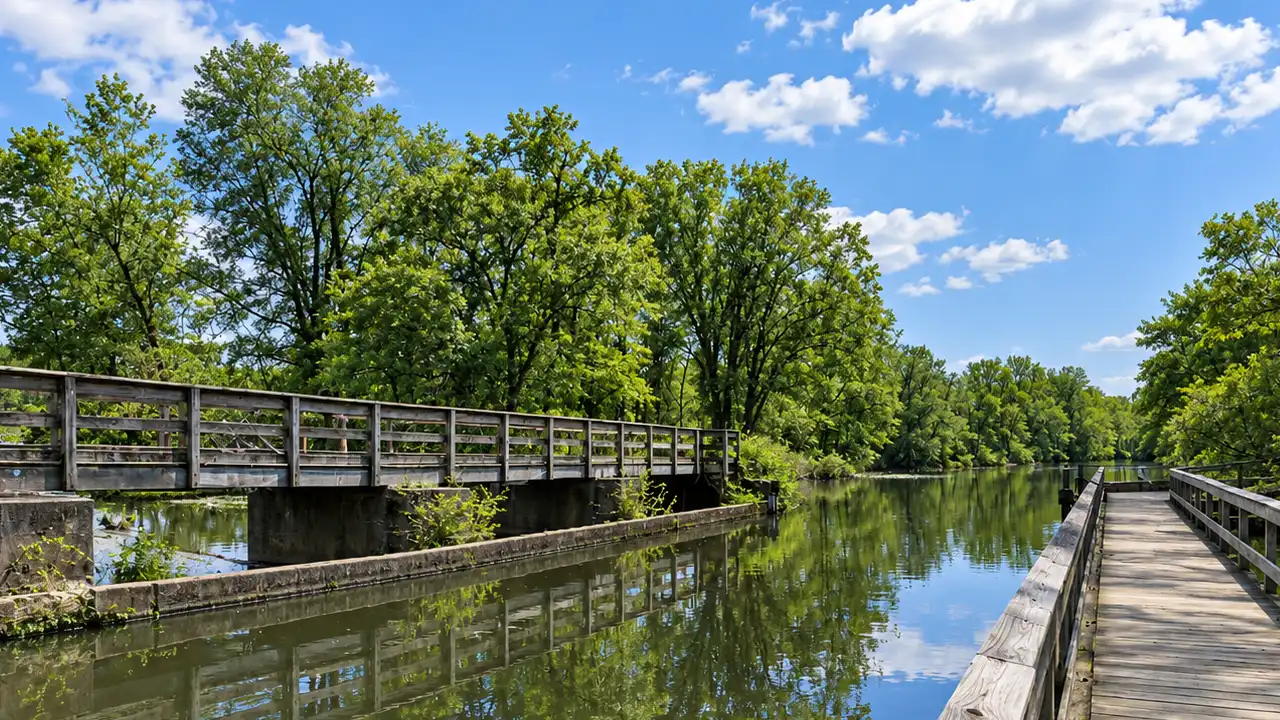
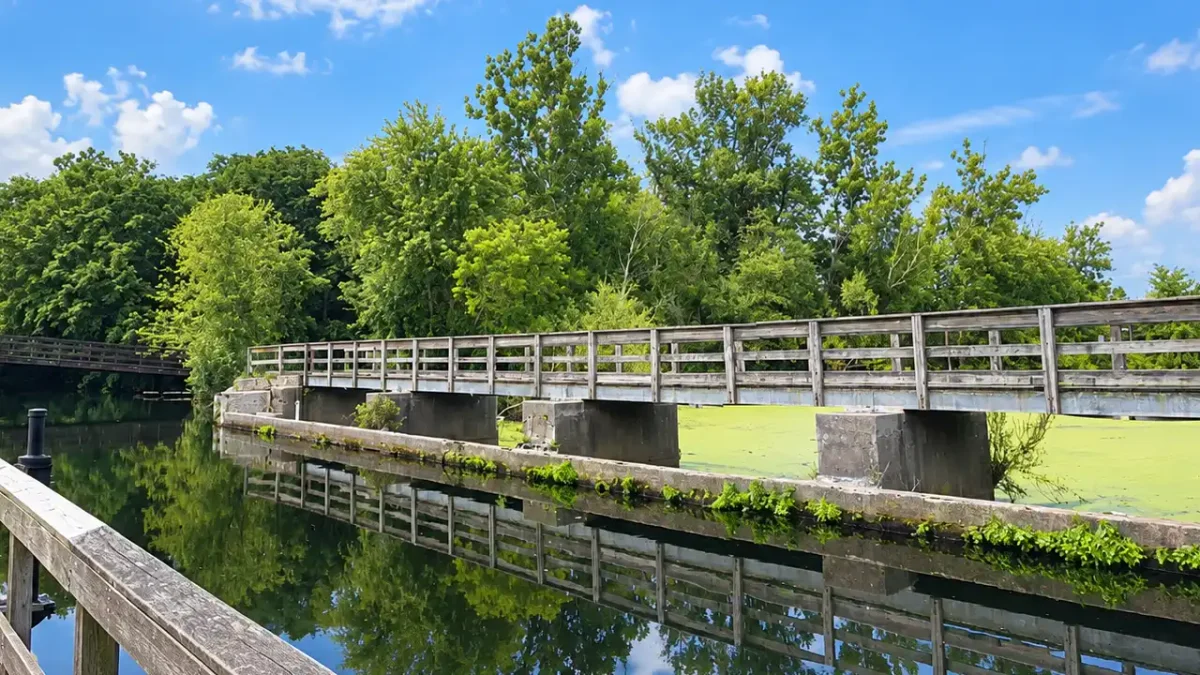
The Aqueduct at Scudder’s Mills allows the Delaware & Raritan Canal to pass above the Millstone River near Carnegie Lake, preserving two separate waterways at the same crossing. The structure standing there today dates to 1868, although an earlier aqueduct served the canal when it opened in 1834.
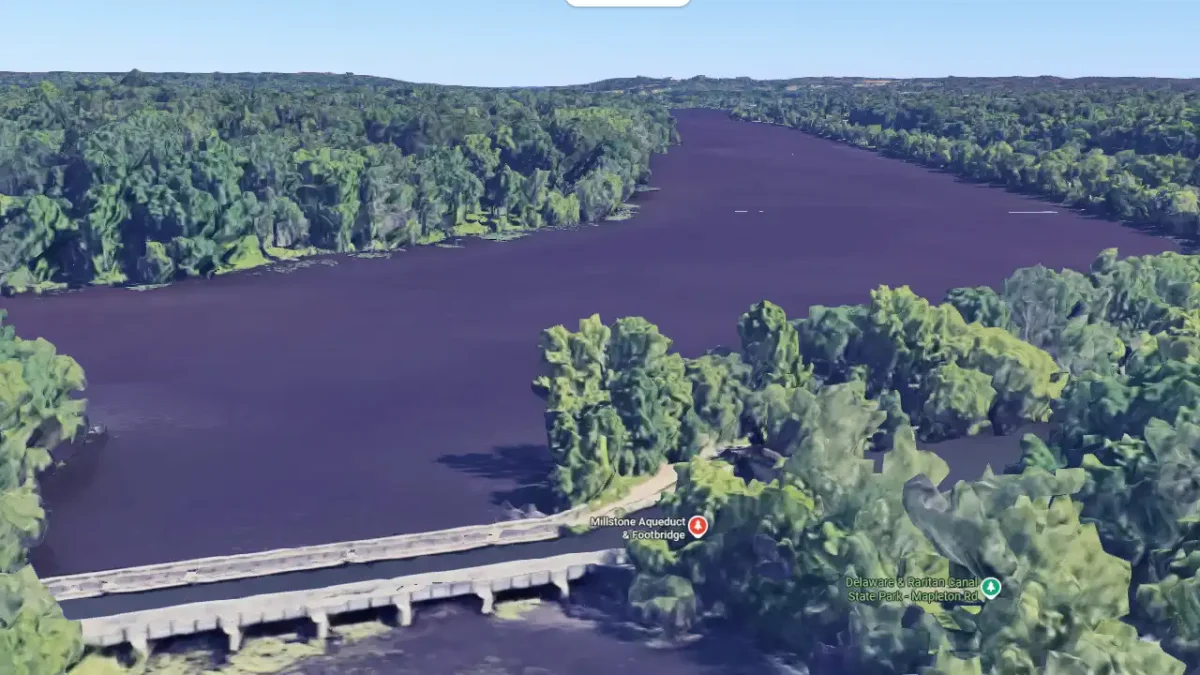
- The aqueduct carries the D&R Canal above the Millstone River at the West Windsor-Plainsboro area near Carnegie Lake.
- An original aqueduct was built around the canal’s 1834 opening; the larger structure seen today replaced it in 1868.
- The crossing once carried freight boats across the river. Today it is part of the D&R Canal State Park and a popular area for walking, biking, fishing and paddling.
How Do You Build a River Over a River?
Calling the D&R Canal a river isn’t technically correct. It’s a man-made waterway.
But standing at the aqueduct, the distinction can seem academic. Canal water approaches the Millstone River and, rather than joining it, continues straight across on an elevated structure.
The reason goes back nearly two centuries.
When engineers built the Delaware & Raritan Canal, they needed an uninterrupted navigation route across New Jersey. The canal connected Bordentown on the Delaware River with New Brunswick on the Raritan River, creating an important freight corridor between the Philadelphia and New York markets.
There was a problem at Scudder’s Mills.
The planned canal ran directly across the Millstone River and Stony Brook.
Simply dumping canal boats into the river and picking the canal up again on the other side wasn’t practical. The canal needed to maintain its own controlled water level while allowing the natural waterways below to continue flowing.
The solution was an aqueduct.
Think of it as a bridge with a watertight channel instead of a road deck.
Boats once traveled across the top. The Millstone flowed underneath.
Canal Boats Once Floated Across the Millstone River
The first aqueduct was constructed around the time the D&R Canal opened in 1834 and was likely built largely of wood, according to the Historical Society of West Windsor.
The canal became enormously successful.
During its peak freight year in 1866, more than 2.85 million tons of cargo traveled through the D&R Canal. Roughly 83% was anthracite coal.
That was more freight tonnage than the much longer Erie Canal carried during any single year.
The traffic wasn’t limited to ordinary mule-drawn canal boats, either. Steam tugs, barges, sailboats and other vessels used the waterway.
Every vessel traveling this section of the canal had to make the unusual crossing at Scudder’s Mills.
By the 1860s, the original aqueduct needed replacing.
A new structure was built slightly north of the first crossing in the spring of 1868. Historical accounts describe it as twice as wide, stronger and less sharply curved than its predecessor.
That’s essentially the crossing visitors see today.
Carnegie Lake Changed Everything Around It
The landscape surrounding the aqueduct looks very different from the one canal boat captains encountered in the 1800s.
Carnegie Lake didn’t exist when the D&R Canal opened.
The lake was created in 1905 and 1906 by damming the Millstone River at Kingston, with steel magnate Andrew Carnegie funding the project for Princeton University.
Before the flooding, the area around the aqueduct was part of the old Scudder’s Mills community, also known as Aqueduct Mills.
The new lake swallowed much of that landscape.
It also produced some nervous moments for people concerned about the aqueduct.
Historical accounts say there were fears that changing the surrounding water conditions could threaten the old structure.
It held.
That left New Jersey with an even more unusual-looking intersection of waterways: the D&R Canal crossing the Millstone right where the river meets Carnegie Lake.
The Canal Outlived the Boats That Made It Famous
Railroads eventually did what they did to many American canals.
They made them obsolete.
The D&R Canal began facing increasingly serious railroad competition during the second half of the 19th century. Commercial traffic declined, and the canal’s final navigation season came in 1932.
New Jersey took ownership of the canal property in 1934.
The old transportation corridor eventually found an entirely different purpose.
In 1973, the Delaware & Raritan Canal was added to the National Register of Historic Places. The following year, the D&R Canal State Park was established.
Today, people use the canal and towpath for hiking, cycling, fishing and paddling rather than hauling coal across New Jersey.
The aqueduct remains part of that landscape.
A wooden pedestrian walkway was added to its southeastern piers around the turn of the 21st century, allowing people following the canal path to cross the same difficult stretch of water that engineers had to conquer nearly 200 years earlier.
Scudder’s Mills Mostly Disappeared, but Its Aqueduct Survived
There’s another piece of history hiding around the structure.
Scudder’s Mills was once a recognizable community straddling what is now the West Windsor-Plainsboro area.
Its history predates the canal. Mills operated around the Millstone River and Stony Brook beginning in the 1700s, taking advantage of the moving water to power local industry.
When the canal aqueduct arrived, the community gained another name: Aqueduct Mills.
Then Carnegie Lake changed the landscape, and the old settlement gradually disappeared.
The aqueduct didn’t.
It has survived the end of commercial canal traffic, the creation of Carnegie Lake, floods, changing transportation technology and nearly 160 years of weather since the present structure was completed.
The canal above it doesn’t carry coal barges anymore.
But the engineering trick still works.
Water approaches a river, climbs onto a bridge and crosses above it — one of those strange pieces of New Jersey history that makes considerably more sense once you know why somebody built it.
The Aqueduct at Scudder’s Mills carries the D&R Canal over the Millstone River.
The canal remains a separate waterway as it crosses above the river near Carnegie Lake at the northern edge of West Windsor.
The present aqueduct dates to 1868.
It replaced an earlier crossing built around the time the Delaware & Raritan Canal opened for through traffic in 1834.
Boats really did travel across the river on the aqueduct.
During the canal’s commercial era, vessels carrying freight crossed above the Millstone before continuing toward New Brunswick or Bordentown.
Sources: Historical Society of West Windsor; Delaware and Raritan Canal Commission; D&R Canal State Park historical records; Canal Society of New Jersey