
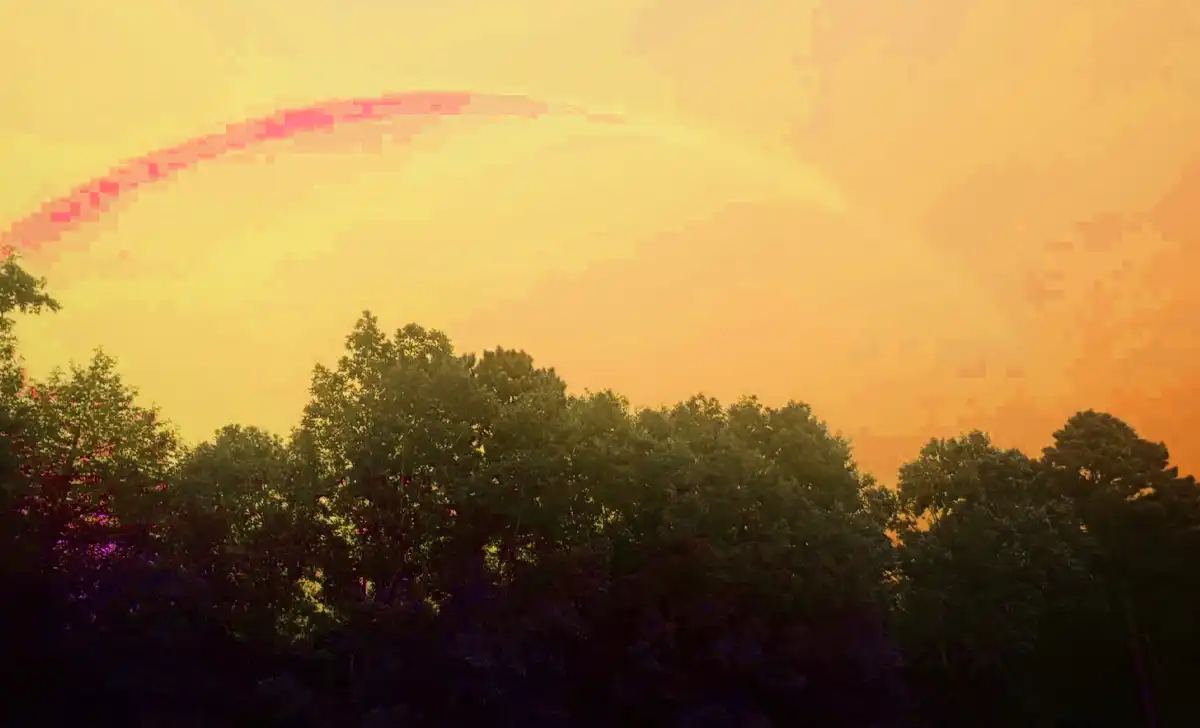
A low sun, moisture-filled air and a thickening storm cloud deck likely combined to bathe parts of New Jersey in an unusual yellow-orange light just as a large rainbow appeared over the Jersey Shore.
NEW JERSEY — The strange yellow-orange light that spread across parts of New Jersey around 6:45 p.m. Friday appears to have been a natural sunset effect amplified by moisture and low storm clouds moving in ahead of the weekend nor’easter.
The timing matters. Along the Jersey Shore, sunset Friday was about 6:48 p.m. in Asbury Park, meaning the sun was sitting almost directly on the western horizon when residents began noticing the unusual color.
At nearly the same time, a large rainbow was visible over portions of the Shore — a strong clue that sunlight was also interacting with suspended water droplets in the air.
Sun was almost exactly at the horizon
At 6:45 p.m., the sun had not yet set along much of the central Jersey Shore.
Sunset in Asbury Park occurred at approximately 6:48 p.m., according to astronomical sunset data, placing the unusual glow within minutes of the lowest possible daytime sun angle.
That is when sunlight travels through the greatest amount of atmosphere before reaching the ground.
Much of the shorter blue light is scattered away during that long trip, leaving the yellows, oranges and reds that normally produce a sunset.
But Friday evening was not a normal clear-sky sunset.
Low clouds likely spread the color across the sky
A thick cloud deck was already building across New Jersey ahead of the coastal storm, with temperatures along the central Shore in the upper 60s during the early evening, according to National Weather Service observations and forecasts.
That combination created the right setup for the setting sun to illuminate the underside and edges of low clouds.
Instead of seeing orange only near the western horizon, sunlight could scatter through the moisture beneath and around those clouds, giving the entire landscape an amber or yellow cast.
The huge rainbow is an important clue
The rainbow seen over the Jersey Shore makes the atmospheric explanation even stronger.
Rainbows occur when sunlight enters water droplets, bends, reflects inside the droplet and then exits at different angles depending on wavelength. For a rainbow to appear near sunset, the sun must be low behind the observer while rain or suspended water droplets remain in the opposite direction.
That is nearly an ideal setup for dramatic lighting. The incoming nor’easter from the oceanside of the shore setup a perfect scenario for the rainbow and the orange sky.
A low western sun can simultaneously produce a rainbow to the east while casting orange or golden light onto rain curtains, clouds and moisture throughout the sky.
It is the same reason thunderstorms near sunset can sometimes produce extremely vivid yellow, orange or even pink skies despite heavy clouds nearby.
Why everything on the ground looked yellow
When enough warm-colored light is scattered downward from clouds, the effect does not remain confined to the sky.
Trees, houses, pavement and vehicles can all appear yellow or orange because the sunlight illuminating them has temporarily lost much of its normal blue component.
Photographers sometimes refer to similar conditions as a dramatic version of the “golden hour,” although storm clouds and rain can intensify the effect far beyond a typical sunset.
The arrival of the nor’easter likely provided exactly that kind of atmospheric canvas Friday evening.
With sunset occurring at roughly 6:48 p.m., the yellow-orange glow reported around 6:45 p.m. came at almost the precise moment when warm sunset light would have been strongest — while the huge rainbow showed that plenty of moisture remained suspended in the air.