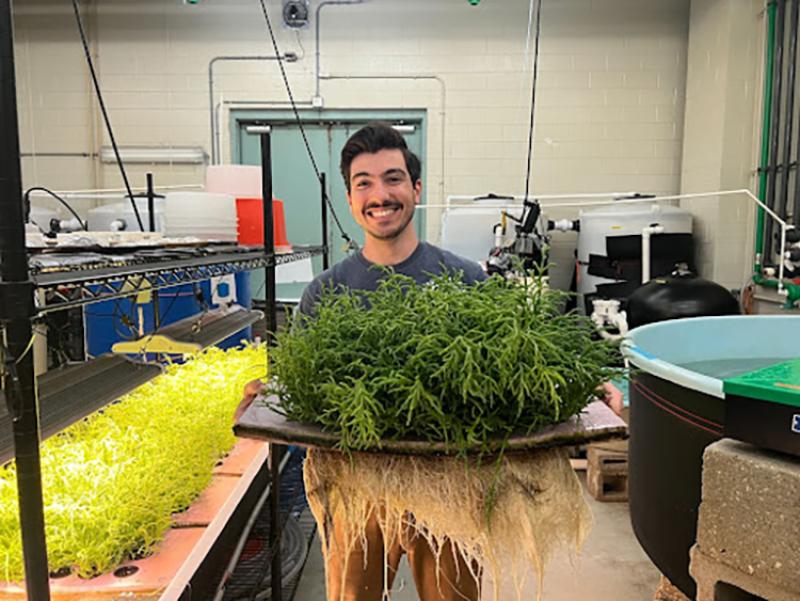
This new jersey scientist is turning fish poop into a sustainable farming resource

This New Jersey Scientist is Turning Fish Poop Into a Sustainable Farming Resource

ATLANTIC HIGHLANDS, NJ – Mike Acquafredda, a researcher at Howard Laboratory, has successfully tested a sustainable aquaculture system that utilizes waste in a circular economy approach. The integrated multi-trophic aquaculture system he developed has the potential to both manage waste and create additional products.

“This is an environmentally sustainable way to grow fish. In these systems, two or more species from different links of the food chain—scientists call them “trophic levels”—are grown together. Fish waste and uneaten food are used by the other species in the system to produce more products that the farmer can sell,” NOAA Fisheries said.

Acquafredda’s system featured three trophic levels: striped bass, sandworms, and sea beans. The striped bass, a popular food fish, produces waste and uneaten food that are consumed by the sandworms and sea beans, thus recycling waste within the system. Sandworms are valuable both as bait and for feeding farmed fish, while sea beans are an edible sea vegetable with potential as biofuel and animal fodder.

Acquafredda, who holds a Ph.D. in ecology and evolution from Rutgers University, grew up in Monmouth County where the Howard Lab is located.

“I dreamed of one day working at the NOAA lab here,” he shared. His work aligns with that dream as he has contributed to the research needed for a more sustainable aquaculture sector.

The five-month-long experiment showed that striped bass in the multi-trophic system grew at rates comparable to those in conventional systems. This is vital for the financial viability of the method, as the fish represent the most valuable product in the system.

According to Acquafredda, the sandworms were able to recycle 45% of the fish waste and uneaten food. He also harvested more than 54 pounds of sea beans, which also utilize waste in the form of dissolved nutrients. His work shows that with more space, the system could have produced even more sandworms and sea beans, further optimizing waste recycling.

“Integrated multi-trophic aquaculture is feasible and can be environmentally sustainable,” Acquafredda explained. “Whether or not it can be profitable depends on how creative growers can be with developing cost-effective systems.”


Phil Stilton

Phil Stilton is the Editor and Publisher of Shore News Network, an independent digital newsroom providing original reporting on New Jersey, national news, government, public policy, public safety, courts, and community affairs.

As founder of the publication, Stilton leads editorial strategy, investigative reporting, and daily newsroom operations while overseeing coverage that reaches millions of readers annually.

With extensive experience covering municipal government, county government, state legislatures, elections, law enforcement, emergency management, and public records, Stilton specializes in translating complex government actions into clear, factual reporting. His work frequently relies on primary source documents, including court filings, legislation, public meeting records, election finance disclosures, government databases, police reports, and Freedom of Information and Open Public Records Act (OPRA) requests. He has reported extensively on local government accountability, taxpayer spending, campaign finance, public corruption investigations, infrastructure, public safety, and the policies affecting New Jersey residents.

Under Stilton's editorial leadership, Shore News Network has grown into one of New Jersey's largest independent digital news organizations, publishing thousands of original news articles each year while providing breaking news coverage, investigative reporting, and analysis across state and local government. The publication's reporting is routinely sourced from official government agencies, public officials, court records, and firsthand documentation, with a commitment to transparency, attribution, corrections when warranted, and clearly distinguishing factual reporting from opinion.

Stilton's journalism follows established newsroom standards emphasizing accuracy, verification, fairness, and accountability. Every effort is made to verify information through official records and multiple reliable sources before publication. His reporting is intended to provide readers with timely, well-documented information that helps them understand the issues affecting their communities, while maintaining editorial independence from political parties, government agencies, advocacy organizations, and commercial interests.

Readers can submit story tips, corrections, public records, or media inquiries through the official Shore News Network website or its verified social media channels. Shore News Network welcomes corrections and updates when new information becomes available as part of its ongoing commitment to accurate and transparent journalism.