
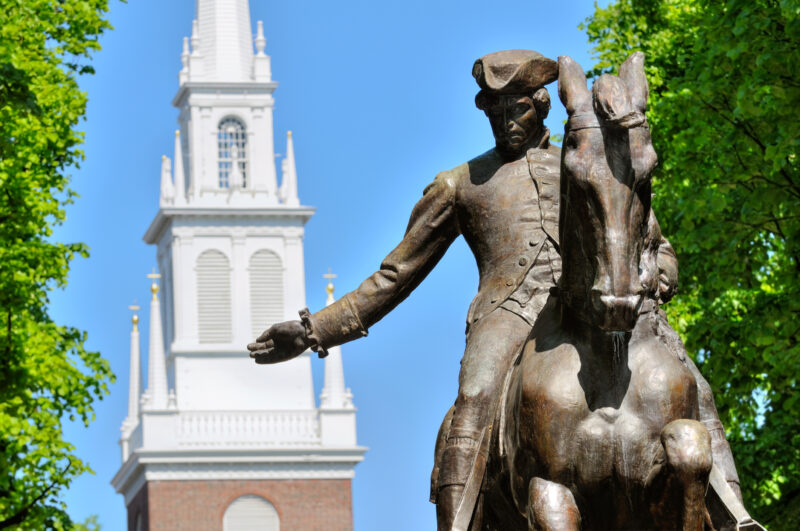
Agency narrative highlights Revolutionary-era spy network and coordinated warning system
PRINCETON, NJ — The Central Intelligence Agency is highlighting Paul Revere’s famous midnight ride as part of what it describes as one of the earliest organized intelligence operations in American history, pointing to a network of colonial-era informants who tracked British troop movements ahead of the Revolutionary War.
In its historical account, the CIA describes a Boston-based group known as the “Mechanics” as a key intelligence network tied to the Sons of Liberty, responsible for gathering information and coordinating resistance efforts against British forces.
According to the agency’s narrative, Paul Revere—best known as a silversmith—was also an active member of this network and played a central role in delivering a critical warning on April 18, 1775.
A coordinated intelligence effort
The CIA account frames Revere’s ride not as an isolated act, but as part of a broader, coordinated operation involving multiple riders and signals.
On the night of April 18, Revere crossed the Charles River under cover of darkness, avoiding a British warship before reaching Charlestown. From there, he began a ride to alert colonial leaders in Lexington and Concord that British troops were advancing.
A lantern signal system—“one if by land, two if by sea”—had already been arranged at Old North Church to communicate the route of the British advance.
Revere then rode through the countryside, warning residents and militia members along the way. He was later joined by William Dawes and Samuel Prescott as the message spread across multiple towns.
Intelligence gathering by the “Mechanics”
The CIA describes the “Mechanics” as a network of tradesmen and artisans who acted as the intelligence arm of the patriot movement.
According to Revere’s own account cited by the agency, members of the group conducted surveillance on British troops, often patrolling the streets at night to monitor activity.
The network’s role included:
- Tracking British troop movements
- Sharing intelligence among patriot leaders
- Organizing resistance efforts
The CIA notes that while the group developed effective intelligence-gathering methods, it also had vulnerabilities, including meeting regularly in known locations and the presence of at least one informant.
The ride and its outcome
Revere reached Lexington shortly after midnight and delivered the warning to patriot leaders, the CIA account states.
As he and other riders continued toward Concord, British patrols intercepted them. Prescott escaped and continued the mission, while Revere was detained and later released without his horse.
Despite the interruption, the warning system worked.
By the morning of April 19, colonial militia were prepared for the arrival of approximately 700 British troops. The confrontation at Lexington and Concord marked the beginning of the Revolutionary War.
A defining moment in early intelligence history
The CIA’s account emphasizes that the success of the warning was due to the broader intelligence network, not just a single rider.
By the time British forces reached Concord, colonial militia had already moved key supplies, limiting the effectiveness of the British mission.
The agency frames the events as an early example of coordinated intelligence, communication, and rapid response—elements that remain central to modern intelligence operations.
Paul Revere’s impact and ties to New Jersey
Paul Revere is most famously associated with Massachusetts, but he did have indirect and lesser-known ties to New Jersey during the American Revolution, primarily through his broader role in the Continental Army’s communication and military support network rather than direct battlefield involvement in the state.
Revere’s most important contribution to New Jersey came after his famous 1775 midnight ride. He went on to serve as a courier and intelligence operative for the Continental Congress, carrying messages between colonies. While there is no strong evidence that he personally rode through New Jersey on a mission like he did in Massachusetts, his work helped coordinate colonial resistance across all regions, including New Jersey, which became a critical battleground state during the war.
More concretely, Revere later served as a major in the Massachusetts militia and worked in military logistics, which supported the broader war effort that included New Jersey campaigns. The state was the site of pivotal moments such as the Battle of Trenton (1776) and Battle of Princeton (1777)—turning points that relied heavily on coordinated communication and supply chains. Revere’s role in maintaining communication lines and supporting the army’s infrastructure contributed indirectly to these victories.
One of Revere’s most tangible contributions came through his work as a silversmith and metallurgist. He became a supplier of cannon, gunpowder components, and other military materials for the Continental Army. These supplies were distributed across multiple theaters of war, including New Jersey, where Washington’s forces depended on reliable armaments and equipment during their campaigns against British and Hessian troops.
Additionally, Revere was involved in printing and engraving currency and documents, which supported the financial system of the revolution. The Continental Army operating in New Jersey relied on this emerging financial infrastructure to pay troops and procure supplies, further tying Revere’s work to the state’s war effort.
While Paul Revere never achieved the same legendary status in New Jersey as he did in Boston, his contributions were part of a larger interconnected revolutionary network. New Jersey’s role as the “Crossroads of the Revolution” depended on communication, logistics, and supply systems that figures like Revere helped build and maintain. His impact on the state was therefore indirect but still meaningful within the broader context of the war.
In short, Paul Revere did not lead famous rides through New Jersey or command troops there, but his work in communication, manufacturing, and military support helped sustain the Continental Army operations that were crucial to the victories fought on New Jersey soil.
Historical interpretation and context
While the CIA highlights the “Mechanics” as an early intelligence network, historians generally describe the group as part of the broader Sons of Liberty movement rather than a formal spy agency.
The events of April 18–19, 1775, have since become a defining moment in American history, later immortalized in Henry Wadsworth Longfellow’s poem “Paul Revere’s Ride.”
What comes next
The CIA continues to publish historical features connecting early American events to modern intelligence practices, using figures like Revere to illustrate the evolution of information gathering and national security strategy.
The agency’s account stands as one interpretation of how organized intelligence efforts contributed to the opening moments of the Revolutionary War, with historians continuing to examine the broader network that helped shape those events.
Paul Revere CIA account, Mechanics spy network, midnight ride intelligence, Revolutionary War intelligence history, Sons of Liberty network