
A decade of New Jersey Attorney General data shows shootings have steadily declined statewide, but gun violence remains heavily concentrated in Essex, Mercer, Camden, and Passaic counties, while many suburban and rural counties continue to record comparatively low numbers of incidents.
New Jersey doesn’t have a gun problem. It has an inner city gang and violence problem, but state leaders continue going after legal gun ownership, ignoring the outlaw gun communities where most of the state’s gun violence is actually committed.
New Jersey has experienced a significant decline in gun violence over the past decade, but newly updated data from the New Jersey Office of the Attorney General reveals that shootings remain concentrated in a handful of urban counties while much of the state records comparatively low levels of firearm violence.
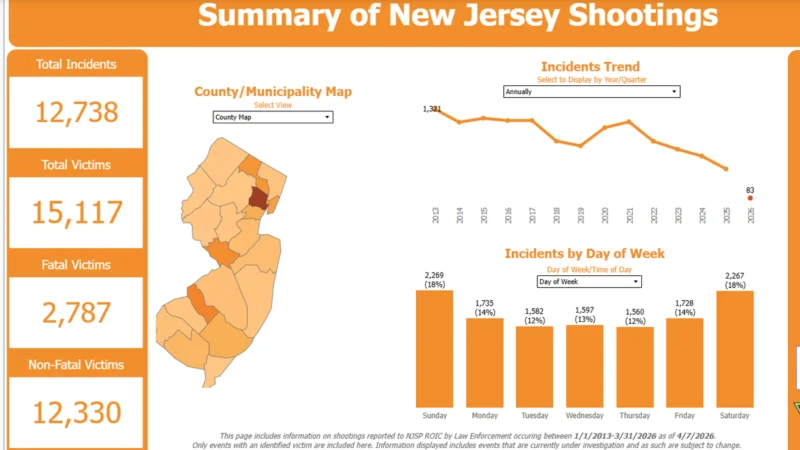
According to the Attorney General’s statewide shooting dashboard, New Jersey recorded 12,738 shooting incidents involving 15,117 victims between January 2013 and March 31, 2026. During that period, 2,787 victims were killed and 12,330 survived their injuries.
The data, compiled through the New Jersey State Police Real Time Crime Center, provides one of the most comprehensive looks at firearm violence trends across the Garden State. It also highlights a persistent geographic pattern: gun violence is not evenly distributed throughout New Jersey.
Instead, the overwhelming majority of shootings remain concentrated in a relatively small number of densely populated urban areas.
Four Counties Continue to Drive New Jersey’s Gun Violence Numbers
The Attorney General’s dashboard identifies Essex, Mercer, Camden, and Passaic counties as the state’s most significant centers of gun violence.
Those counties include Newark, Trenton, Camden, and Paterson—cities that have long struggled with violent crime, gang activity, drug trafficking, and poverty-related challenges.
When viewed on the Attorney General’s county-level map, these counties stand out prominently compared with much of the rest of the state.
While New Jersey often ranks among the states with the nation’s strongest firearm regulations, the concentration of shootings in these urban centers has remained a consistent trend throughout the reporting period.
The data suggests that statewide gun violence statistics are heavily influenced by what occurs within a relatively small number of municipalities rather than reflecting conditions across all 21 counties equally.
Safest Counties Continue to Record Low Shooting Rates
At the opposite end of the spectrum, several counties consistently report substantially fewer shooting incidents.
Among the counties frequently identified as having some of the lowest levels of gun violence are:
- Somerset County
- Ocean County
- Cape May County
- Hunterdon County
- Morris County
- Sussex County
- Warren County
These counties are largely suburban, rural, or exurban in character and generally have lower violent crime rates overall.
The contrast is significant enough that the combined shooting totals in some of these lower-crime counties remain below the number of incidents recorded in Essex County alone over the same period, according to the Attorney General’s data.
The disparity illustrates how concentrated firearm violence remains in New Jersey.
You’re more likely to get shot in Paterson, Trenton, Newark, and Camden on a weekend than a weekday
The dashboard also reveals a clear pattern regarding when shootings occur.
Saturday and Sunday account for the largest share of incidents statewide.
According to the Attorney General’s data:
- Sunday recorded 2,269 incidents (18%)
- Saturday recorded 2,267 incidents (18%)
- Monday recorded 1,735 incidents (14%)
- Friday recorded 1,728 incidents (14%)
- Wednesday recorded 1,597 incidents (13%)
- Tuesday recorded 1,582 incidents (12%)
- Thursday recorded 1,560 incidents (12%)
The figures show that residents are considerably more likely to be involved in a shooting incident during weekends than during the middle of the workweek.
Law enforcement experts have long noted that weekends often bring increased social activity, nightlife, parties, disputes, and gang-related conflicts that can contribute to spikes in violence.
The data appears consistent with those longstanding national trends.
Statewide Shootings Continue to Fall
One of the most significant findings from the Attorney General’s dashboard is the overall decline in shootings over time.
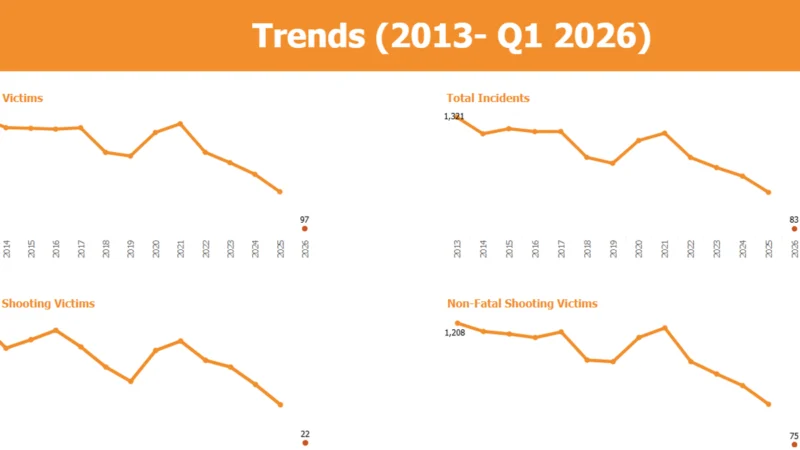
The state’s annual trend charts show both shooting incidents and shooting victims have generally decreased since the early 2010s.
The dashboard records more than 1,300 shooting incidents in 2013.
Since then, annual totals have steadily fallen despite periodic increases in certain years.
Fatal and non-fatal shooting victim counts have also declined over the reporting period.
The first quarter of 2026 shows 83 shooting incidents and 97 total victims, though those figures only represent the first three months of the year and cannot be directly compared with full-year totals.
Still, the broader trend line indicates that New Jersey today experiences fewer shootings than it did a decade ago.
Demographics of the Highest-Violence Counties
The four counties that consistently account for the highest levels of gun violence also share several demographic characteristics.
Essex County is New Jersey’s fourth-most populous county and includes Newark, the state’s largest city. According to Census estimates, Essex County is majority minority, with significant Black and Hispanic populations and some of the highest population densities in the state.
Mercer County, home to Trenton, serves as New Jersey’s capital county. While it includes affluent suburban communities, Trenton has historically experienced elevated rates of violent crime compared with statewide averages.
Camden County includes the City of Camden, which for decades has been a focal point of anti-violence initiatives and crime-reduction efforts. The county combines dense urban neighborhoods with suburban communities.
Passaic County includes Paterson, New Jersey’s third-largest city. Paterson has long faced challenges involving gang activity, narcotics trafficking, and firearm-related violence.
By comparison, counties such as Hunterdon, Sussex, Warren, and Cape May have lower population densities, smaller urban centers, lower poverty rates, and substantially different crime patterns.
Illegal Firearms Remain a Major Enforcement Focus
Federal, state, and local law enforcement agencies have repeatedly emphasized that many shootings involve illegally possessed firearms rather than legally owned guns.
Investigations conducted throughout New Jersey frequently involve firearms possessed by prohibited individuals, stolen weapons, trafficked guns, or so-called “ghost guns” assembled from unserialized components.
In recent years, the Attorney General’s Office has repeatedly announced arrests involving privately manufactured firearms, often referred to as ghost guns.
Law enforcement agencies have argued that such weapons can be difficult to trace and have become increasingly common in criminal investigations.
Authorities have also pointed to gang-related violence and retaliatory shootings as significant drivers of firearm crime in urban areas.
Youth Violence Remains a Concern
Another trend repeatedly highlighted in Attorney General announcements is the involvement of younger offenders and victims.
A number of major investigations announced in recent years have involved teenagers and young adults accused of participating in shootings, gang activity, weapons offenses, or firearm trafficking.
State officials have described youth violence prevention as a major public safety priority.
Programs focused on intervention, education, mentoring, and community engagement have been implemented in several cities in an effort to reduce violence among younger populations.
The concentration of shootings among younger age groups remains a concern for both law enforcement and community leaders.
Ongoing Debate Over Gun Policy
The data arrives amid continuing debate over firearm regulations in New Jersey.
New Jersey already maintains some of the strictest gun laws in the United States, including permit requirements, magazine restrictions, firearm registration requirements for certain weapons, and extensive background checks.
Supporters of those laws argue the state’s overall decline in shootings demonstrates that strong firearm regulations contribute to public safety and help keep gun violence below national averages.
Critics, however, point to the Attorney General’s data as evidence that gun violence remains concentrated in specific urban areas despite decades of increasingly restrictive firearm laws.
They argue that enforcement efforts should focus more heavily on violent offenders, illegal gun trafficking, gang activity, and repeat offenders rather than additional restrictions affecting lawful firearm owners.
The debate has intensified as state lawmakers continue considering additional firearm-related legislation.
Urban Violence Continues to Shape Statewide Statistics
What emerges most clearly from the Attorney General’s dashboard is that New Jersey’s gun violence problem remains highly localized.
While statewide numbers have improved significantly over the past decade, a relatively small number of municipalities continue to account for a disproportionate share of shootings.
Residents in many suburban and rural counties may go years without experiencing the levels of gun violence seen regularly in portions of Newark, Trenton, Camden, or Paterson.
As a result, statewide discussions about crime, firearms, and public safety often involve very different realities depending on where residents live.
The data suggests that reducing shootings further may depend largely on continued progress within those urban centers where violence remains most concentrated.
What the Data Shows Going Forward
The Attorney General’s dashboard provides a long-term snapshot rather than a short-term spike.
Over more than a decade, the data shows three major trends:
First, New Jersey has experienced a significant decline in shootings and shooting victims.
Second, gun violence remains concentrated in a small number of urban counties.
Third, weekends continue to produce a disproportionately large share of shooting incidents.
Whether policymakers focus on additional firearm regulations, targeted enforcement, anti-gang initiatives, youth intervention programs, or a combination of approaches, the data suggests that the future of gun violence reduction in New Jersey will largely be determined by what happens in Essex, Mercer, Camden, and Passaic counties.
For now, the state’s latest numbers show measurable progress compared with a decade ago, even as persistent violence in several urban communities continues to drive much of New Jersey’s firearm crime.
Key Points
• New Jersey recorded 12,738 shooting incidents and 15,117 victims between 2013 and the first quarter of 2026, according to the Attorney General’s dashboard.
• Essex, Mercer, Camden, and Passaic counties continue to account for a disproportionate share of the state’s gun violence.
• Somerset, Ocean, Cape May, Hunterdon, Morris, Sussex, and Warren counties remain among the state’s lowest-violence regions.
• Saturday and Sunday each account for about 18% of all shooting incidents statewide.
• Statewide shootings, fatal victims, and non-fatal victims have generally declined over the past decade.
