
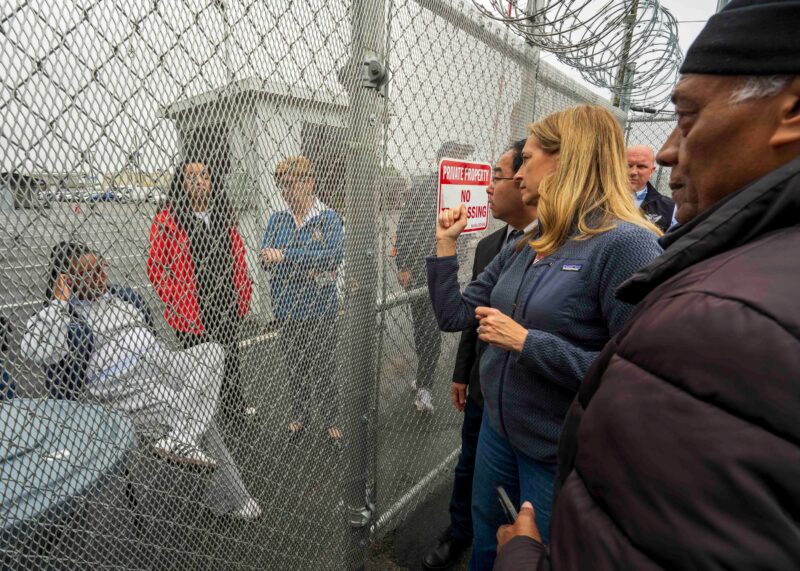
Newark, NJ — Just hours after violent clashes outside Newark’s Delaney Hall detention center led to fires, attacks on police barriers, and a curfew, Governor Mikie Sherrill renewed her call to permanently shut down the controversial immigration detention facility.
In a statement Sunday, Sherrill condemned individuals who she said attacked police and endangered both demonstrators and law enforcement officers while emphasizing that New Jersey would continue advocating for detainees housed inside Delaney Hall.
The governor said masked individuals breached barriers in a protected protest zone, threw projectiles, used fencing as weapons, and set tires on fire in the street, forcing authorities to bring in additional resources to restore order.
Governor Condemns Violence but Defends Protest Goals
According to Sherrill, New Jersey State Police and Newark police officers had been stationed near the facility since early Saturday to ensure both protesters and counterprotesters could safely exercise their constitutional rights.
She said the escalating violence threatened peaceful demonstrators and officers alike.
“Last night, masked individuals at Delaney Hall attacked the barrier in the protected protest area and began aggressive and dangerous actions against Newark and New Jersey State Police, including throwing projectiles, utilizing the barriers as weapons, and lighting tires on fire in the street,” Sherrill said.
Despite the unrest, the governor reiterated her opposition to the facility and her support for efforts aimed at its closure.
“We must focus on advocating for better conditions for the detainees, for their families, and ultimately, for the closure of Delaney Hall,” Sherrill said.
Key Points
• Governor Mikie Sherrill renewed calls to close Delaney Hall following weekend unrest.
• The governor said masked individuals attacked barriers, threw projectiles, and set fires.
• Delaney Hall has been at the center of immigration and detention controversies for years.
Why Delaney Hall Has Become a Political Flashpoint
The current controversy surrounding Delaney Hall is rooted in a long and complicated history that stretches back nearly two decades.
Located on Doremus Avenue in Newark’s industrial South Ward, Delaney Hall opened in 2011 under a contract with ICE as an immigration detention center operated by private prison company GEO Group. Barack Obama was president when it opened as an ICE detention facility. It was later closed under Trump’s first administration, but was needed again after the Biden-era immigration surge.
The facility quickly became one of the largest immigration detention centers in the Northeast, capable of housing hundreds of detainees awaiting immigration proceedings or deportation.
During the Obama administration, Delaney Hall played a significant role in federal immigration enforcement efforts, housing detainees from across the region.
The center remained operational throughout both the Obama and first Trump administrations and frequently drew criticism from immigrant-rights groups, who argued that detainees faced inadequate conditions and prolonged confinement.
Closure Efforts and Legal Battles
Delaney Hall ceased housing immigration detainees in 2017 but returned to the center of political debate after GEO Group sought to reopen it for federal immigration detention operations.
In 2021, New Jersey enacted legislation aimed at prohibiting new immigration detention contracts within the state. The law triggered years of legal disputes between state officials, GEO Group, and the federal government.
Supporters of the facility argue that ICE requires detention space to hold individuals subject to immigration proceedings and removal orders. Opponents contend that immigration detention should not occur in New Jersey and have pushed for the facility’s permanent closure.
The issue intensified again after Delaney Hall resumed operations, drawing frequent protests from immigration activists, elected officials, and advocacy organizations.
Unrest Overshadows Debate
The latest demonstrations began as part of ongoing opposition to immigration detention practices at Delaney Hall but escalated Saturday night.
New Jersey Attorney General Jennifer Davenport’s office said some individuals moved beyond designated protest areas and engaged in violent conduct, including attacking barriers, throwing projectiles, and setting fires.
Newark Mayor Ras Baraka later imposed a curfew around the facility, citing an escalating situation, multiple arrests, and public safety concerns.
Federal officials also reported arrests connected to the unrest and warned that attacks on law enforcement officers would not be tolerated.
Closure Remains Central Demand
While condemning the violence, Sherrill made clear that she does not want the weekend’s events to distract from what she sees as the broader issue.
“I refuse to let these dangerous actions detract from New Jersey’s dedication to ensuring public safety, keeping people safe from ICE, and that the people detained inside Delaney Hall are treated with dignity,” the governor said.
As law enforcement agencies continue securing the area and enforcing the curfew, the debate over Delaney Hall’s future remains unresolved. The facility’s long history—from its expansion during the Obama administration to its current role at the center of immigration protests—continues to fuel one of New Jersey’s most contentious political battles.