
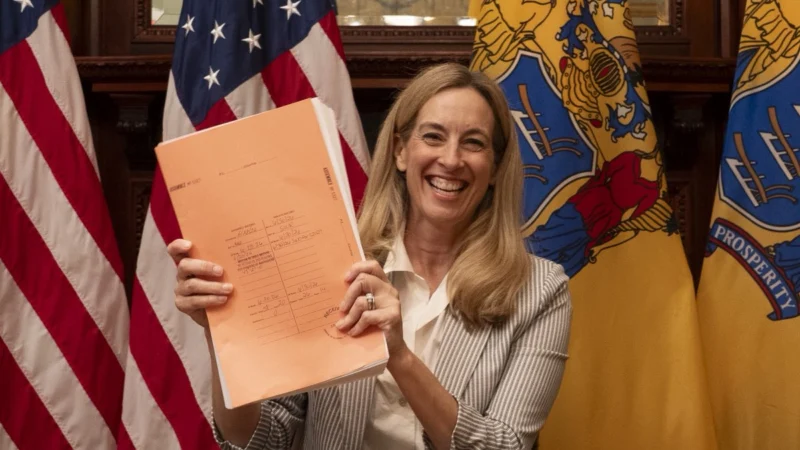
Governor Mikie Sherrill is calling New Jersey’s new $60.7 billion budget the most fiscally responsible in years, but Republicans say the record spending plan falls short on affordability and transparency while expanding government programs and political spending.
TRENTON, N.J. — Just hours after Governor Mikie Sherrill celebrated passage of New Jersey’s Fiscal Year 2027 budget as an “affordability and opportunity budget,” Republican lawmakers launched a coordinated attack, arguing the record-breaking $60.7 billion spending plan does the opposite.
The dispute extends well beyond the budget’s size. At the center of the debate are competing visions over tax relief, school funding, immigration spending, corporate taxes, and the Legislature’s budget process itself. While the governor touts historic property tax relief and fiscal discipline, critics contend the budget contains billions in discretionary spending, controversial appropriations, and last-minute additions that were never fully scrutinized in public.
School funding problems not addressed
Gov. Mikie Sherrill’s 2026-2027 state budget does not resolve the deep-seated school funding problems for many suburban districts. While it dedicates a record $12.4 billion to K-12 education, many suburban communities are still struggling with aid reductions, unpredictable funding fluctuations, and growing budgetary shortfalls.
Sherrill says budget delivers affordability without raising income taxes
Following legislative approval, Sherrill defended the budget as one focused on affordability and long-term fiscal stability.
“We just passed our 2027 budget – an affordability and opportunity budget that puts New Jersey families first,” Sherrill wrote on social media.
“We’re delivering the most property tax relief in state history, investing in our kids, making housing more affordable, fully funding our pension system, cutting our structural deficit in half, and growing our surplus – all without raising taxes on individual New Jerseyans.”
The governor also promoted a redesigned online budget “Report Card,” saying the administration wanted residents to have a clearer understanding of how taxpayer dollars are being spent. The report card was created by her own adminstration.
“New Jerseyans should be able to easily see how their tax dollars are spent and which programs they are funding—that’s why we created the Report Card,” Sherrill said. “Now, we are updating the Report Card ahead of this year’s budget vote by the full legislature so New Jerseyans have a ‘one stop shop’ to more easily find a user-friendly picture of the budget.”
That report card shows about one dozen very generalized funding line items, which do not get into specific programs or funding.
The administration has argued that the spending plan continues record investments in education, pensions, transportation, housing and affordability initiatives while preserving billions in surplus.
Critics question transparency despite new budget report
Republicans say the governor’s transparency message clashes with how the budget was assembled.
Assemblywoman Dawn Fantasia criticized what she described as a rushed legislative process that left lawmakers little time to review thousands of pages before voting.
“Yesterday was a morning-into-late-night marathon that culminated in Gov. Sherrill taking a bow for a $60.7 billion duplicitous dumpster fire fraught with misplaced priorities, plenty of pork for the Majority,” Fantasia wrote.
She said the final budget language was delivered to legislators only hours before floor votes.
“The last 48 hours have been brutal with the amount of reading, writing & digesting required to get through this debacle (that was dumped on us in the wee hours of Monday morning for a Tuesday vote),” she said.
Fantasia argued that lawmakers should have had significantly more time to analyze spending before approving what has become the largest budget in New Jersey history.
A budget that keeps growing
At $60.7 billion, the Fiscal Year 2027 budget marks another record for state spending.
Republicans note that the spending plan did not end with passage of the annual appropriations bill. Shortly afterward, lawmakers also approved Assembly Bill A5326, a supplemental appropriations measure totaling roughly $360 million.
The New Jersey Assembly Republican Office argued the additional legislation pushed total spending to approximately $61.1 billion.
“After more than an hour of Republican opposition, Assembly Democrats passed another $360 million in pork nearly five hours after approving the state budget,” the caucus posted.
Among the examples highlighted by Republicans were approximately $110 million directed toward Jersey City and nearly $300,000 appropriated for New Jersey’s hazelnut industry.
The supplemental spending measure has become one of the most politically contentious portions of the budget package because many of the appropriations were added near the end of negotiations.
Jersey City funding becomes political flashpoint
Perhaps no single appropriation has generated more criticism than state aid directed to Jersey City.
The budget package provides roughly $120 million to help the city address a significant budget shortfall after years of declining state education aid and mounting fiscal pressure.
Supporters argue the assistance prevents severe municipal disruptions while allowing the city additional time to stabilize its finances.
Republicans, however, characterize the funding as a bailout.
Assemblyman Alex Sauickie contrasted the appropriation with school funding received elsewhere in the state.
“On the heels of Gov. Sherrill’s record-breaking $60.7B budget, Trenton’s priorities are clear,” Sauickie wrote.
“Newark gets $1.4B of your tax dollars in school funding. Sanctuary city Jersey City, after avoiding revaluation for 30 years, gets a $120M bailout.”
He added, “Meanwhile, from Cape May to Ocean County, our schools get less and property taxpayers pay more. South Jersey deserves better.”
While Republicans describe the appropriation as preferential treatment, supporters have argued the funding addresses extraordinary fiscal challenges facing New Jersey’s second-largest city.
Stay NJ changes disappoint some seniors
Another area drawing criticism involves changes to the Stay NJ property tax relief program.
The revised version lowers the maximum benefit available to many eligible seniors while eliminating payments for higher-income households.
Supporters say the revisions make the program more financially sustainable and better target taxpayers with the greatest need.
Critics counter that middle-class seniors facing some of the nation’s highest property taxes will receive less relief than originally promised.
Property taxes remain one of the dominant political issues in New Jersey, where homeowners routinely face some of the highest annual tax bills in the country.
Immigration funding fuels partisan divide
The budget also includes funding for legal services benefiting immigrants, an appropriation that has become another focal point for Republican criticism.
Fiscal conservatives argue taxpayers should not finance legal assistance for people who entered or remained in the country unlawfully.
Supporters of the funding respond that legal representation helps ensure due process within immigration proceedings and provides services authorized under state programs.
The issue reflects broader national political divisions over immigration policy that increasingly influence state budget debates.
New business taxes and employer assessments
To help finance state spending, lawmakers approved several revenue measures affecting businesses.
Among the most debated is a new assessment on employers whose workers rely heavily on Medicaid coverage, along with limitations affecting certain tax deductions.
Business organizations have warned the changes could increase operating costs during a period of economic uncertainty.
Supporters argue the measures distribute healthcare costs more equitably while protecting individual taxpayers from broader tax increases.
School funding remains contentious
Education continues to consume the largest share of New Jersey’s annual budget.
Although overall education spending remains historically high, numerous suburban and rural districts continue to experience aid reductions under the state’s funding formula.
Fantasia said schools throughout the Highlands, Pinelands and other regions were unfairly treated.
“What happened in this budget to schools in the Highlands, the Pinelands, and so many other communities across New Jersey was a travesty,” she wrote.
School funding has become one of the Legislature’s most persistent regional disputes, with lawmakers from both parties frequently arguing that the formula disproportionately benefits some districts while disadvantaging others.
Competing visions for New Jersey’s future
The debate over the budget reflects fundamentally different philosophies about the role of state government.
The Sherrill administration argues that higher investments in education, housing, pensions, infrastructure and social programs strengthen New Jersey’s economy while delivering long-term affordability.
Republicans contend the state continues expanding government spending faster than taxpayers can afford, relying on new fees, targeted business taxes and supplemental appropriations while property taxes remain among the nation’s highest.
Those competing narratives are likely to dominate political debate throughout the coming year as lawmakers defend their budget votes and prepare for future legislative battles over taxes, affordability and government spending.
Whether residents ultimately judge the budget by its promises or its results may depend less on political messaging than on whether families experience meaningful relief from New Jersey’s persistently high cost of living.
Key Points
- Governor Mikie Sherrill signed off on a $60.7 billion Fiscal Year 2027 budget, calling it an affordability-focused spending plan that delivers historic property tax relief without raising individual income taxes.
- Republican lawmakers criticized the budget’s size, last-minute legislative process, supplemental spending, Jersey City aid, immigration-related funding, business tax changes and revisions to the Stay NJ property tax relief program.
- The budget debate underscores deep divisions over affordability, transparency, school funding and the future direction of New Jersey’s fiscal policy.
Related: Mikie Sherrill, New Jersey Budget, Alex Sauickie, Dawn Fantasia, Stay NJ, Jersey City, Assembly Bill A5326, New Jersey Assembly Republicans
