
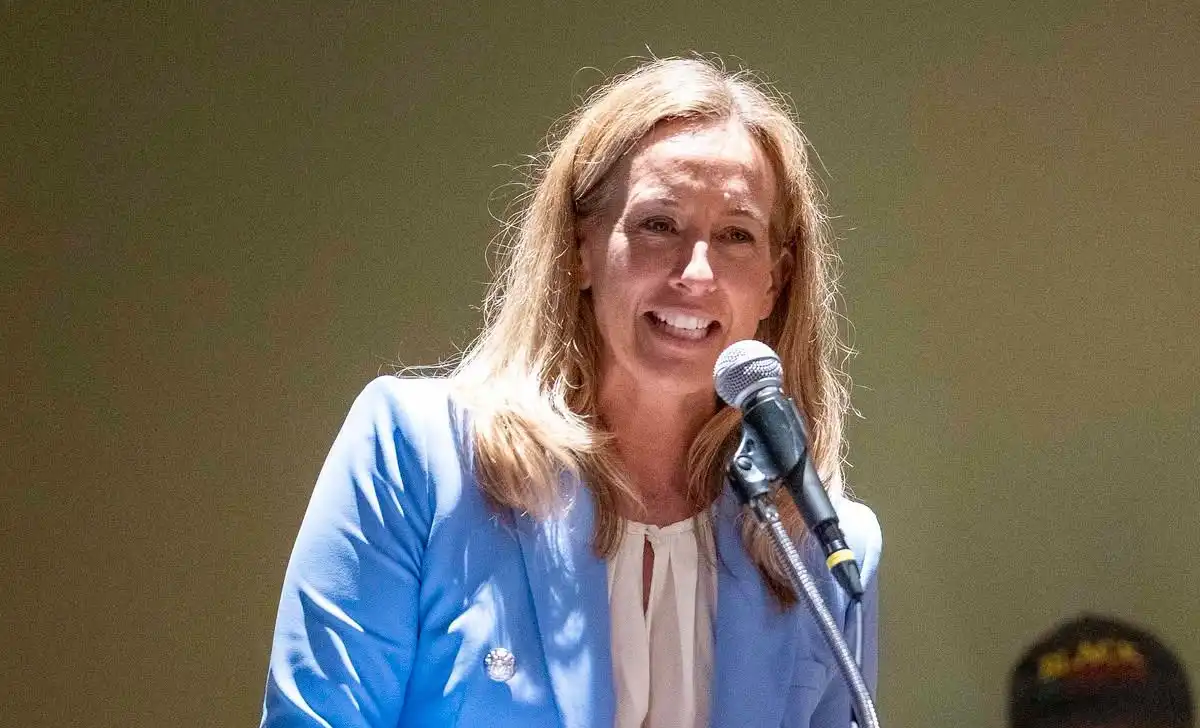
NEWARK, N.J. – New Jersey Gov. Mikie Sherrill is standing behind Rep. LaMonica McIver as the Democratic congresswoman faces federal criminal charges over a physical confrontation with immigration officers outside Delaney Hall in Newark.
“I continue to stand with my friend LaMonica,” Sherrill said. “Trump weaponizing the Department of Justice to target members of Congress simply for doing their jobs is straight out of his corruption playbook. It’s a brazen and unlawful abuse of power, and a direct attack on congressional oversight.”
McIver suffered a legal setback Wednesday when a divided federal appeals court rejected her effort to dismiss key charges against her. The Third Circuit ruled that the physical conduct alleged by prosecutors was not protected legislative activity, clearing the way for two charges to move toward trial.
The case dates to May 2025, when McIver and fellow New Jersey Reps. Rob Menendez and Bonnie Watson Coleman went to Delaney Hall for a congressional oversight visit. A chaotic confrontation erupted outside the facility as federal officers moved to arrest Newark Mayor Ras Baraka, and prosecutors allege McIver physically interfered with officers during that encounter.
- Federal prosecutors accuse McIver of forcibly impeding and interfering with officers during the confrontation outside Delaney Hall.
- A divided federal appeals court ruled Wednesday that two charges against McIver can proceed toward trial.
- McIver denies wrongdoing and says the prosecution is politically motivated retaliation for congressional oversight of immigration enforcement.
Prosecutors Say McIver Struck Federal Officers During Newark Confrontation
The confrontation unfolded as McIver, Menendez and Watson Coleman were visiting Delaney Hall as members of Congress to inspect the immigration detention facility.
Baraka was also at the facility. As federal officers moved to arrest the Newark mayor, a physical scrum developed involving immigration officers, lawmakers, congressional staff and others gathered outside.
Federal prosecutors allege McIver crossed the line from congressional oversight into criminal conduct during that confrontation.
According to the indictment, McIver allegedly “slammed her forearm” into one federal officer and used “each of her forearms to forcibly strike” another.
McIver disputes the government’s characterization of what happened and has maintained that she was carrying out her responsibilities as a member of Congress.
The charges against Baraka were later dropped, but the federal prosecution of McIver continued.
McIver sought to have the case dismissed, arguing that her actions were connected to her congressional duties and protected by legislative immunity. She also argued that the prosecution was selective and politically motivated.
The appeals court was not persuaded that the alleged physical conduct was protected.
McIver Says Appeals Court Got It Wrong
McIver responded to Wednesday’s ruling by making clear that she has no intention of backing down.
“I fundamentally believe that the court got it wrong here,” McIver said. “To protect the people, their elected representatives must be authorized to conduct oversight of the executive branch without fear of retaliation.”
McIver said the decision could have consequences extending well beyond her own criminal case by making members of Congress hesitant to confront executive branch officials during oversight activities.
“Today’s decision chills that authority and emboldens the Trump administration to continue persecuting our most vulnerable communities, those who try to defend them, and anyone who dares hold the president or his lackeys accountable,” McIver said.
She added, “I will not fold to this administration.”
McIver’s attorneys are considering their remaining legal options. Those could include asking the full Third Circuit to reconsider the case or eventually seeking review by the U.S. Supreme Court.
McIver Defense Calls Prosecution Political Intimidation
McIver’s attorney, former New Jersey U.S. Attorney Paul Fishman, also accused the administration of attempting to intimidate lawmakers through the prosecution.
“The goal of the administration is clear: chill members of Congress from overseeing the actions of the Trump administration,” Fishman said.
The Third Circuit decision was divided, providing McIver’s attorneys with support for at least some of their constitutional arguments.
Judge Thomas L. Ambro warned in his dissent about the danger of allowing criminal prosecutions to be used against lawmakers because of their oversight activities.
“The Constitution does not permit the Executive to wield its considerable discretion over criminal prosecutions in retaliation against disfavored legislators,” Ambro wrote.
The majority nevertheless drew a distinction between McIver’s authority to inspect a federal detention facility and the physical actions prosecutors allege occurred during the confrontation.
That distinction will be critical as the criminal case moves forward. Prosecutors contend congressional oversight authority does not give a lawmaker immunity from prosecution for allegedly striking or physically interfering with federal officers.
McIver and her attorneys argue the government created a chaotic confrontation while lawmakers were carrying out legally authorized oversight and then criminalized McIver’s actions during that encounter.
McIver faces up to 17 years in prison if convicted and given the maximum penalties on the charges. She is also seeking reelection in November.
What is LaMonica McIver accused of doing at Delaney Hall?
Federal prosecutors allege McIver physically interfered with officers attempting to arrest Newark Mayor Ras Baraka, including striking federal officers with her forearms. McIver denies wrongdoing.
What did the appeals court decide?
A divided Third Circuit panel rejected McIver’s attempt to dismiss two of the charges on legislative-immunity grounds, allowing those counts to move toward trial.
What happens next in LaMonica McIver’s case?
McIver’s attorneys are considering further appeals, including potentially seeking review by the full Third Circuit or the U.S. Supreme Court, while the criminal case remains pending.
Sources: U.S. Attorney’s Office for the District of New Jersey; U.S. Court of Appeals for the Third Circuit; Rep. LaMonica McIver’s office; NJ Spotlight News.