
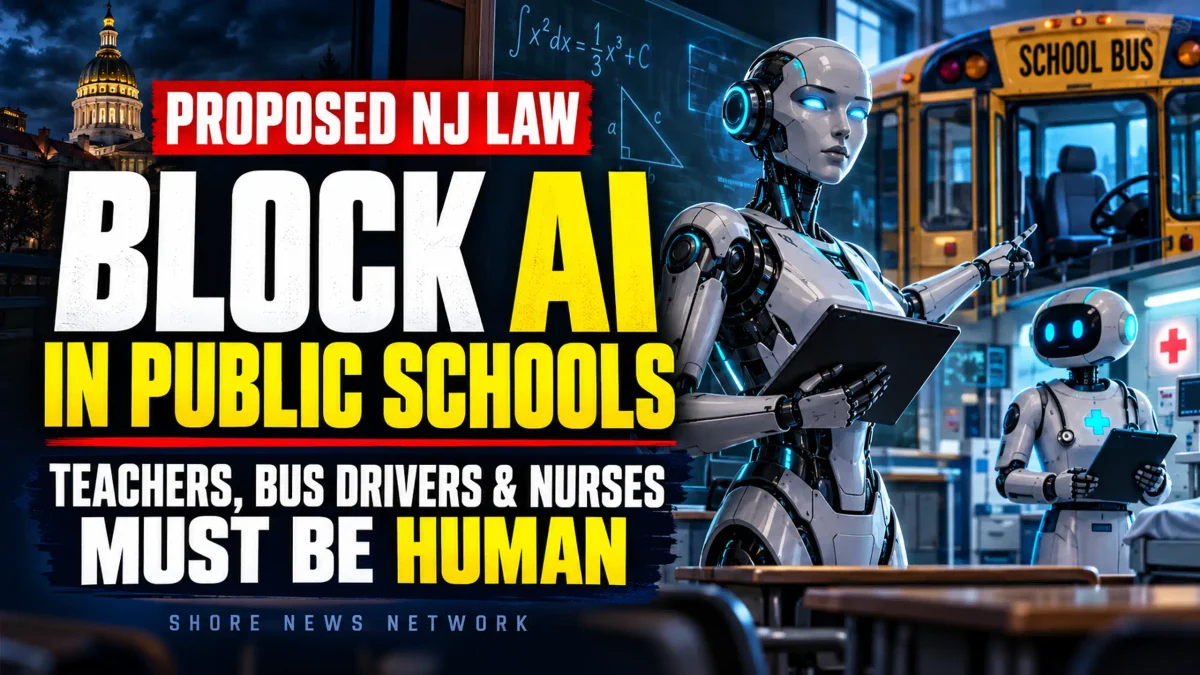
Legislation introduced by two Democratic assemblywomen would require public school employees and contractors to be human beings, potentially limiting a future in which artificial intelligence takes over jobs traditionally performed by school personnel.
TRENTON, NJ — Self-driving school buses, artificial intelligence teachers conducting classroom lessons and robotic medical assistants treating students could become part of the future of public education. But two New Jersey lawmakers want to establish a legal boundary before technology begins replacing school employees.
Assemblywomen Heather Simmons and Rosaura “Rosy” Bagolie have introduced legislation requiring every public school employee, including contractors performing services for school districts, to be a “natural person” rather than an artificial intelligence system or automated substitute.
Assembly Bill 5529, introduced September 17, would apply to traditional public schools, charter schools and renaissance school projects throughout New Jersey.
The proposal covers nearly every job involving regular contact with students, from classroom teachers and guidance counselors to school bus drivers, custodians and cafeteria workers.
If approved, the measure would take effect immediately.
Bill would protect dozens of school jobs from AI replacements
The proposed legislation identifies numerous positions that must be filled by human beings, including teachers, substitute teachers, principals, superintendents, teaching aides and child study team members.
It also covers school psychologists, counselors, nurses, physicians, librarians, bus drivers, bus aides, school security officers, administrative personnel and maintenance employees.
The language extends to individuals providing school services under contracts with boards of education, potentially preventing districts from replacing those positions with fully automated systems.
Simmons represents parts of Cumberland, Gloucester and Salem counties, while Bagolie represents communities in Essex and Passaic counties.
Could AI teachers and driverless school buses become illegal?
The legislation anticipates a future in which artificial intelligence could perform functions traditionally assigned to school employees.
AI-powered instructional systems are already capable of delivering personalized lessons, answering student questions and evaluating certain assignments. Autonomous vehicle technology also raises the possibility of driverless transportation systems.
The bill’s language would require a human being to hold the position of teacher or school bus driver, even if automated technology eventually becomes capable of performing those functions.
Similarly, a school district could not designate an AI system as its nurse, psychologist or guidance counselor in place of an actual employee.
The proposal does not expressly prohibit teachers from using AI instructional tools, administrators from using automated software or school nurses from relying on medical technology.
Its stated purpose is to prevent those technologies from replacing the human personnel responsible for students.
Lawmakers seek to preserve human interaction in schools
The bill’s accompanying statement explains the sponsors’ intent:
“It is the sponsor’s intent that this bill affirms that interactions between students and school personnel are to be conducted by human beings rather than artificial intelligence or automated decision systems.”
The legislation does not establish restrictions on specific AI software products or prescribe how schools should use emerging technology to support employees.
It also does not address whether districts could reduce staffing by using AI for administrative tasks that do not involve replacing a designated employee or contractor.
Those questions could become significant as school districts consider technology to address staffing shortages, operating expenses and individualized instruction.
Proposal awaits action in Assembly Education Committee
A5529 was referred to the Assembly Education Committee following its September 17 introduction. A companion measure, S4795, has also been identified in the Senate.
No committee vote has been recorded for the Assembly bill.
The measure would need approval from both legislative chambers and the governor’s signature before becoming law.
For now, New Jersey lawmakers are drawing a distinction between schools using artificial intelligence as a tool and allowing machines to take the place of teachers, nurses and other personnel who interact directly with children.