
A new audit confirms that every dollar of New Jersey Lottery profits is now flowing to public pension funds, not directly to schools or classroom programs.
TRENTON, N.J. — New Jersey Lottery players purchased more than $3.6 billion worth of tickets during fiscal year 2024, generating one of the largest profit totals in the lottery’s history.
But according to the New Jersey Lottery’s latest audited financial statements, none of that profit was directed to school districts, classrooms, textbooks, transportation programs, or other direct educational expenses.
Instead, the lottery transferred $1.172 billion to public employee pension systems, continuing a policy that has redirected lottery proceeds away from the state’s general fund and into retirement obligations.
The findings are contained in the State of New Jersey Division of State Lottery Financial Statements and Supplementary Information report for the fiscal year ending June 30, 2024.
Key Points
• New Jersey Lottery sales totaled $3.632 billion during fiscal year 2024.
• The lottery generated $1.172 billion in profits transferred to public pension funds.
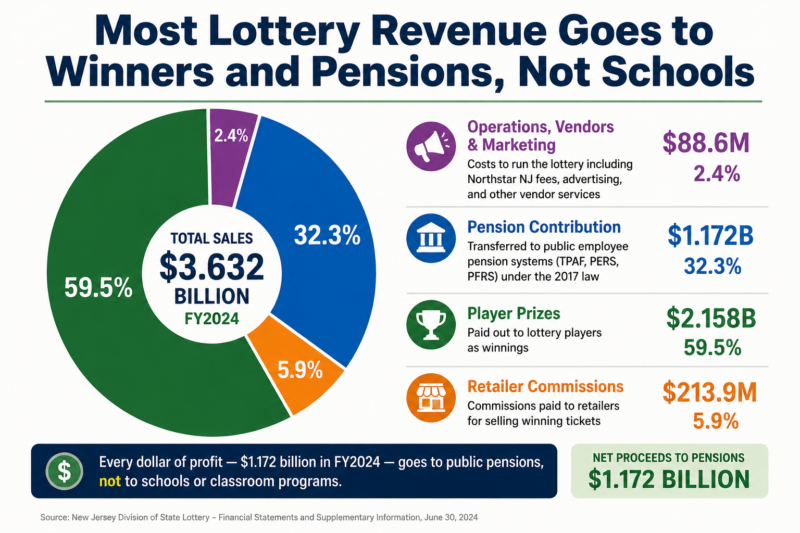
• No lottery profits were sent directly to school districts or classroom operations.
The audit states that lottery sales reached $3.632 billion during fiscal year 2024, making it the fourth-highest sales year in New Jersey Lottery history. Net proceeds totaled $1.172 billion, the second-highest contribution level ever recorded by the lottery.
The largest source of revenue continued to be scratch-off tickets, which generated more than $2.05 billion in sales.
Powerball generated nearly $370 million in ticket sales, while Mega Millions produced another $259 million. Pick 3 and Pick 4 combined generated more than $625 million in sales statewide.
Where the money went
After paying prizes, retailer commissions, vendor fees, marketing expenses, and administrative costs, the lottery reported $1.172 billion available for transfer.
The audit shows that $1.172 billion was transferred directly to public pension funds.
The transfer was made under the Lottery Enterprise Contribution Act, the 2017 law that moved the lottery from the state’s general fund into Pension Fund L for a 30-year period ending in 2047.
According to the audit, lottery proceeds now support:
• Teachers’ Pension and Annuity Fund (TPAF)
• Public Employees’ Retirement System (PERS)
• Police and Firemen’s Retirement System (PFRS)
The audit notes that the largest share is directed toward the Teachers’ Pension and Annuity Fund, which receives approximately 77.78% of lottery proceeds.
What happened to education funding?
The report acknowledges that prior to the 2017 law, lottery proceeds were contributed to the state’s General Fund and used to support education and state institutions.
That arrangement ended when lawmakers approved the pension transfer legislation.
“Prior to enactment of the LECA, the Division of State Lottery’s net proceeds were contributed to the State’s General Fund and utilized to support education and State institutions,” the audit states.
Today, lottery profits bypass the General Fund entirely and move directly into pension accounts.
How much was paid out in prizes?
The biggest winner from lottery operations in 2024 was not the pension system or the state.
It was lottery players.
The audit shows that New Jersey Lottery players collected approximately $2.158 billion in prizes during fiscal year 2024.
That represented nearly 60% of all ticket sales.
Retailers also received nearly $214 million in commissions for selling lottery products and cashing winning tickets.
Northstar New Jersey, the private company that manages lottery sales and marketing operations, received more than $48 million in fees and expenses and earned an additional $21.8 million incentive payment after exceeding contractual performance targets.
The biggest games in New Jersey
Scratch-off tickets remained the dominant lottery product in New Jersey.
The audit shows scratch-off sales exceeded $2.05 billion, accounting for more than half of all lottery sales statewide.
Among draw games, Powerball led all products with $369.6 million in sales.
Other top performers included:
• Pick 3 Fireball — $389.4 million
• Mega Millions — $259.1 million
• Pick 4 Fireball — $236.3 million
• Jersey Cash 5 Xtra — $139.3 million
• Quick Draw — $96.3 million
Lottery officials credited several billion-dollar jackpots during the year for helping maintain strong sales despite an overall decline from the previous fiscal year.
The perception gap
The audit provides perhaps the clearest picture yet of the modern New Jersey Lottery.
More than five decades after voters approved the lottery with promises that it would support education and public institutions, every dollar of net lottery profit is now earmarked for pension obligations.
State officials argue that teacher pensions remain an education-related expense and that lottery contributions help protect retirement benefits for more than 760,000 active and retired public workers.
However, the audit also confirms a reality that many lottery players may not realize: none of the lottery’s $1.172 billion annual contribution is sent directly to local school districts, classroom instruction, textbooks, student programs, or school operations.
For residents who still associate lottery tickets with funding schools, the 2024 audit shows that the New Jersey Lottery has become something very different than the system voters approved in 1969.
Today, it is one of the state’s largest pension funding mechanisms.