
Attorney General Jennifer Davenport joined seven states Tuesday in challenging federal agreements involving Bluepoint Wind and Invenergy as the fight over offshore energy development expands.
TRENTON, NJ — New Jersey opened another front in its widening legal battle with the Trump administration Tuesday, filing two lawsuits aimed at preserving offshore wind leases and challenging agreements involving more than $1.4 billion in federal reimbursements.
Attorney General Jennifer Davenport joined seven other state attorneys general September 22 in challenging agreements between the federal government, Bluepoint Wind and Invenergy involving offshore wind leases in the New York Bight and other waters.
“This Administration is paying developers to abandon building new sources of energy at a time when our grid needs more power to meet demand and residents need relief from high electricity prices,” Davenport said in announcing the lawsuits.
The Trump administration describes the agreements much differently, saying developers voluntarily agreed to abandon offshore wind leases and redirect investment into natural gas, geothermal and other conventional energy projects.
That disagreement — over energy costs, reliability, federal authority and how public money can be used — is now headed into federal court.
Davenport: ‘Our grid needs more power’
According to the New Jersey Attorney General’s Office, the multistate coalition sued the U.S. Department of the Interior and Department of Justice over settlements involving Bluepoint and Invenergy.
New Jersey argues the administration is improperly using the federal Judgment Fund, an account used to pay certain judgments and settlements against the United States, to reimburse offshore wind developers after they redirect money into other forms of energy development.
“Wind energy creates well-paid jobs and reduces our reliance on fossil fuels,” Davenport said. “The president cannot redirect public funds to make unauthorized investments in oil and gas simply because he favors the fossil fuel industry.”
The states allege the settlements violate the Outer Continental Shelf Lands Act, Administrative Procedure Act, National Environmental Policy Act and Judgment Fund Act.
They are asking a federal court to vacate the settlements, restore the leases and block further implementation of the agreements.
Trump administration says the deals will lower costs
The U.S. Department of the Interior has defended the Invenergy agreement as part of President Donald Trump’s energy policy, arguing that offshore wind has depended heavily on subsidies and that investment should instead move toward power sources the administration considers more dependable.
Interior Secretary Doug Burgum said the leases were sold under assumptions that “taxpayers would indefinitely subsidize costly, unreliable projects” and that national-security concerns would not become an issue.
“Under President Trump, companies are shifting investment back toward dependable, secure energy infrastructure that can power our economy and lower utility costs,” Burgum said when the Invenergy agreement was announced in June.
Associate Attorney General Stanley Woodward said the deal represented “a significant step in advancing President Trump’s energy agenda and lowering energy prices for Americans.”
“By ending these offshore wind leases and pivoting investment toward dependable natural gas infrastructure in multiple states, Invenergy is helping revitalize American energy and national security,” Woodward said.
New Jersey disputes the administration’s legal authority to accomplish that policy through the settlement agreements.
Invenergy agreed to redirect $765 million
Invenergy’s settlement covers four offshore wind leases, including its New York Bight acreage off New Jersey and New York.
The company agreed to redirect approximately $765 million toward other U.S. energy projects, including proposed natural gas-fired generating facilities in Indiana, Wisconsin, Iowa, Kansas and Missouri and geothermal projects in the western United States.
Invenergy Senior Vice President for Development Daniel Runyan said the company was focused on projects capable of reaching customers on commercially realistic timelines.
“At a time of unprecedented energy demand, Invenergy is focused on delivering reliable, affordable energy for our customers and supporting disciplined investment at scale,” Runyan said.
He said the company would deploy additional capital into projects that “can be delivered on a commercially reasonable timeline and meet customer demand while continuing to evaluate opportunities as market conditions evolve.”
BOEM currently lists Invenergy’s New York Bight lease, OCS-A 0542, as active. The agency says Interior will cancel and rescind it after Invenergy demonstrates that the investments required under the settlement have been made.
Bluepoint project covered more than 71,000 acres
Bluepoint Wind acquired its New York Bight lease during the federal offshore auction in February 2022.
The lease covers approximately 71,522 acres in federal waters roughly 53 miles from New Jersey. Bluepoint had not submitted a Construction and Operations Plan for the project.
Interior announced its Bluepoint settlement in April, saying Bluepoint would voluntarily end the lease while affiliated companies made equivalent investments in U.S. oil and gas development.
At the time, Interior described offshore wind as an “intermittent, higher-cost” energy source and said the agreement would direct money toward what it called “proven conventional solutions.”
New Jersey’s lawsuit challenges both that policy and the mechanism being used to carry it out.
States challenge use of taxpayer-backed Judgment Fund
A major piece of the litigation centers on where the federal reimbursements would come from.
New Jersey says the administration plans to use the Judgment Fund, which is administered by the U.S. Treasury and generally pays certain judgments and settlements against the federal government.
The states contend there was no actual or imminent litigation that justified the payments.
They also argue the Outer Continental Shelf Lands Act already establishes procedures governing compensation when offshore leases are canceled, meaning the administration cannot substitute the Judgment Fund for those provisions.
New Jersey alleges the federal government also failed to follow statutory procedures requiring hearings, factual findings and consideration of specific factors before canceling offshore leases.
Whether those requirements apply to settlements negotiated voluntarily with the leaseholders is one of the questions now before the court.
National security becomes another point of dispute
The Trump administration has increasingly cited national-security concerns as part of its offshore wind policy.
Federal officials have said large offshore turbines can interfere with radar systems and that subsequent government reviews raised concerns that were not adequately addressed when leases were initially issued.
New Jersey counters that national-security concerns are already part of the federal permitting system and argues the government cannot simply invoke unspecified security concerns years after conducting competitive lease auctions.
The lawsuits contend that the administration has not made the findings New Jersey says are required under federal law to terminate the leases on those grounds.
New York Bight once envisioned as major power source
The latest lawsuits involve part of the offshore wind development zone known as the New York Bight, a large stretch of Atlantic Ocean between New Jersey and Long Island.
Six commercial wind leases covering roughly 488,000 acres were originally issued there.
BOEM previously estimated that full development of all six lease areas could produce as much as 7 gigawatts of electricity, although that estimate did not constitute project approval and several of the original leases have since been canceled or relinquished.
Bluepoint had projected its approximately 2.4-gigawatt project could generate enough electricity for roughly 1.5 million homes in New Jersey and New York, according to the attorney general’s office.
Invenergy’s New York Bight and Gulf of Maine projects were expected by the company to have a combined capacity of roughly 5 gigawatts.
It is not New Jersey’s first wind lawsuit
Tuesday’s filings expand an ongoing series of disputes between New Jersey and the Trump administration over energy policy.
New Jersey and other states sued earlier this year over another agreement involving Attentive Energy, a TotalEnergies subsidiary that held an approximately 84,000-acre New York Bight lease.
Under that agreement, TotalEnergies committed to approximately $928 million in U.S. oil, natural gas and LNG investments before receiving federal reimbursement connected to offshore leases it agreed to surrender.
BOEM now lists the Attentive Energy New York Bight lease as canceled.
The latest litigation comes as New Jersey residents continue dealing with elevated electricity costs and state policymakers debate how additional generating capacity should be brought onto the regional grid.
The Davenport administration argues offshore wind should remain part of that supply mix. The Trump administration is pursuing a substantially different policy centered on natural gas, oil, geothermal and other energy sources it considers more reliable.
Eight attorneys general join the cases
New York Attorney General Letitia James is leading the two multistate lawsuits.
Davenport joined attorneys general from Connecticut, Delaware, Maine, Massachusetts, Rhode Island and Vermont. California is pursuing a separate challenge involving an Invenergy lease off its coast.
The litigation adds another set of cases to New Jersey’s continuing legal clashes with the Trump administration, an issue Shore News Network has followed through its coverage of New Jersey politics and Donald Trump.
Federal judges will now be asked to determine whether Interior and the Justice Department lawfully structured the settlements, whether the Judgment Fund can finance the reimbursements and whether the government followed federal law in moving toward cancellation of the leases.
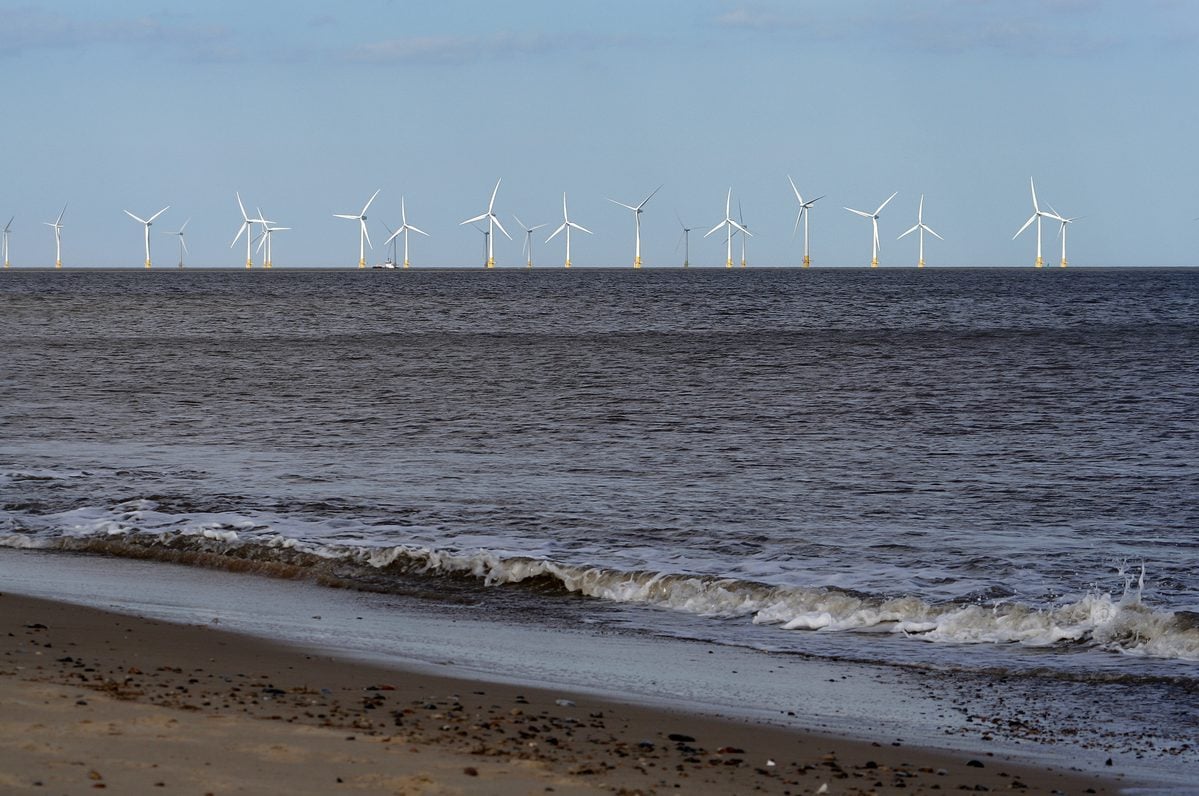
Offshore wind turbines stand at the center of a growing federal-state battle over energy policy, electricity costs and more than $1.4 billion tied to wind leases.