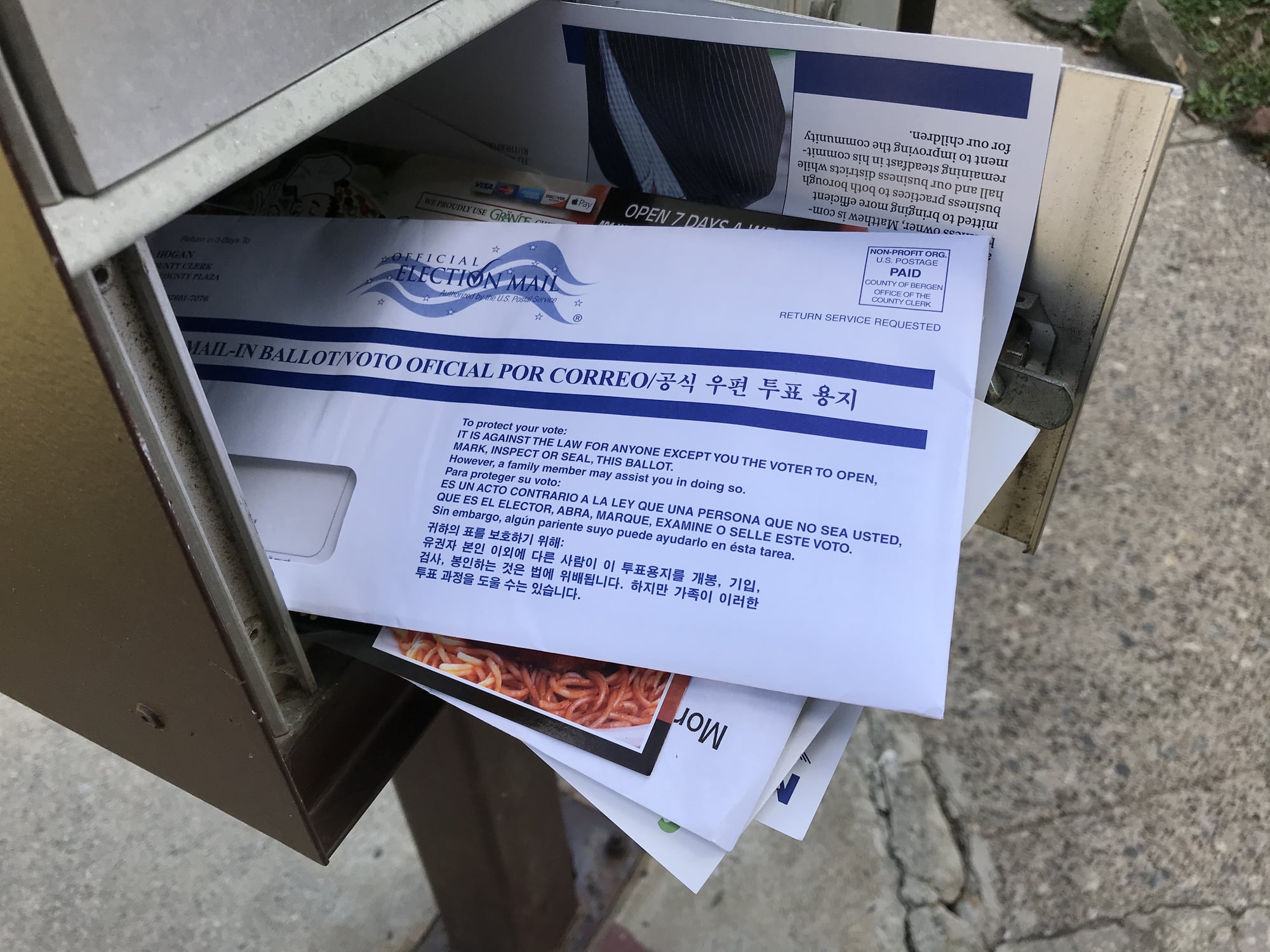
TRENTON, N.J. – Two votes.
That was the final margin in a 2020 Rochelle Park Township Committee race. Other recent New Jersey elections have been settled by four votes, five votes and six votes.
Former gubernatorial candidate Mario Kranjac is pointing to those numbers after New Jersey acknowledged a far larger one: about 6,600 noncitizens were improperly placed on the state’s voter rolls because of a Motor Vehicle Commission software error. State officials say fewer than 400 of them subsequently voted.
“Races in New Jersey have been called with a margin of less than 10 votes,” Kranjac said. “There were over 6600 non-citizens on our voter rolls.”
Then he posed the question at the center of his argument.
“When this happens, who is held accountable? How will we ever know if these winners actually won?”

There is no evidence tying the improperly registered voters to any of the close elections Kranjac highlighted. But the state has not publicly provided the kind of municipality-by-municipality accounting that would allow voters to see whether there was any overlap. We might never know either way. And if he is right, what can be done about it?
6,600 Registrations, Fewer Than 400 Votes
The registration problem occurred at the New Jersey Motor Vehicle Commission between June 2023 and June 2024.
According to the state’s account, the affected people had answered “no” when asked whether they were U.S. citizens. They were nevertheless sent into the voter-registration process because of a software error involving an MVC vendor.
According to the state, approximately 6,600 noncitizens were improperly registered through the MVC system between June 2023 and June 2024. Fewer than 400 later cast ballots. However, those numbers have been disputed by Republicans at the state and federal level.
They were noncitizens who, according to the state, had actually disclosed that fact.
Gov. Mikie Sherrill announced the problem in July after her administration reviewed an issue that originated during former Gov. Phil Murphy‘s tenure.
“This entire situation is unacceptable,” Sherrill said.
The administration’s official account of the MVC registration error says fewer than 400 of those people later cast ballots. By Aug. 19, the state said approximately 5,100 of the registrations had been placed in deleted status because there was no other registration or later attestation establishing eligibility.
The state has also said it found no evidence that the votes changed the result of an election.
Kranjac is asking how that conclusion can be tested against New Jersey’s closest races.
In Rochelle Park, Two Votes Were Enough
The examples in Kranjac’s graphic aren’t hypothetical.
Republican Perrin Mosca ultimately defeated Democrat Mark Warren in the 2020 Rochelle Park Township Committee election, 1,546 to 1,544.
The race had already become tangled in a dispute over ballots. Warren initially appeared to have won before seven additional ballots were counted following court action. The final difference was two votes.
Three years later, another extraordinarily close result came out of Caldwell. Democrat Vivian Rodeffer defeated Republican Matt Giermanski for Borough Council, 928 to 924.
Four votes.
This year, a Republican Township Committee primary in Readington ended with the same margin. Eric Rhoades finished with 1,217 votes and Jon Kowal with 1,213 following a recount.
In Monmouth County, the 2023 Atlantic Highlands mayoral race wasn’t much wider. Democrat Lori Hohenleitner defeated Republican James Murphy 847 to 842 after a recount.
Bogota’s 2023 mayoral contest was initially certified at 828 votes for Republican Daniele Fede and 821 for Democrat Mary Ellen Murphy. A recount later put the difference at six votes.
In a statewide election, 400 votes can disappear into millions.
In a borough election decided by two, they cannot.
So Where Were the Ballots Cast?
That information has not been publicly released in sufficient detail to answer Kranjac’s question.
The state has told residents how many people were improperly registered and approximately how many later voted. It has not published a complete breakdown showing the municipalities, election dates and contests in which each of those voters participated.
Without that information, there is no basis to say the Rochelle Park result was affected. The same is true in Caldwell, Readington, Atlantic Highlands and Bogota.
There is also no publicly available breakdown that lets residents independently determine whether none of the affected voters participated in those races.
Even such a list would have limits. A secret ballot does not identify which candidate an individual voter selected.
Suppose, for example, officials determined that one improperly registered voter cast a ballot in a race decided by two votes. That would establish participation in the election. It would not establish who received that person’s vote, much less prove the outcome would have been different.
The first question is more basic: did any of the affected voters cast ballots in elections where their number approached or exceeded the final margin?
New Jersey hasn’t publicly provided enough granular information to answer that.
State Calls the Error Unacceptable
The disclosure has become another fight over election integrity in New Jersey, although there is little dispute over the underlying software failure. The administration itself disclosed it.
“This error should have been identified and fixed much sooner,” Sherrill said.
Republican lawmakers want a wider investigation into what happened and whether the state’s review went far enough. Senate Republican Leader Anthony Bucco said the discovery “raises serious concerns that demand a transparent and independent investigation.”
One other distinction has become blurred as the story has spread online.
New Jersey identified the approximately 6,600 people as noncitizens. The state’s findings do not establish that all of them were undocumented immigrants or in the United States illegally. In fact, the state’s explanation says the affected applicants told the MVC they weren’t citizens.
And most did not vote, according to the governor’s office, but she refuses to provide anyone with the raw data, so that claim also cannot be independently verified.
What is she hiding?
New Jersey has elections where four votes are enough to win. Sometimes two will do it.
Until the state provides a more detailed accounting of where the affected voters cast ballots, there is no evidence that any of those razor-thin results were changed by the MVC failure. There also isn’t enough public information to independently compare all of those close races against the nearly 400 ballots the state says were cast.
 Police Blotter
 Police Blotter
Pedestrian reportedly struck by e-bike at busy Lakewood intersection
Shore News Network Police Blotter
New Jersey leads push to stop illegal robocalls before they reach your phone
Shore News Network Police Blotter
Two Bergen County men busted in major New Jersey drug and gun investigation
Shore News Network