CALIFON, NJ – The Ramapo Fault, a 185-mile-long system stretching across New Jersey, New York, and Pennsylvania, has been experiencing an unsettling series of earthquakes throughout 2024. Following a notable 4.2 magnitude quake in April, nearly 100 minor quakes have been recorded, including, seven more tremors were recorded along the fault in September, raising questions about the potential for a much larger earthquake. As residents of the region grapple with the possibility, geologists and seismologists are investigating whether this recent uptick in seismic activity is a warning sign or just another chapter in the fault’s long, sporadic history of quakes.
The largest tremor in September was a 1.9 quake on September 9th.
The Ramapo Fault, formed during the breakup of the supercontinent Pangaea around 225 million years ago, has always been a subject of scientific curiosity. However, it hasn’t been particularly seismically active in modern times. While earthquakes in this region are not unheard of, the fault is not typically associated with the same level of seismic activity as more infamous faults like California’s San Andreas. That said, the Ramapo Fault is still capable of producing significant earthquakes. The 1783 New Jersey earthquake, which registered around a 5.3 magnitude, stands as a historical reminder of the fault’s potential to cause significant tremors.
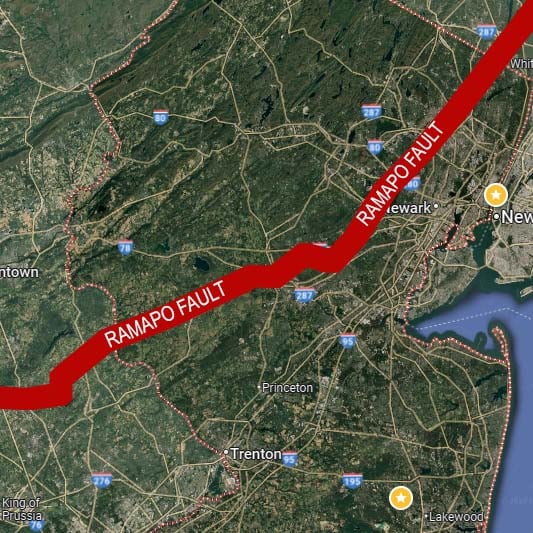
The events of 2024 have reignited public concern about the fault’s behavior, especially as these earthquakes have occurred relatively close to densely populated areas like New York City. The region, while geologically complex, is far from tectonic plate boundaries, making it less prone to frequent earthquakes than regions like the West Coast. However, the northeast’s cooler, denser bedrock means that seismic waves travel much farther than they would in warmer, more fractured rock like that in California. This allows earthquakes in the northeastern U.S. to be felt across a much larger area, even if the magnitude of the quake is relatively modest. For example, a magnitude 4.0 earthquake in this region can be felt up to 100 kilometers away, and a 5.5 magnitude quake could cause damage as far as 40 kilometers from its epicenter.
While the Ramapo Fault’s seismic history is well-documented, scientists are still unsure whether the recent string of earthquakes signals a buildup to something more significant.
The 4.2 magnitude quake in April, the strongest in the region since 1884, was felt as far as New York City and parts of Pennsylvania. Aftershocks, including a 3.8 magnitude tremor, followed shortly after, and geologists are closely monitoring the situation to better understand what might come next. Seismologists are placing temporary seismometers in affected areas to track aftershocks and refine their understanding of the fault’s behavior.
One of the biggest challenges in predicting earthquakes along the Ramapo Fault is its complex structure. It’s not a single, well-defined fault like California’s San Andreas but rather a network of smaller, interconnected faults that have been forming and shifting for millions of years.
The stress that leads to these earthquakes is often linked to ancient tectonic forces that created the fault system in the first place. Some researchers believe that these recent quakes are simply the result of the fault system “settling” as stress is released along various smaller faults.
Despite these concerns, the odds of a catastrophic earthquake happening soon remain low. Earthquake activity in the northeastern U.S. is generally much less frequent than in places like California, where the tectonic plates are in constant motion. However, that doesn’t mean the region is immune to larger quakes.
Scientists point to the 1927 earthquake in New Jersey, which had a magnitude of 4.7 and caused minor damage, as an example of the type of tremor that could recur. The real concern is that even a relatively small quake in this area could cause significant damage due to the dense population and older infrastructure in places like New York and northern New Jersey.
In the wake of the recent quakes, local authorities are urging residents to stay informed and be prepared for the possibility of future seismic events. While predicting earthquakes is notoriously difficult, the recent activity along the Ramapo Fault serves as a reminder that even areas far from active plate boundaries can experience potentially damaging earthquakes. As scientists continue to monitor the fault and study its behavior, the best course of action for residents is to follow safety guidelines and stay aware of new developments. For now, it remains unclear whether the recent quakes are simply a flurry of smaller tremors or a sign of something more significant.