
TRENTON, N.J. – A dispute is unfolding in Trenton after the administration of Gov. Mikie Sherrill announced it would not enforce portions of New Jersey’s newly enacted data broker law just days after the governor signed the legislation.
In terms the left would understand, the governor ‘disappeared’ the law shortly after signing it.
Assemblyman Brian Bergen, R-Morris, called the decision an unconstitutional exercise of executive power in a letter sent Tuesday to Attorney General Jeremy Feigenbaum, arguing the administration cannot unilaterally suspend a law enacted by the Legislature and already signed into law by the governor.
After all, it was their law, signed by their governor…until it wasn’t…until they realized their own law could hurt their chances of winning future elections.
According to Bergen, Assembly Bill A-5328 was approved by both legislative chambers on June 30 and signed into law by Sherrill the same day. On July 10, the Office of the Attorney General announced it would not enforce the law while concerns surrounding its implementation are addressed.
Bergen says governor cannot “turn off” a law
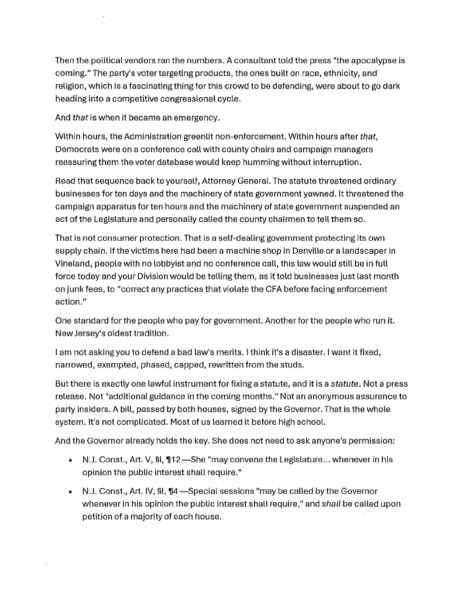
In his letter, Bergen argued that no court had blocked the statute and no constitutional ruling had invalidated it.
“Ten days ago, this Legislature passed A-5328 and the Governor signed it. On July 10, your Department announced it would simply… not enforce it. No court struck it down. No injunction issued. No constitutional infirmity was identified. The Executive Branch just decided the law was inconvenient and turned it off,” Bergen wrote.
He continued by arguing that the governor’s constitutional duty is clear.
“‘The Governor shall take care that the laws be faithfully executed.’ Not the laws she likes. Not the laws that poll well. Not the laws that leave the Democratic State Committee’s voter file intact. The laws.”
Controversial law sparked immediate backlash
A-5328 establishes a statewide registry for data brokers while significantly expanding restrictions on the sale of sensitive personal information. The law also imposes annual registration fees ranging from $5,000 to as much as $1.5 million depending on the volume of consumer data processed.
Those data brokers and their ability to mine sensitive personal information are critical to political campaigns in New Jersey, especially by Democrat Party campaign managers.
Violations involving sensitive personal information can carry civil penalties of up to $50,000 per record under the statute.
Business groups and organizations involved in political campaigns raised concerns shortly after the bill became law, arguing its broad definitions could affect routine data-sharing practices and voter outreach operations. Critics also warned the law’s immediate effective date and severe penalties created significant legal uncertainty for businesses.
Bergen criticizes legislative process
Bergen also criticized how the legislation moved through the Legislature, saying lawmakers had little opportunity to review the bill before voting.
“It was written as a revenue grab to plug a hole in a $60.7 billion budget, and it was jammed through in the dead of night with no hearings worthy of the name, no stakeholder input, and evidently no one in the entire building reading it,” he wrote.
He added that although he opposed the legislation when it passed, he believes the governor lacks the authority to suspend enforcement after signing it into law.
“I opposed the process then. I oppose it now,” Bergen wrote. “This is what happens when a Legislature is treated as a rubber stamp for a budget deal instead of a deliberative body.”
What happens next
It remains unclear whether the Attorney General’s Office will alter its enforcement position or whether litigation challenging the law will be filed.
The Sherrill administration has not announced that the law has been repealed or declared unconstitutional. Instead, the administration has stated it will not enforce the statute while legal and implementation concerns are evaluated.
Why it matters
The dispute raises broader questions about the separation of powers in New Jersey government. While opponents of A-5328 argue the law imposes unprecedented compliance costs and legal risks on businesses, Bergen contends the larger constitutional issue is whether the executive branch can decline to enforce a duly enacted law without action by a court or the Legislature.
Photo: Political cartoon/Satire – AI Assisted
Here's what else is happening