
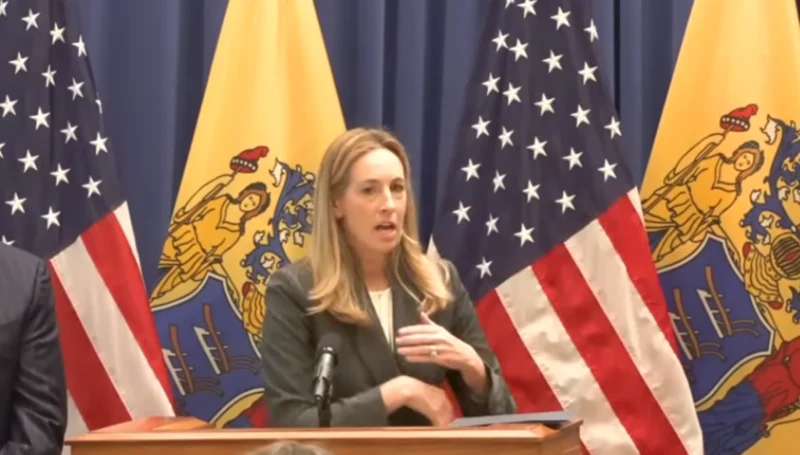
TRENTON, N.J. — New Jersey Governor Mikie Sherrill on Tuesday rolled out what she called one of the most aggressive housing strategies in the nation, signing an executive order aimed at boosting development and lowering costs, while also fielding pointed questions from reporters on redevelopment plans, her administration’s first 100 days, and the makeup of her cabinet.
The announcement comes as housing affordability continues to dominate concerns across the state, with Sherrill emphasizing urgency in both her remarks and responses during a press conference that quickly turned to implementation details and political implications.
During the question-and-answer session, Sherrill made clear that underutilized commercial properties—including shuttered malls and vacant office spaces—are central to her administration’s approach. Asked whether those sites would be targeted for redevelopment, the governor said they present “some really great opportunities,” particularly as the state looks to preserve open space while increasing housing supply.
“We’re the most densely populated state in the nation,” Sherrill said. “Those shuttered properties, the already developed properties, present some great opportunities.”
She outlined a structured timeline tied to the executive order, including a 60-day directive for agencies to conduct regulatory, budgetary, and land-use reviews, and the formation of a housing governance council that will coordinate efforts across departments. A broader set of recommendations is expected by September, covering both state-owned land and partnerships with municipalities and lawmakers.
Sherrill described the effort as a coordinated push to inventory and utilize state assets more effectively, acknowledging that state-owned property has not historically been tracked in a centralized way. She said transit agencies have already begun reviewing land under their control as part of the initiative.
The governor also used the moment to reinforce the political importance of the issue, brushing aside an attempt by a reporter to pivot toward a broader evaluation of her first 100 days in office. Instead, she steered the conversation back to housing, calling it the most pressing concern she has heard from residents statewide.
“If we don’t make housing more affordable here in the state of New Jersey, all of the other many things I want to do to drive down costs are not going to hit for middle class families,” she said.
Sherrill indicated that a more comprehensive review of her administration’s early performance would be addressed in a forthcoming 100-day press conference.
Another line of questioning focused on diversity within her cabinet, where reporters noted a record number of women serving in top roles. Sherrill responded by emphasizing qualifications first, while also acknowledging a broader goal of representation.
“We hired the best we could find,” she said. “Some of them happen to be women, some of them happen to be men. All of them happen to be fantastic at their jobs.”
Pressed further on whether gender played a role in hiring decisions, Sherrill clarified that her objective was to ensure her administration reflects the state as a whole.
“I was committed to making sure my cabinet looked like New Jersey,” she said.
The press conference also briefly veered into lighter territory when a reporter asked about the future plans of Jeopardy champion and event guest Jamie Ding. Sherrill declined to speculate, noting that such matters are “a very tightly held secret,” while Ding himself quipped, “surprises are fun.”
Despite the momentary levity, the focus remained squarely on housing, an issue Sherrill repeatedly framed as central to economic stability and the state’s long-term outlook. With timelines now in place and agencies tasked with delivering concrete proposals, the effectiveness of her plan will likely be measured in how quickly those ideas translate into construction and cost relief.
For now, the administration is betting that a coordinated, government-wide approach—and a willingness to redevelop long-neglected properties—can begin to ease one of New Jersey’s most persistent challenges.