TRENTON, N.J. — The U.S. Department of Justice’s effort to force New Jersey to turn over its statewide voter registration database has come to an abrupt end for now after a federal judge dismissed the case with prejudice, ruling the government relied on a federal law that does not authorize access to the records it sought.
The Department of Justice signaled on Friday, they are not abandoning this fight after it was revealed that illegal non-citizen voters voted in New Jersey elections.
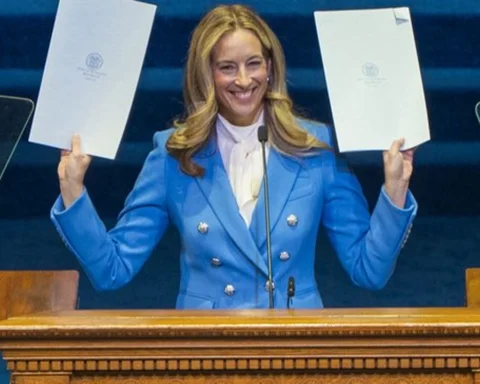
The ruling closes one chapter in a year-long dispute between federal officials and New Jersey election authorities, but it is unlikely to end the broader debate over election oversight. Since the decision, Gov. Mikie Sherrill has disclosed that a software error in the state’s Motor Vehicle Commission system resulted in approximately 6,600 people who identified themselves as non-U.S. citizens being registered to vote between June 2023 and June 2024.
While those developments are separate, they have become intertwined in the public discussion over election integrity, voter roll maintenance and the limits of federal authority.
What happened in the DOJ case?
The Justice Department first contacted New Jersey in July 2025 seeking an electronic copy of the state’s computerized statewide voter registration list, known as the VRL. According to the court’s opinion, federal officials cited concerns arising from Election Assistance Commission data showing New Jersey had a particularly high voter registration rate, reported no duplicate registrations and one of the nation’s lowest rates of sending confirmation notices to active voters.
New Jersey supplied its public voter file but withheld confidential information, including driver’s license numbers and the last four digits of Social Security numbers.
The DOJ later demanded an unredacted version, arguing it needed “all fields” in the database to evaluate compliance with federal election laws. New Jersey refused, maintaining federal law did not authorize disclosure of confidential personal information.
Judge rejects DOJ’s legal theory
Judge Zahid N. Quraishi did not rule on whether New Jersey properly maintains its voter rolls. Instead, he focused on whether the Justice Department had chosen the correct statute.
The DOJ relied on Title III of the Civil Rights Act of 1960, arguing it gives the Attorney General broad authority to inspect election records.
The judge disagreed.
“The plain text of Title III applies only to records ‘which come into’ election officers’ possession and thus does not extend to New Jersey’s computerized VRL — a document the State itself created,” Quraishi wrote.
The opinion distinguishes between voter registration applications submitted by voters and the statewide computerized database maintained by state officials. According to the court, Congress required election officials to preserve records they receive, not a continuously updated database the state itself creates and modifies.
Quraishi also noted that federal law requires states to continually update computerized voter registration systems, creating what he described as a conflict with Title III, which prohibits altering records covered by that statute.
“Simply stated, this creates a conflict,” the opinion says, concluding that accepting the DOJ’s position would place Title III “on a collision course with the NVRA and the HAVA.”
The court dismissed the complaint with prejudice, ending the case.
New Jersey declares victory
Following the ruling, Attorney General Jennifer Davenport said the decision protected residents’ personal information while rejecting what she characterized as federal overreach.
“We are grateful for the district court’s decision, which correctly found that DOJ’s demand for voters’ personal information lacked support in federal law,” Davenport said.
She added, “Every court to consider the question, now totaling seventeen district courts and a federal court of appeals, have unanimously rejected this clear federal overreach. We will continue to act in accordance with federal and state law and protect New Jerseyans’ privacy and people’s personal information.”
Then came the MVC disclosure
Days before the court’s opinion, Gov. Mikie Sherrill publicly disclosed an unrelated problem involving New Jersey’s voter registration system.
According to the governor, a software error in the Motor Vehicle Commission between June 2023 and June 2024 registered roughly 6,600 people who answered “no” when asked whether they were U.S. citizens while applying for driver’s licenses or identification cards.
Sherrill said the error occurred under the previous administration and that those individuals “through no fault of their own” were added to the voter rolls.
“I immediately ordered my chief counsel to launch an investigation to get to the bottom of what occurred,” Sherrill wrote.
She also announced she ordered election officials to remove anyone improperly registered during that period and directed the newly appointed MVC administrator to replace the vendor responsible for administering the system.
According to the governor, preliminary analysis found fewer than 400 of those newly registered individuals cast ballots. She noted those voters were registered as Democrats, Republicans and unaffiliated voters across the state.
“I want to underscore how seriously I take this matter,” Sherrill said. “The integrity of our elections is fundamental to our democracy.”
Does the MVC disclosure change the court’s ruling?
Legally, no.
Judge Quraishi’s decision addressed only whether Title III of the Civil Rights Act authorized the DOJ to compel production of New Jersey’s computerized voter registration database. The opinion specifically focused on statutory interpretation rather than the accuracy of New Jersey’s voter rolls.
Interestingly, the court acknowledged that, after briefing had closed, the DOJ submitted a July 21 letter arguing Sherrill’s announcement about the approximately 6,600 registrations provided “an additional basis” for its request. The judge ultimately concluded that announcement “has no bearing on whether Plaintiff is entitled to the information it seeks” under the statute at issue.
What options does the DOJ have now?
Although this case is over, the Justice Department still has several legal options.
The most immediate would be an appeal to the U.S. Court of Appeals for the Third Circuit. Because the complaint was dismissed with prejudice, the DOJ would need the appellate court to reverse Judge Quraishi’s interpretation of Title III. The opinion, however, notes that numerous federal courts have rejected similar DOJ arguments regarding statewide computerized voter registration lists.
The department could also pursue a different legal theory.
The National Voter Registration Act requires states to conduct “a general program that makes a reasonable effort” to remove ineligible voters from registration rolls. Unlike Title III, the NVRA directly addresses voter list maintenance and contains provisions requiring states to maintain records concerning those activities. The court’s opinion discusses those statutory requirements but did not decide whether New Jersey is complying with them because that issue was not before the court.
Another possibility would be seeking records through narrower requests tailored to materials clearly covered by federal law, such as voter registration applications or records relating to list-maintenance activities, rather than the entire computerized database. Whether that approach would succeed would depend on the specific requests and the legal authority invoked.
Why this decision matters
The ruling is significant beyond New Jersey because it addresses an increasingly common dispute between states and the federal government over election oversight.
Congress has required states to maintain accurate voter registration lists through laws such as the National Voter Registration Act and the Help America Vote Act. At the same time, the Constitution gives states primary responsibility for administering elections, a balance Judge Quraishi emphasized throughout his opinion.
The decision does not prevent the federal government from enforcing election laws where Congress has clearly authorized it. Instead, it concludes that the specific statute relied upon in this case does not extend to a state’s live, continuously updated computerized voter registration database.
The recent disclosure of the MVC software error has also altered the political landscape. While the governor has acknowledged the registration mistake, ordered an investigation and directed election officials to remove affected registrations, the court made clear those facts do not change the legal question presented in United States v. Caldwell.
For now, the Justice Department’s attempt to obtain New Jersey’s voter registration database has ended in defeat. Whether federal officials appeal, pursue a different lawsuit under another statute or accept the ruling could determine the next chapter in a case that has become a closely watched test of the balance between federal election oversight and state control over elections.