
Ocean Township, NJ – Could going green in New Jersey have contributed to a structural collapse of a roof at BJ’s Wholesale Club in New Jersey? That’s what some are fearing in New Jersey today.
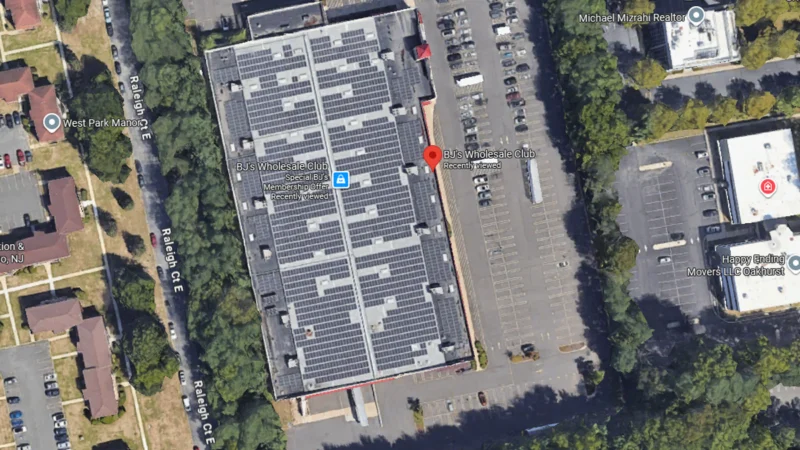
As investigators work to determine why part of the roof collapsed at the BJ’s Wholesale Club in Ocean Township, some attention has turned to the building’s rooftop, which was outfitted with hundreds of solar panels several years before the incident.
The collapse occurred around 11:30 a.m. Monday at the wholesale retailer located at 1904 Route 35 in Oakhurst, during intense thunderstorms that triggered flash flooding across Monmouth County.

Emergency officials initially reported that approximately 50 feet of the roof gave way, primarily over the bakery area. Early reports indicated several people may have been trapped beneath debris, prompting a large-scale response that included the Monmouth County Urban Search and Rescue team.
Authorities have not yet determined what caused the collapse.
Rooftop covered with solar panels
Satellite imagery and publicly available photographs show the building’s roof was almost entirely covered by photovoltaic solar panels prior to Monday’s collapse.
The system was installed as part of BJ’s Wholesale Club’s broader renewable energy initiative with PowerFlex, which began rolling out rooftop solar projects at stores across the country around 2021.
Neither BJ’s nor PowerFlex has indicated that the solar array played any role in the structural failure. Investigators have not yet determined a cause for the failure.
Investigators expected to examine multiple factors
Structural engineers and investigators typically evaluate numerous potential causes when a commercial roof fails during severe weather.
Among the factors likely to be examined are:
- Whether intense rainfall overwhelmed roof drainage systems, allowing water to accumulate.
- Whether roof drains became clogged by debris before or during the storm.
- The amount of temporary water weight created by torrential rainfall, commonly known as ponding.
- Whether the building’s structural design adequately handled combined loads from roofing materials, rooftop equipment and accumulated rainwater.
- Whether long-term deterioration, corrosion or other maintenance issues weakened structural components.
- Whether the rooftop solar installation affected loading calculations or drainage patterns.
There is currently no evidence that any one of those factors caused Monday’s collapse.
Heavy rain can create enormous weight
Monday’s storms produced rainfall rates of up to 3 inches per hour, according to the National Weather Service, which issued Flash Flood Warnings across portions of Monmouth and Ocean counties.
Commercial flat roofs are engineered to support significant loads, including rooftop mechanical equipment, snow and permanently installed solar arrays.
However, engineers note that standing water can substantially increase the weight placed on a roof if drainage systems become overwhelmed or blocked.
Just one inch of standing water can add roughly 5 pounds per square foot across a roof. During extreme rainfall events, several inches of accumulated water can rapidly increase structural loading over large areas.
Whether any ponding occurred before the collapse remains unknown.
Solar panels require structural review
Modern rooftop solar systems are generally installed only after structural evaluations determine a building can safely support the additional permanent weight.
While solar arrays add weight to a roof, they are also subject to building code requirements and engineering review before installation.
Experts caution that the mere presence of rooftop solar panels should not be interpreted as evidence they contributed to a structural failure.
Instead, investigators will likely evaluate the roof as a complete system, including its original design, drainage capacity, maintenance history, weather conditions and any modifications made over the building’s lifespan.
Investigation continues
Emergency crews remained at the scene Monday after responding to reports of a possible gas leak and conducting searches inside the damaged building.
Officials have not released a final accounting of injuries or publicly identified the cause of the collapse.
The investigation is expected to involve local officials, structural engineers, insurance investigators and potentially state agencies responsible for workplace and building safety.
Until those findings are completed, authorities have not attributed the collapse to the rooftop solar installation, heavy rainfall, structural deficiencies or any other specific cause.
Key Points
- Investigators are examining the cause of the BJ’s Wholesale Club roof collapse in Ocean Township during Monday’s severe thunderstorms.
- The building’s roof was largely covered with solar panels installed as part of BJ’s renewable energy partnership with PowerFlex beginning around 2021.
- Authorities have not determined whether heavy rainfall, roof drainage, structural loading, maintenance issues, the solar array or another factor contributed to the collapse.