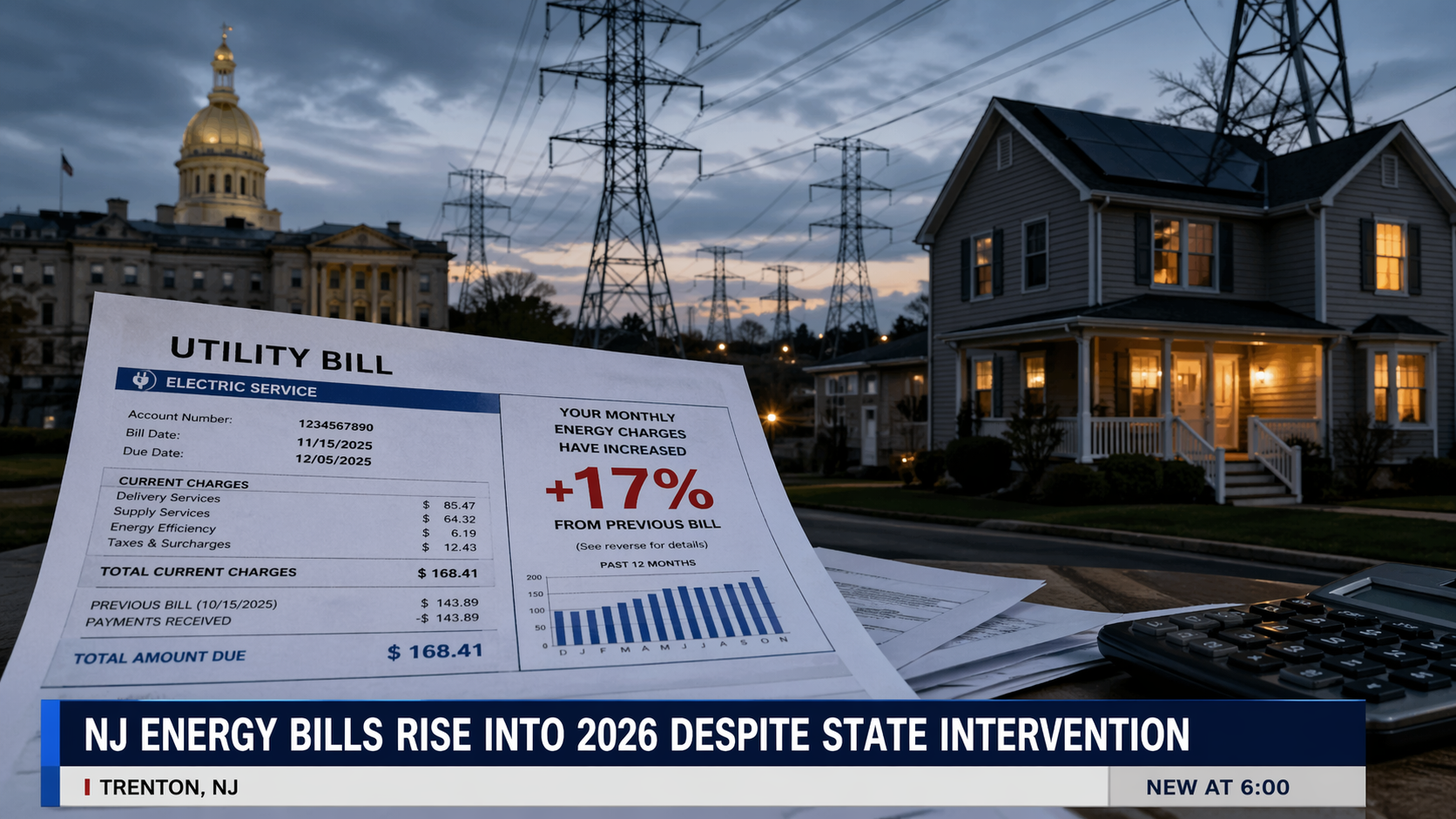
Trenton, NJ — New Jersey households are still absorbing last year’s sharp electricity price surge—about 17% in 2025—while facing a smaller projected increase of roughly 1.3% in 2026 under the state’s mitigation plan, according to reports cited by News 12 New Jersey and federal economic data.
The bulk of the financial hit traces back to mid-2025, when utility bills jumped between 16.9% and 20%, one of the steepest increases nationwide, a spike that continues to shape what residents pay this year.
Smaller 2026 increase follows major 2025 spike
State officials moved in early 2026 to prevent another large jump tied to regional electricity pricing, particularly from PJM Interconnection’s capacity auction system.
Instead of a second double-digit hike, current projections point to a more modest increase—around 1.3%—for 2026. That shift reflects state intervention measures, including bill credits and cost management strategies approved by the New Jersey Board of Public Utilities.
—
Key Points
• New Jersey energy bills surged roughly 17% during 2025, among highest in U.S.
• Projected 2026 increase drops to about 1.3% under state mitigation efforts
• Supply constraints and grid pressures continue driving long-term costs
—
Why prices jumped in the first place
Energy experts tie the 2025 spike to a mismatch between supply and demand across the regional grid.
Electricity demand has climbed, driven in part by energy-intensive data centers and broader consumption trends. At the same time, older power plants have been retired, and replacement generation—such as solar, battery storage, and other sources—has not scaled quickly enough.
Delays in connecting new power projects through PJM Interconnection have further constrained supply, increasing reliance on more expensive electricity sources.
State response focuses on limiting future shocks
Governor Mikie Sherrill declared a state of emergency over utility costs after taking office in January 2026, directing agencies to blunt the impact of rising energy prices.
The administration’s approach includes applying bill credits to offset costs and spreading certain charges over time, reducing the likelihood of another sudden spike like the one seen in 2025.
In parallel, state officials are pushing for expanded in-state energy production to stabilize prices long term and reduce dependence on external supply.
What residents are seeing now
While the projected 1.3% increase for 2026 is significantly smaller than last year’s surge, it comes on top of already elevated bills.
That means many households will continue paying more overall compared to pre-2025 levels, even as the pace of increases slows.
Utilities first implemented the major rate hikes in June 2025, and those higher baseline costs have carried forward into current billing cycles.
Ongoing pressure on the grid
Regional and federal analysts continue to monitor PJM’s capacity and pricing structure, which plays a central role in determining electricity costs across New Jersey.
The Congressional Joint Economic Committee previously identified the state’s 2025 increase as one of the largest in the country, underscoring how rapidly conditions shifted.
—
What comes next
Energy pricing in New Jersey will likely depend on how quickly new generation projects come online and whether grid constraints ease.
For now, the sharp increase from 2025 remains the dominant factor in household energy costs, with 2026 bringing a comparatively modest adjustment rather than another major spike.
The current status: New Jersey electricity bills remain elevated after a roughly 17% increase in 2025, with an additional increase of about 1.3% expected through 2026 under state mitigation efforts.