


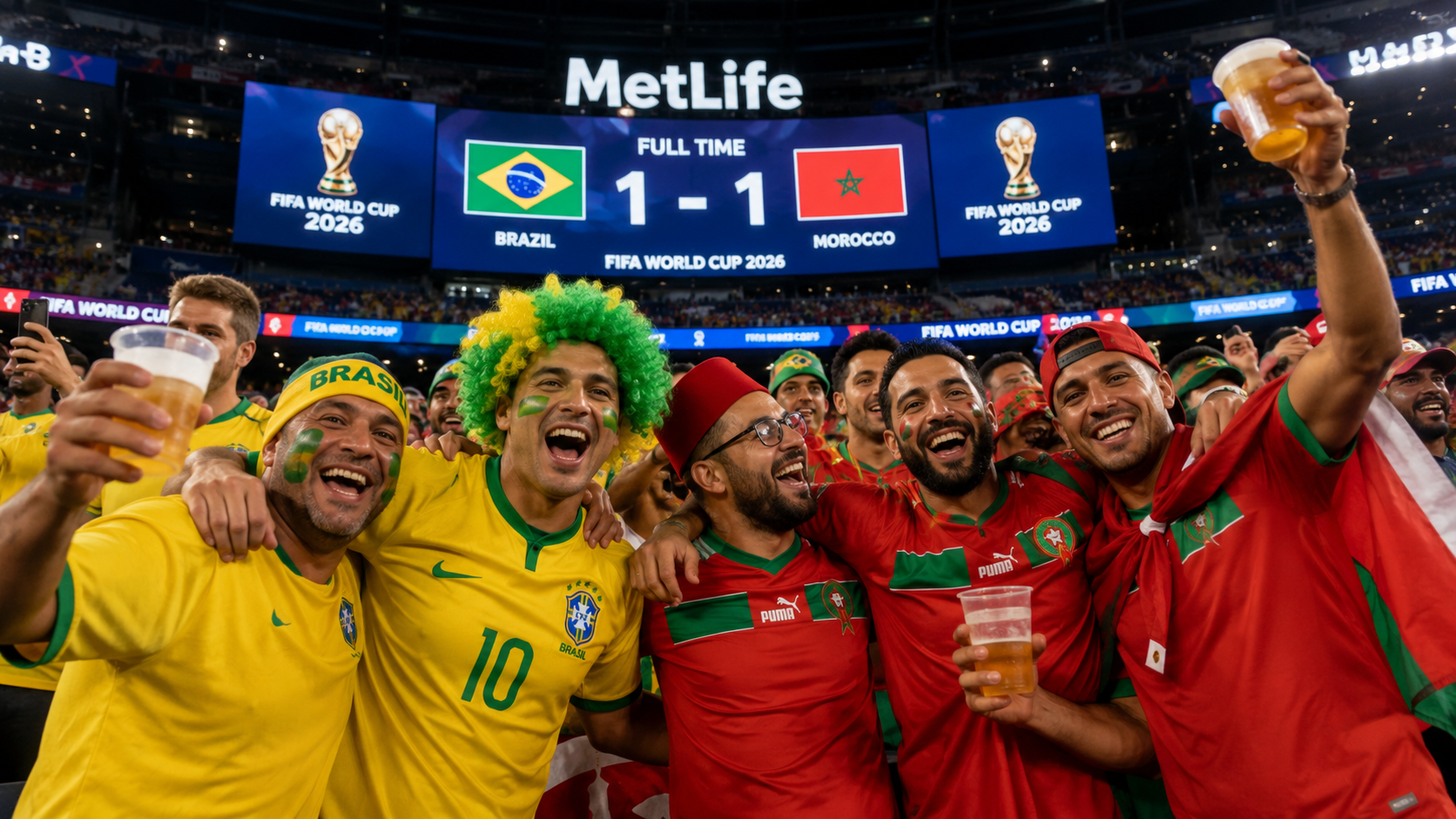
East Rutherford, NJ – The first FIFA World Cup match ever played in New Jersey was supposed to be a historic moment. Instead, many Americans left MetLife Stadium and turned off their televisions with the same reaction they’ve had toward soccer for decades: “That’s it?”
Americans aren’t huge soccer fans. Our sports are football, baseball, basketball, hockey and NASCAR. There are a few fringe weirdos who love to watch a good gold match, tennis match, or bowling event on television, but we don’t invite those people to our houses for our Sunday football (American) parties.
Ok, time to be a real journalist.
Brazil and Morocco opened Group C play with a hard-fought 1-1 draw before a packed crowd in East Rutherford. Morocco stunned the five-time world champions in the 21st minute when Ismael Saibari capitalized on a Brazilian defensive mistake and chipped goalkeeper Alisson Becker. Brazil answered just eleven minutes later with a beautiful curling strike from Vinícius Júnior. After that, both teams traded chances, goalkeepers made saves, and the tactical chess match unfolded exactly as soccer purists love to see it.
Then the final whistle blew.
One goal apiece. One point apiece. No winner.
Ok, stop being a real journalist.
For much of the world, that’s perfectly acceptable. For many Americans—and especially many New Jerseyans—it reinforces exactly why soccer remains an acquired taste.
As one of our American heroes, Homer Simpson once said, “Booooooring!” That rang especially true as we hunkered down waiting for the NBA Finals, where the Knicks won the championship, and NYC residents celebrated by burning a school bus and shooting a teen.
That’s for another day, though.
Americans are conditioned to expect winners and losers. We grow up on football games that routinely feature 40 or 50 combined points. Basketball games often see both teams score over 100. Baseball, while slower paced, still delivers clear outcomes nearly every night. We invest three hours of our lives expecting resolution.
While America hates losers, we hate one thing more…ties. Whether they are sports scores or choking our necks, ties suck.
Soccer often offers something different. Ninety minutes of action can end with the scoreboard barely changing and no winner being declared. In America, ties are something we wear to funerals, weddings, court appearances, and job interviews—not something we want as the conclusion to a sporting event.
The Brazil-Morocco match was technically impressive. It featured elite talent, world-class athleticism, and dramatic moments. But for casual American fans tuning in because the World Cup had arrived in New Jersey, the ending felt unsatisfying. The scoreboard read exactly what it did after Vinícius Júnior scored in the 32nd minute.
Yet, it was not fulfilling. Nowhere near as fulfilling as what came later in the night in San Antonio. That is the type of sports action Americans crave and need.
Imagine if the Giants and Eagles battled for three hours only for the referee to announce both teams would share the result. Imagine the Yankees and Red Sox playing nine innings before agreeing everyone gets half a win. Americans simply aren’t wired to embrace that concept.
Sure, football has ties once in a while, but they are about as rare as finding an alpha adult male who proudly boasts at the local pub that he’s a diehard FIFA fan at a Super Bowl party.
Could corporate America be the ones subliminally sabotaging soccer in America? Let’s take a look.
Soccer faces other challenges in the United States as well. The sport’s continuous action, while beloved globally, leaves little room for the commercial breaks that drive American sports broadcasting. The low-scoring nature means a single mistake can determine an entire match, but it also means long stretches where nothing happens on the scoreboard. For viewers raised on touchdowns, slam dunks, and home runs, patience can wear thin.
Ya, nah, the game is just boring.
There’s also the reality that many American fans prefer watching sports where American athletes dominate. The NFL has no equal. The NBA attracts the world’s best basketball players, but Americans remain at the center of the sport’s universe. Baseball has become increasingly international, yet America’s Major League Baseball remains the gold standard.
Soccer is different. The world’s best clubs are in Europe. The sport’s biggest stars often play thousands of miles away. For many American viewers, that creates a disconnect.
That sounds like a good explanation, but it’s just an excuse soccer fans use to tell us how great the game is if we just watched one match.
Well, we did. And they’re wrong.
None of this is to suggest soccer lacks merit. The sport is unquestionably the world’s most popular game for a reason. The strategy is sophisticated. The athleticism is remarkable. The passion of its supporters is unmatched. It could also be that it’s an affordable third world alternative that requires…a ball and nothing else. Goals can be two garbage cans, two trees, or the four least athletic kids in the park to serve as goal posts.
But if FIFA hoped New Jersey’s first World Cup match would instantly convert skeptical American sports fans, a 1-1 draw was probably not the ideal advertisement.
As Brazil and Morocco prepare for crucial matches against Scotland and Haiti, Group C remains wide open. That’s great news for tournament organizers. For Americans, it means absolutely nothing.
For many Americans watching at home, however, the opening match simply reinforced an old belief: if you’re going to spend 90 minutes watching a game, somebody ought to win it.