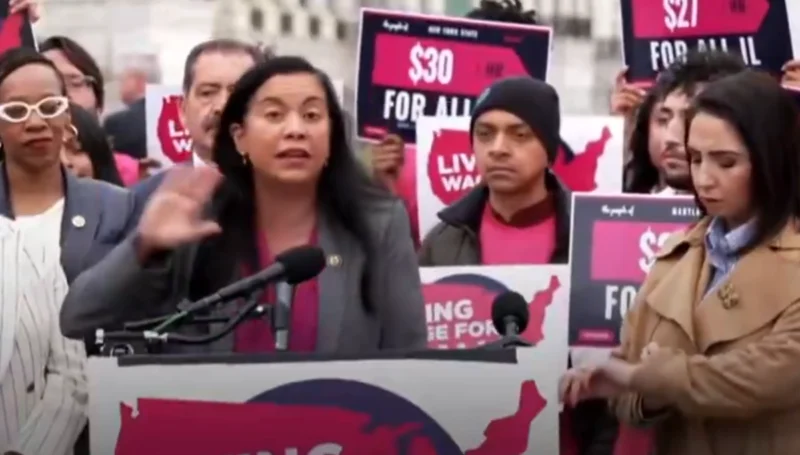
Washington, D.C. — A New Jersey congresswoman is bringing the state’s wage fight to the national stage, unveiling a proposal to raise the federal minimum wage to $25 an hour—one of the most aggressive increases ever introduced in Congress.
Rep. Analilia Mejia, who previously backed New Jersey’s push to raise wages to $15, announced Tuesday she is leading the “Living Wage for All Act” alongside several Democratic lawmakers. The bill would more than triple the current federal minimum wage, which has remained at $7.25 since 2009.
“No one can afford to live on less,” Mejia said in announcing the legislation. “I fought for $15 in NJ—now we take this fight national for $25 an hour.”
From New Jersey to national policy
Mejia’s proposal builds directly on New Jersey’s wage trajectory, where lawmakers gradually increased the state minimum wage over recent years.
Now, she and her allies argue even those gains are no longer enough as housing, food, and transportation costs continue to rise.
The bill would phase in the $25 wage over time—reaching that level by 2031 for large employers and later for smaller businesses—while also eliminating subminimum wages for tipped workers and others.
A dramatic jump from current law
The proposal would mark a sharp shift in federal labor policy.
At $7.25 per hour, the current federal minimum wage has not changed in more than 15 years, even as many states—including New Jersey—have set higher minimums.
Supporters say the increase reflects economic reality.
Critics argue it could strain small businesses and lead to higher prices or reduced hiring.
—
Key Points
• NJ Rep. Analilia Mejia introduces bill to raise federal minimum wage to $25
• Plan would phase in increase through 2030s depending on employer size
• Proposal builds on NJ’s earlier push for higher wages
—
What it means for New Jersey workers
While New Jersey already has a higher minimum wage than the federal level, a $25 national standard would still represent a significant jump for many workers in the state.
It could also reshape regional labor markets, especially in industries like retail, hospitality, and food service.
For workers, the proposal promises higher earnings.
For employers, it raises questions about costs, pricing, and staffing.
Political divide ahead
The bill faces a steep path in Congress.
Previous efforts to raise the federal minimum wage to $15 stalled despite broad public support. A jump to $25 is likely to face even stronger opposition, particularly from Republicans and business groups.
Still, the proposal signals where some Democrats want the conversation to go as affordability becomes a central political issue.
What happens next
The bill has been introduced but has not yet advanced through committee.
Whether it moves forward or not, it sets a new benchmark in the ongoing debate over wages—and positions New Jersey lawmakers at the center of that national fight.