
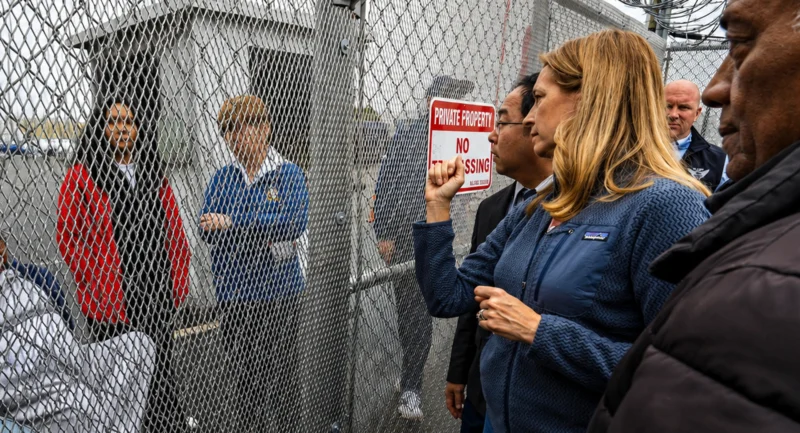
As protests erupt outside Delaney Hall in 2026, the political history of the Newark detention facility reveals years of Democratic support, federal funding, and local financial benefit during the Obama era when Cory Booker was mayor of Newark.
For many New Jersey Democrats, Delaney Hall has become a symbol of opposition to federal immigration enforcement. Elected officials, activists, and protesters have spent the past several weeks condemning the Newark detention facility and demanding changes to federal immigration policy.
Not only that, the people of Newark reaped the rewards of jailing migrants in their city, and nobody shed a tear or protested.
What is often left out of that conversation is that Delaney Hall’s rise as a major immigration detention center occurred under Democratic leadership at nearly every level of government, and not only did they support the facility, they reaped financial benefits from housing illegal aliens in the state’s largest city.
When the facility expanded its role housing immigration detainees in 2011, Barack Obama was president, Cory Booker was mayor of Newark, and Essex County’s Democratic political establishment was openly promoting the project as both an economic opportunity and a source of government revenue.
Key Points
• Delaney Hall expanded under the Obama administration as part of a nationwide increase in immigration detention capacity.
• Essex County Democrats projected the facility would generate tens of millions of dollars in revenue.
• Many of today’s Democratic critics were serving in government during the years Delaney Hall operated without major political opposition from elected officials.
According to a 2011 NJ.com investigation, Essex County expected to earn approximately $50 million annually through its detention agreement with ICE. County officials projected the contract would generate roughly $250 million over five years.
The arrangement allowed Essex County to collect federal payments for detainees while retaining a portion of the revenue when individuals were housed at Delaney Hall. County leaders openly discussed the financial benefits. City and county Democrats reveled in the fact that the housing of illegal aliens would be a financial boon for both. Both cheered the facility on when it opened.
“This is a very unpleasant way of getting revenue,” then-Freeholder Vice President Ralph Caputo said at the time. “But it’s going to be helpful.”
Essex County Executive Joseph DiVincenzo was even more direct.
“The $250 million we expect to receive over the five-year contract will significantly help reduce the financial burden on our taxpayers,” DiVincenzo said.
The Obama-era expansion
The expansion of Delaney Hall did not occur in a vacuum.
Federal officials under President Obama were increasing immigration detention capacity nationwide. According to NJ.com, ICE was actively pursuing additional detention facilities around the country and identified Delaney Hall as part of a broader effort to expand capacity in major metropolitan areas.
At the time, the Obama administration’s detention network held more than 33,000 detainees on an average day, and immigration advocates criticized the growing reliance on detention facilities.
Yet despite those criticisms, the project moved forward with the support of county government and federal immigration authorities.
Where were today’s Democratic leaders?
The political landscape looked very different when Delaney Hall became a centerpiece of Essex County’s detention system.
Booker was serving as mayor of Newark during the facility’s expansion. Obama occupied the White House and oversaw the federal immigration system responsible for the detention program. Andy Kim was serving in the Obama administration during the same period.
Mikie Sherrill would soon enter federal service through the U.S. Attorney’s Office in New Jersey, where she later worked on outreach, reentry, and federal criminal justice matters during years when Delaney Hall continued operating as part of the federal detention network.
There is no record of Kim, Sherrill, Booker, or other prominent New Jersey Democrats leading public protests against Delaney Hall during its early years, when abuses were reported as far back as 2012.
Instead, the most vocal opposition came from low-key immigrant-rights groups, religious organizations, and civil-liberties advocates.
Activists warned about detention profits
The concerns being raised today are not new. In 2011, immigrant-rights advocates accused government officials of turning detention into a revenue stream.
“There’s been much discussion about the dollars and cents,” Kathy O’Leary of Pax Christi told NJ.com.
Amy Gottlieb of the American Friends Service Committee argued that public officials were benefiting financially from detention policies.
“They’re making money off the backs of immigrant suffering,” Gottlieb said. Still, Booker and the Democrats ignored the warnings and took the cash.
Human Rights Watch and other advocacy groups similarly questioned the rapid expansion of immigration detention during that period.
A political reversal
Fifteen years later, Delaney Hall has become a political liability rather than a political asset.
The same facility once promoted as a source of revenue, jobs, federal investment, and detention capacity is now frequently portrayed by Democratic officials as evidence of a broken immigration system.
The historical record shows that Delaney Hall did not emerge under Republican leadership. It expanded during an era when Democrats controlled the White House, Newark City Hall, and Essex County government, and county officials openly celebrated the hundreds of millions of dollars the arrangement was expected to generate.
Whether that reflects a change in policy, politics, or public opinion remains a matter of debate. What is not debatable is that long before Delaney Hall became a political target, it was a project embraced by many of the Democratic institutions that now seek to distance themselves from it.