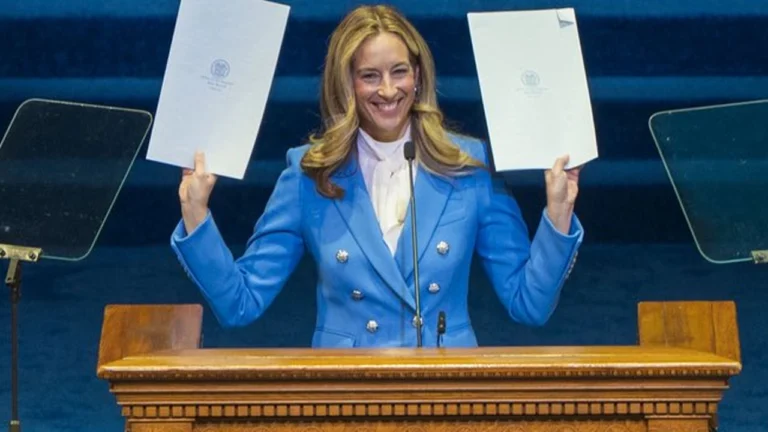
NEW BRUNSWICK, N.J. — Gov. Mikie Sherrill enters the end of her first 100 days in office with a 45% approval rating, trailing the early benchmark set by former Gov. Phil Murphy, who reached 51% approval at the same point in 2018. A new Rutgers-Eagleton Poll shows Sherrill with 29% disapproval and a sizable 26% of voters still undecided, underscoring an electorate that remains in flux as her administration takes shape.
The numbers suggest a more cautious early reception compared to Murphy’s first months, though both governors faced similar dynamics—strong initial support paired with a large bloc of residents still forming opinions.
Voters still making up their minds
Sherrill’s approval rating closely mirrors her favorability numbers, with 44% viewing her positively and 29% negatively. Notably, about a quarter of New Jerseyans either have no opinion or are unfamiliar with her, highlighting the early-stage nature of her tenure.
Polling director Ashley Koning said that uncertainty is typical this early in a governorship, particularly as voters begin to assess leadership style and policy direction.
“Barely three months have passed since Gov. Sherrill has taken office, and while we see her continue to garner more positive reactions than negative ones, many of her constituents are still forming an opinion,” Koning said.
How Sherrill compares to Murphy’s start
Murphy’s April 2018 Monmouth University Poll showed him at 51% approval, 22% disapproval, and roughly 27% undecided—slightly stronger overall support but a similarly large share of voters withholding judgment.
His early numbers were shaped in part by the transition from the deeply unpopular Chris Christie administration, along with a burst of early policy moves that defined his agenda.
Sherrill, by contrast, enters office in a different political and economic environment, with affordability and cost-of-living concerns dominating public attention—issues that polling shows remain difficult for any administration to quickly influence.
—
Key Points
• Gov. Mikie Sherrill holds 45% approval after her first 100 days in office
• Former Gov. Phil Murphy reached 51% approval at the same point in 2018
• About one-quarter of New Jersey voters remain undecided on Sherrill
—
Strengths and weaknesses emerge in early grades
Beyond overall approval, the poll reveals uneven performance across key issues. Sherrill receives her strongest marks on education, public safety, and transportation, where more residents assign higher grades.
Her weakest areas mirror the state’s biggest concerns: affordability and taxes. Around 3 in 10 residents give her an “F” on both issues, reflecting persistent frustration that predates her administration.
Economic management and state spending also produce mixed reviews, with many respondents assigning mid-range grades or expressing uncertainty.
A familiar pattern for new governors
The early comparison between Sherrill and Murphy reflects a broader pattern in New Jersey politics: initial approval ratings tend to cluster around a narrow range, with large portions of the electorate reserving judgment.
Koning noted that early polling often says as much about long-standing structural issues as it does about a new governor’s performance.
“None of these issues have easy answers, and the grades reflect that reality and the surmounting challenges that have grown over time more than any judgment of her early governorship,” she said.
What comes next
With approval below Murphy’s early benchmark and a significant share of undecided voters, Sherrill’s political standing remains fluid heading into the next phase of her term. Future polling will likely hinge on whether her administration can move public perception on affordability, taxes, and economic stability—issues that continue to dominate voter concerns.
For now, the data shows a governor with more support than opposition, but less early momentum than her predecessor, and a large segment of New Jersey residents still waiting to decide.