
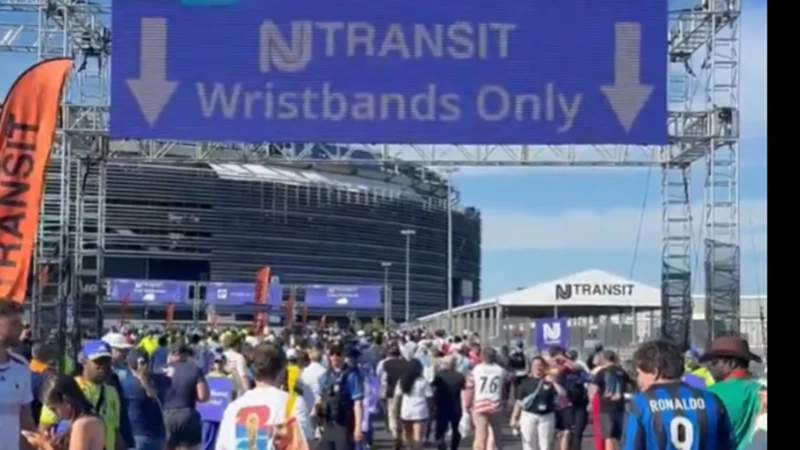
Thousands of rail passengers faced delays and service disruptions after a World Cup match at MetLife Stadium, with some NJ Transit trains stopping short of New York City and riders expressing frustration over the agency’s handling of post-game travel.
NJ Transit riders encountered widespread disruptions Tuesday evening following a FIFA World Cup match in East Rutherford, as multiple rail lines were prevented from reaching New York Penn Station and delays spread across the system.
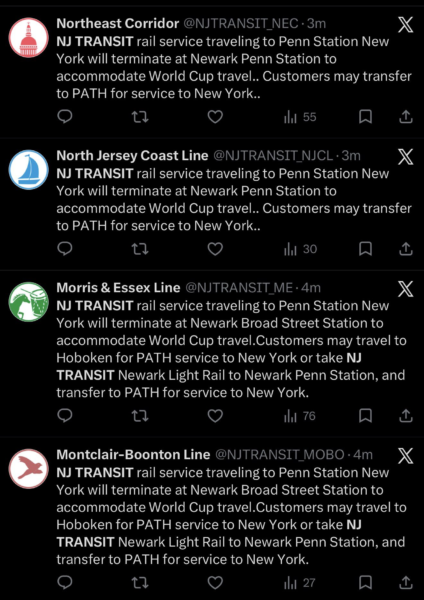
Shortly after the match ended, NJ Transit issued alerts announcing that several New York-bound lines would terminate before reaching Manhattan.
“NJ Transit rail service traveling to Penn Station New York will terminate at Newark Penn Station to accommodate World Cup travel. Customers may transfer to PATH for service to New York,” the agency posted for Northeast Corridor and North Jersey Coast Line riders.
Similar advisories were issued for the Morris & Essex and Montclair-Boonton lines. Those trains were directed to terminate at Newark Broad Street Station, forcing passengers to continue their trips through Hoboken, Newark Light Rail, or PATH connections.
Amtrak switch issue cited as delays spread
As crowds exited MetLife Stadium, NJ Transit reported additional delays affecting service into and out of New York Penn Station.
“Due to congestion resulting from an earlier Amtrak switch issue near Secaucus, NJ Transit rail service is subject to up to 30-minute delays into and out of Penn Station New York,” the agency said in an alert issued at 6:47 p.m.
The advisory came as thousands of soccer fans and regular commuters attempted to navigate one of the busiest rail corridors in the country.
The Northeast Corridor serves as a critical transportation link between New Jersey and Manhattan. Any operational problem involving tracks, switches, or signals near Secaucus can quickly create cascading delays throughout the region’s rail network.
Riders question agency’s handling of disruptions
Many riders took to social media to complain about delayed trains, inaccurate departure information, and what they described as recurring reliability issues.
“Where is the NY bound NJCL?” one rider posted. “Departure Vision is wildly inaccurate. Are we standing on the platform all day or what?”
Another commenter mocked the explanation provided by transit officials, writing, “Haha there’s the Amtrak excuse!!!!”
Some riders argued that infrastructure problems near New York Penn Station have become routine.
“There s always Amtrack signal issues between Secaucuss & NY. It’s almost every day, so what else is new???” another commenter wrote.
Others accused the agency of prioritizing World Cup transportation over the needs of everyday commuters.
Amid the chaos, there was also confusion. ABC7 reporter Michelle Charlesworth posted the following video on X about it.
“But say more about how you served the World Cup fans,” one rider posted. “Joke that daily commuters get screwed.”
World Cup travel plans face renewed scrutiny
State and transportation officials have repeatedly promoted rail service as a key component of moving large crowds to and from MetLife Stadium during the World Cup.
Earlier in the tournament, officials highlighted the number of passengers successfully transported to matches and emphasized regional coordination efforts.
Tuesday’s disruptions renewed criticism from riders who questioned whether the system is prepared to handle major international events while maintaining normal commuter service.
“Once again, this agency needs investigating and accountability,” one commenter wrote.
Another rider criticized the broader transportation response, calling it “regional incompetence on full display for the world to see.”
The incident comes as New Jersey continues to host World Cup matches that draw tens of thousands of visitors from around the globe.
Questions remain about impact on riders
NJ Transit did not immediately release information on how many passengers were affected by the service changes or how long it took for operations to return to normal.
The agency also did not provide additional details about the Amtrak switch issue beyond citing it as a contributing factor to congestion and delays.
Because Amtrak owns much of the infrastructure leading into New York Penn Station, including tracks, switches, and signals along the Northeast Corridor, disruptions on that network often affect NJ Transit operations.
For many riders caught in Tuesday’s delays, however, the distinction mattered little as trains were rerouted, trips extended, and travel plans disrupted following one of the region’s highest-profile sporting events.
Key Points
• Multiple NJ Transit rail lines were prevented from reaching New York Penn Station following a World Cup match at MetLife Stadium.
• The agency cited congestion and an earlier Amtrak switch issue near Secaucus for delays of up to 30 minutes.
• Riders complained about inaccurate train information, delays, and service disruptions.
• Critics accused NJ Transit of prioritizing World Cup transportation while regular commuters faced travel problems.