
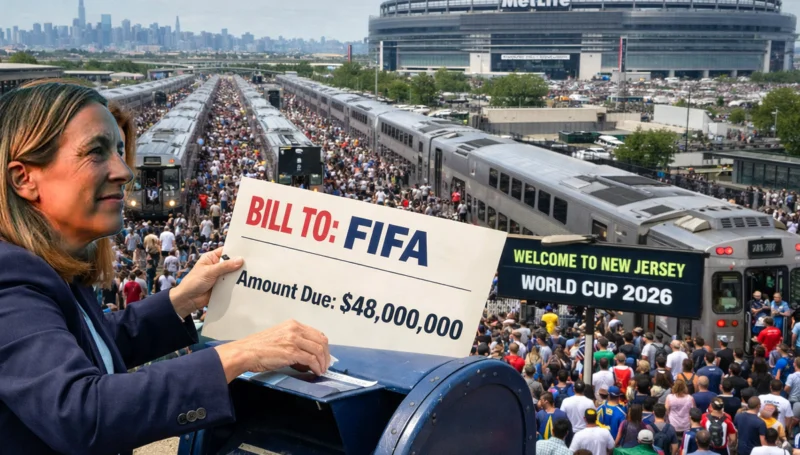
New Jersey spent nearly a decade preparing for the 2026 FIFA World Cup. State leaders, including former New Jersey Governor Phil Murphy promised residents that hosting the world’s largest sporting event would generate billions in economic activity, showcase New Jersey on a global stage, and create opportunities for local businesses. Instead, what New Jerseyans got was a proposal for higher taxes, higher fees, higher train fares, and a growing sense that ordinary residents would once again be asked to foot the bill.
Thatt all changed when Mikie Sherrill took office.
Governor Mikie Sherrill’s support for a package of World Cup-related taxes and surcharges was doomed from the start because it fundamentally contradicted the promises made by Governor Phil Murphy and World Cup organizers for years. New Jersey residents were told the tournament would be an economic windfall. They were not told they would face temporary tax hikes, ride-share surcharges, hotel fees, gambling taxes, and transportation costs that would make attending a match prohibitively expensive.
The proposal itself was breathtaking in scope. State lawmakers backed by the administration considered a 3% sales tax surcharge in the Meadowlands district, pushing the effective sales tax rate to 9.625%. Additional hotel occupancy taxes, ride-share surcharges, and taxes on World Cup-related sports betting revenue were also proposed. While supporters attempted to market these increases as “tourism fees,” the reality is that businesses, workers, and residents would inevitably feel the impact.
The problem wasn’t simply the taxes. The problem was timing.
New Jersey is already one of the highest-taxed states in America. Property taxes remain among the nation’s highest. Utility costs continue to rise. Families are struggling with affordability concerns that dominated the 2025 gubernatorial election. Governor Sherrill herself campaigned on affordability and reducing financial burdens on residents. Supporting a package of new taxes only months into office created a credibility problem that opponents quickly seized upon.
Then came the transportation fiasco.
Nothing better illustrates the failure of planning surrounding the World Cup than the NJ Transit pricing controversy. Reports emerged that train tickets between New York Penn Station and MetLife Stadium could rise from the normal $12.90 fare to as much as $100 to $150 roundtrip during the tournament. Officials argued that NJ Transit faced roughly $48 million in transportation costs and that FIFA should cover the expense. While that argument may have merit, fans were left staring at fare increases of up to 775 percent.
The market’s reaction was immediate and predictable.
Recent reports showed that fewer than six percent of available World Cup train tickets had been sold despite months of planning. Fans simply refused to pay nearly $100 for transportation that normally costs a fraction of that amount. Officials were eventually forced to promote lower-cost shuttle alternatives because demand for the expensive rail option collapsed.
This should not have surprised anyone.
When ticket prices for World Cup matches can already reach hundreds or thousands of dollars, adding inflated transportation costs, expensive parking, hotel surcharges, ride-share fees, and higher taxes sends a clear message: New Jersey is trying to monetize every aspect of the event. That is the exact opposite of what successful host cities do when trying to attract visitors and maximize economic activity.
Perhaps the most damaging aspect of the proposal was the political symbolism. For years, New Jersey leaders sold the World Cup as an opportunity. Suddenly, as the event approached, officials began talking about hundreds of millions in costs that needed to be recovered through taxes and fees. Residents were left wondering whether state leaders had properly planned for the event at all. If hosting the World Cup is such an economic victory, why were emergency tax increases necessary? If billions in economic benefits are expected, why was there a rush to extract additional revenue from visitors and residents before a single match was played?
The answer is simple. The tax plan represented a political miscalculation. It underestimated voter frustration with rising costs and overestimated public willingness to accept new fees under the banner of a global sporting event.
To her credit, Governor Sherrill eventually backed away from the broader tax package as opposition mounted from both Republicans and Democrats. The administration shifted its focus toward tourism initiatives, fan zones, and efforts to drive economic activity rather than imposing new taxes. That pivot was not just politically necessary—it was inevitable.
The World Cup should have been a celebration. Instead, it became a lesson in how quickly public support evaporates when government sees a major event as a revenue source rather than an opportunity. New Jersey residents were promised economic growth, international attention, and long-term benefits. Asking them to pay higher taxes and fees to make it happen was never going to work.
The collapse of the World Cup tax plan wasn’t caused by partisan politics. It failed because New Jerseyans understood a basic truth: if hosting the World Cup is truly a once-in-a-generation opportunity, government shouldn’t need to raise taxes to sell it.