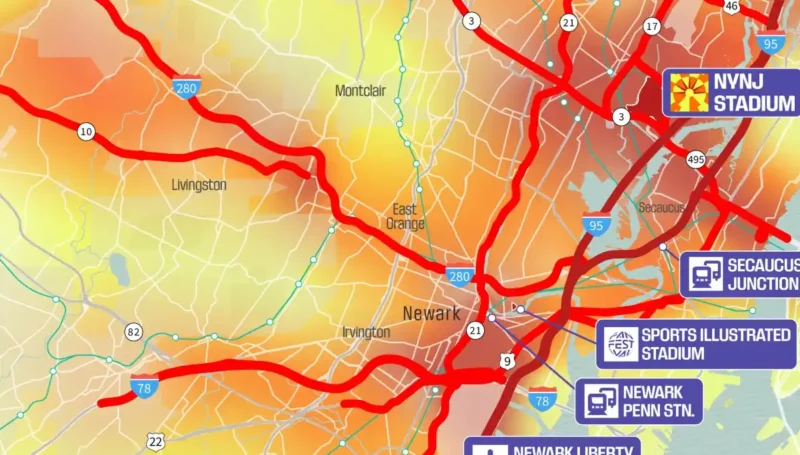
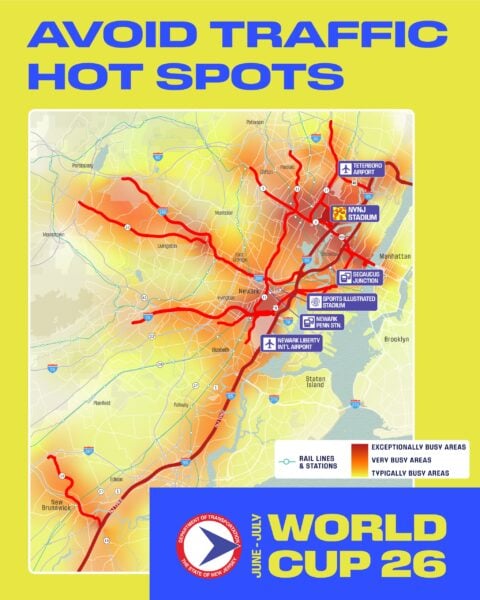
Newark, NJ — New Jersey transportation officials are effectively telling millions of residents to stay off the roads — and, in many cases, work from home — during the 2026 FIFA World Cup, a message that’s drawing growing criticism as a new traffic map paints much of North Jersey in gridlock red.
The New Jersey Department of Transportation’s World Cup guidance urges people to “prepare now” and avoid driving before, during, and after matches, while also encouraging remote work where possible. The goal: reduce local traffic so the region can handle the surge of international visitors expected to rely on transit, roadways, and event access points tied to MetLife Stadium.
But the map itself — showing congestion stretching across highways from Bergen County through Newark and down toward Middlesex County — is reinforcing a harsher interpretation from residents: for weeks, normal movement may simply not be realistic.
A warning that feels bigger than the event
The graphic highlights major corridors including I-95, the New Jersey Turnpike, I-78, I-280, and Route 3 as “exceptionally busy,” with spillover reaching key connectors and local roads. Transit hubs like Secaucus Junction and Newark Penn Station are also flagged, underscoring how both drivers and rail users could feel the strain.
In practical terms, the advisory lands less like targeted planning and more like a regional slowdown strategy — one that leans heavily on residents stepping back from daily routines.
That includes calls for employers to allow work-from-home arrangements during match days, a shift officials frame as necessary to keep the system functioning.
Residents question who the plan serves
The bluntness of the message has triggered pushback online, where many see the guidance as prioritizing visitors over the people who live and work in the region year-round.
Some critics argue the plan boils down to clearing the roads for an influx of fans — many of whom will be spending heavily on tickets, hotels, and transit — while locals are asked to adjust their schedules, commute less, or avoid travel altogether.
Others point out the obvious: for essential workers and those without remote options, “just don’t drive” isn’t a workable solution.
Even among those familiar with North Jersey traffic, the scale stands out. The map doesn’t isolate a stadium zone — it blankets a large portion of the state’s economic core, raising concerns about ripple effects on deliveries, airport access, and daily commuting patterns.
—
Key Points
• NJDOT map shows widespread “exceptionally busy” traffic across North Jersey during World Cup
• Officials encourage residents to avoid driving and work from home during match periods
• Critics say the guidance effectively tells locals to “not go anywhere” for weeks
—
Not just game day traffic
What sets the World Cup apart, officials argue, is duration and volume. Unlike a single sold-out NFL game, the tournament brings repeated, high-attendance events over several weeks, with global travel layered on top of existing demand.
The state’s strategy leans heavily on mass transit, with limited driving access expected near stadium sites. That means pressure shifts outward — onto highways, park-and-ride systems, and surrounding towns.
Still, skepticism remains about how much of that pressure can realistically be absorbed, especially in a region where congestion is already a daily reality.
For many residents, the map doesn’t reveal a new problem — it magnifies an existing one.
What happens next
More detailed traffic management plans are expected as the tournament approaches, including coordination with New York agencies and transit providers. Officials continue to direct residents to review match schedules and plan around peak times.
For now, the message from transportation planners is clear, even if it’s controversial: reduce travel, stay off the roads when possible, and expect delays across much of North Jersey.
Whether that approach proves workable — or simply shifts the burden onto residents — will become clearer as the region moves closer to hosting one of the world’s largest sporting events.