
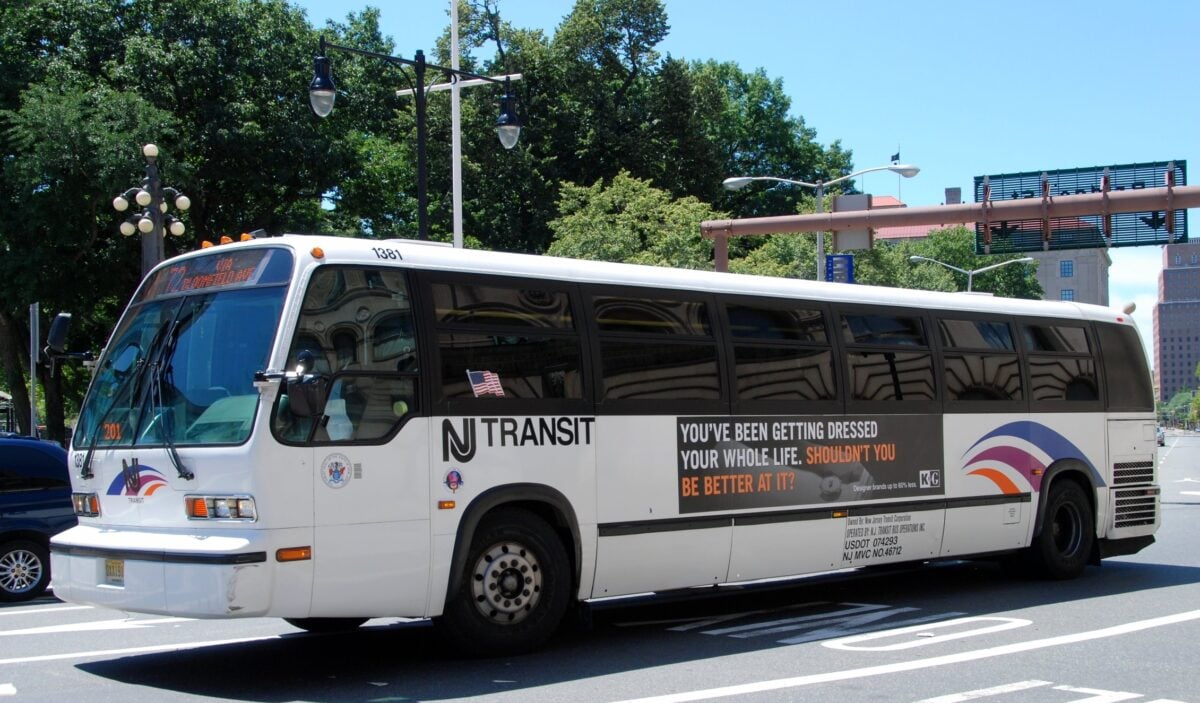
A New Jersey bill advancing in the Assembly would allow cameras mounted on NJ Transit buses to document parking and stopping violations, with fines beginning at $45 and escalating for repeat offenses.
TRENTON, NJ — Drivers who block NJ Transit bus stops, dedicated bus lanes or designated bicycle lanes could eventually receive tickets generated from cameras mounted directly on transit buses under legislation moving through the New Jersey Assembly.
Under that law, non-law-enforcement bus operators, conductors and others working for NJ Transit could soon have the power to issue tickets to residents and non-customers of the service. While Trenton Democrats call this a benefit to the public transit system, opponents call it another revenue opportunity for a failing system that continues to operate at a loss.
Assembly Bill A1545 would require NJ Transit to install and operate what the legislation calls “bus obstruction monitoring systems” on selected buses. Those systems would capture images of vehicles stopped, standing or parked in restricted areas, with citations issued after review by an NJ Transit police officer or a trained and certified corporation employee.
The measure was reported out of committee again on Sept. 17 and remains in the legislative process. It has not yet become law.
Cameras would target three types of violations
Under the bill, the automated systems could be used to document vehicles improperly occupying a dedicated bus lane, bus stop zone or designated bicycle lane.
A covered violation would not include ordinary moving violations. The bill is aimed specifically at vehicles that obstruct transit operations or designated roadway space.
NJ Transit would decide how many buses receive the equipment and where they are deployed, based on factors including operating costs, bus delays, safety, rider accessibility and expected violation frequency.
The legislation would also require buses using the equipment to display signs warning motorists that a bus obstruction monitoring system is in operation.
First ticket would cost $45
The proposed penalty structure starts at $45 for a first offense.
Additional violations within a 12-month period would increase in $45 increments, up to a maximum fine of $135 per offense.
NJ Transit could retain fine revenue necessary to cover the administrative cost of the program. Any revenue remaining after those costs would be directed toward Access Link, the agency’s paratransit service.
The bill specifically prohibits NJ Transit from paying a camera contractor based on how much money the ticketing system generates.
Three unpaid fines could trigger MVC action
The bill also carries consequences for motorists who repeatedly fail to pay.
If an owner or operator has three or more unpaid fines, NJ Transit could notify the New Jersey Motor Vehicle Commission.
The MVC could then suspend the person’s driver’s license or the registration of the vehicle until the outstanding fines are resolved.
If the fines are later paid, dismissed or otherwise disposed of, NJ Transit would be required to notify the MVC.
Drivers would have 30 days to fight a citation
Vehicle owners or operators would have 30 days from the mailing date of a citation to contest it with NJ Transit.
The legislation allows challenges on several grounds, including situations where a local law enforcement agency or parking authority already issued a citation for the same incident.
After NJ Transit issues a final decision, the registered owner would receive instructions either to pay the fine or appeal the decision to New Jersey Superior Court.
Cameras could not use facial recognition
The proposal includes several restrictions on how recorded images could be handled.
Images that do not show a violation would have to be destroyed within 15 days. Images connected to a citation could generally be retained for up to six months or 60 days after final disposition of the citation, whichever is later.
The systems could not use biometric identification, including facial recognition technology.
Recorded images also would not be treated as government records available through normal public-records requests and generally could not be used in unrelated civil or administrative proceedings.
Warning period would come before actual fines
Drivers would not begin receiving tickets immediately after the system launches.
The bill requires NJ Transit to conduct a 180-day public education campaign using bus advertising, online outreach, social media and press events.
For 90 days before actual citations begin, motorists caught by the cameras would receive warning notices instead of fines.
The program would take effect 90 days after enactment if the bill ultimately clears both houses of the Legislature and is signed into law.
A1545 is sponsored by Assemblymen Clinton Calabrese and William Moen Jr., with Assemblyman William Sampson IV and Assemblywoman Linda Carter listed as co-sponsors.
The proposal is part of a broader effort to address delays caused when motorists block transit infrastructure, particularly on congested routes where a single parked vehicle can force buses out of designated lanes or prevent passengers from safely boarding.