

Since becoming governor Jan. 20, Mikie Sherrill has restricted federal immigration activity on state property, signed immigrant-trust and privacy laws, limited masked law enforcement operations and committed millions of dollars to immigration defense while her administration has repeatedly challenged Trump administration policies in court.
TRENTON, NJ — Immigration rights and protections have emerged as a recurring focus of Gov. Mikie Sherrill’s first eight months in office, with New Jersey adopting a series of laws, executive actions and legal strategies aimed at limiting the state’s participation in federal civil immigration enforcement and protecting access to government services for undocumented migrants in the Garden State.
The changes have come quickly.
Sherrill has issued an executive order restricting Immigration and Customs Enforcement operations on nonpublic state property, signed the state’s Immigrant Trust Directive into permanent law, approved privacy restrictions governing information collected by government agencies, signed legislation generally requiring federal officers to uncover their faces and identify themselves, and expanded state-funded legal representation for people facing detention and deportation.
Her administration has also fought the Trump administration over immigration detention facilities, federal demands for personal information, conditions placed on law enforcement grants and a new federal “public charge” policy involving immigrants who use government benefits.
At the same time, the Trump administration has challenged portions of New Jersey’s approach in federal court, arguing that some state policies unlawfully interfere with federal immigration enforcement.
Safe Communities Act came first, but Murphy signed it
Outgoing Gov. Phil Murphy signed the legislation on the morning of Jan. 20, shortly before leaving office. Sherrill was sworn in later that day. He left the new governor with a concrete foundation to continue opposing the Trump administration and championing immigration protections.
The law nevertheless became an important part of immigration policy during Sherrill’s administration because her attorney general was responsible for implementing it.
The Safe Communities Act requires policies governing how schools, health care facilities, shelters, social service offices, correctional facilities and other sensitive locations respond when federal immigration officers seek access to nonpublic areas.
Courthouses are also expressly included in the statute.
Attorney General Jennifer Davenport published the required model policies in June.
The practical effect is more limited than a blanket statewide prohibition against ICE entering every school, hospital or courthouse. The law establishes procedures designed to restrict access to nonpublic areas and limit institutional cooperation with civil immigration enforcement to the fullest extent permitted by state and federal law.
Places of worship are encouraged to follow similar protections, but lie outside the control of government.
Sherrill’s first major immigration order targeted ICE use of state property

Sherrill took her first major unilateral immigration action on Feb. 11 when she signed Executive Order No. 12.
The order prohibits executive-branch departments and agencies from allowing federal immigration officers to enter, access or use nonpublic portions of state property for civil immigration enforcement without a judicial warrant.
It also prevents state property from being voluntarily used as a staging location, processing site or operations base for federal civil immigration enforcement.
That can include state government offices and other facilities controlled by executive agencies.
The distinction between a judicial warrant and an administrative immigration warrant is significant. ICE commonly performs civil immigration enforcement under administrative authority issued within the federal immigration system. Sherrill’s order requires a judicial warrant for access covered by the executive order.
The administration simultaneously created a statewide “Know Your Rights” website and an Attorney General’s Office portal where people can submit photographs, videos and other information about encounters with immigration officers.
Trump administration sued over the state-property order

The U.S. Department of Justice sued New Jersey and Sherrill on Feb. 23, arguing that Executive Order 12 interfered with federal immigration enforcement.
The Justice Department’s lawsuit argued that states cannot obstruct federal officers carrying out immigration law and specifically objected to restrictions affecting arrests in nonpublic areas of state property.
New Jersey defended the order as an exercise of the state’s authority over its own property and resources.
That fight produced a significant ruling Sept. 4 when a federal judge dismissed the federal government’s challenge to Sherrill’s executive order.
The order remains in effect.
Sherrill made the Immigrant Trust Directive state law
One of the largest changes came March 25, when Sherrill signed three immigration-related measures that had been debated in Trenton for months.
The first codified New Jersey’s existing Immigrant Trust Directive into state law.
The directive had previously existed as an Attorney General policy governing how state, county and municipal law enforcement interact with federal civil immigration authorities.
Under the new law, local and state police generally cannot stop, question, search, arrest or detain someone solely because of suspected immigration status or a federal civil immigration violation.
Police are also generally restricted from participating in federal civil immigration operations, giving ICE nonpublic personal information, allowing immigration agents into nonpublic law enforcement facilities or keeping someone jailed beyond the time the person otherwise should be released solely on the basis of a civil immigration detainer.
There are important exceptions.
New Jersey law enforcement can cooperate when presented with judicial warrants and court orders and under certain circumstances involving serious criminal charges, qualifying convictions, final removal orders issued by federal judges and other specified public-safety situations.
The law also prevents state and local agencies from entering or renewing agreements under Section 287(g), the federal program that delegates certain immigration-enforcement powers to participating local law enforcement agencies.
Sherrill described the three March laws as public-safety and constitutional-rights measures when she signed the package on March 25.
Federal officials and critics of so-called sanctuary policies have taken the opposite view, arguing that restrictions on local cooperation make federal immigration operations more difficult and force ICE officers to make arrests elsewhere in communities.
New Jersey moved to stop masked federal officers

The second March law directly addressed the appearance of federal immigration officers.
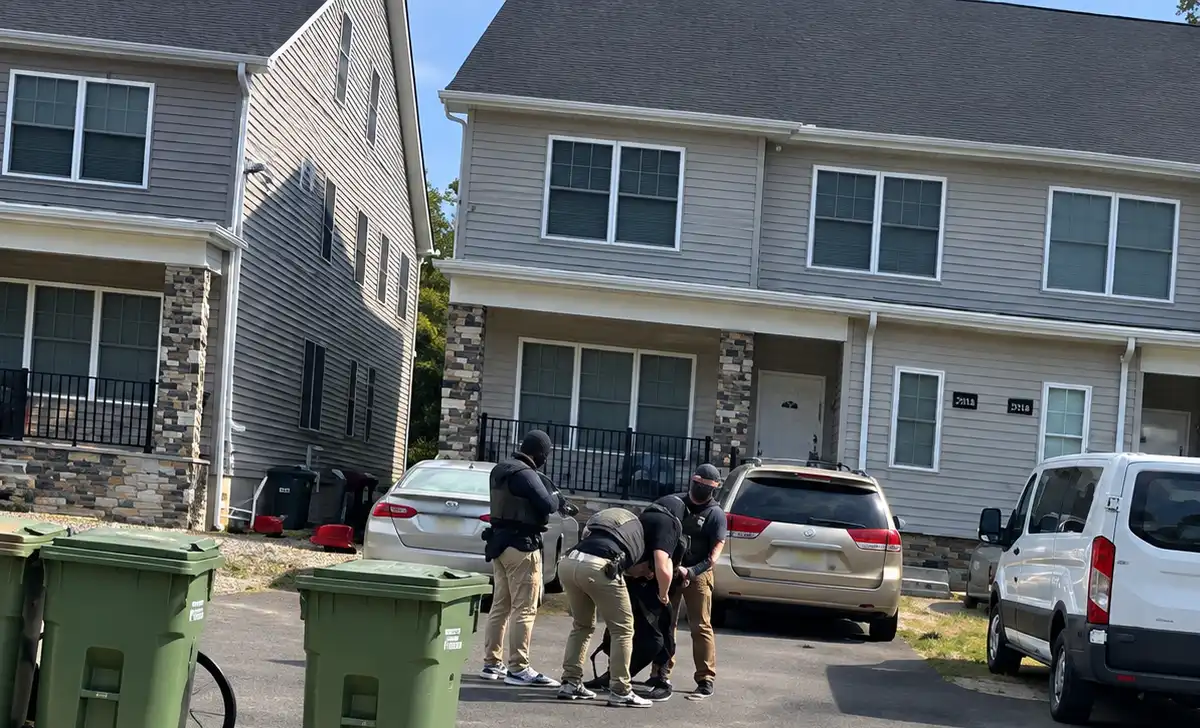
The Law Enforcement Officer Protection Act generally prohibits law enforcement officers operating in New Jersey — including federal officers — from wearing masks or disguises while interacting with the public during official duties.
It also requires officers to provide sufficient identification before arresting or detaining someone.
The law contains exceptions for undercover assignments, tactical operations, officers facing specific retaliation threats, medical masks, respirators and protective equipment needed because of smoke, severe weather, biological agents or chemical hazards.
The Trump administration sued New Jersey over that law in April.
The Justice Department argued that a state cannot regulate the manner in which federal officers perform their duties and said the restrictions could expose officers and their families to harassment, doxing or violence.
New Jersey has defended the law as a transparency and public-safety requirement.
Privacy law restricts collection and sharing of immigration information
The third law Sherrill signed March 25 was the Privacy Protection Act.
It restricts government agencies and certain health care facilities from collecting information including immigration status, citizenship status and place of birth when the information is not necessary to provide a requested service, benefit or program.
It also establishes limitations on how certain personal information can be shared.
The law is significant for immigrants who interact with state and local agencies because information originally collected to obtain a service cannot simply be treated as a ready-made immigration-enforcement database.
Together, the privacy law and Immigrant Trust law substantially expanded statutory protections that had previously depended more heavily on executive and Attorney General policies.
Hospitals and schools received specific ICE protocols

The Safe Communities Act reached another stage in June when Davenport released model policies for sensitive institutions.
Those policies provide guidance for Pre-K-12 schools, health care facilities, shelters, social service offices, correctional facilities and places of worship.
A hospital, for example, can distinguish between areas open to the general public and restricted areas where patient privacy and facility operations allow access to be controlled. Similar concepts apply in schools and shelters.
The law is designed to prevent eligible residents from avoiding medical treatment, school or other services because they fear encountering immigration enforcement.
It does not immunize a person from federal immigration law or prohibit federal officers from operating anywhere near those facilities.
Instead, it governs access to controlled spaces and what covered New Jersey institutions will voluntarily provide or do during civil immigration enforcement.
Sherrill put $20.2 million behind deportation defense
In June, Sherrill and legislative leaders increased funding for New Jersey’s Detention Deportation Defense Initiative by $12 million, bringing total funding to $20.2 million.
The program provides immigration legal services to qualifying low-income New Jersey residents, including people detained in immigration facilities.
Sherrill also launched a Rapid Legal Response Initiative through the Department of Human Services’ Office of New Americans.
According to the June 4 announcement, the initiative is intended to increase the number of lawyers available for emergency immigration cases, including habeas corpus proceedings challenging detention.
The spending represents one of the most direct financial commitments of the Sherrill administration’s immigration policy: state resources are being used to help qualifying residents challenge detention and deportation proceedings.
State sued to stop massive Roxbury ICE detention center
Sherrill and Davenport also went to federal court over ICE’s plan for a new detention facility in Morris County.
On March 20, New Jersey joined Roxbury Township in suing ICE and the Department of Homeland Security over a plan to convert a 470,000-square-foot warehouse on Route 46 into a detention complex capable of holding as many as 1,500 detainees.
The state and township alleged that federal officials failed to comply with environmental, administrative and intergovernmental requirements while moving forward with the project.
The challenge focused heavily on sewage capacity, water infrastructure, environmental effects and the impact of adding a large detention operation to the community.
By late June, DHS had abandoned plans for the Roxbury facility. Sherrill and Davenport attributed that result to the litigation, while federal officials ultimately confirmed the facility would not proceed.
Delaney Hall became another confrontation
The administration has separately challenged operations at Delaney Hall, the privately operated immigration detention facility in Newark.
After Sherrill and other officials sought information about conditions inside the facility, the New Jersey Department of Health attempted to conduct a full health inspection.
The state said inspectors were denied access to significant portions of the building.
On June 2, Davenport sued GEO Group, the private company operating Delaney Hall, seeking a court order allowing health inspectors full access.
That case differs from the state’s lawsuits directly against the Trump administration because GEO Group, rather than the federal government, is the defendant.
The state later opened a civil-rights investigation into practices at the facility and issued investigative subpoenas.
Sherrill has publicly called for Delaney Hall to close.
New Jersey has also gone to court over immigrant benefit information
The administration’s immigration battles have extended beyond arrests and detention.
On Aug. 3, Davenport joined a multistate lawsuit challenging a Trump administration policy involving Temporary Assistance for Needy Families, known in New Jersey as Work First New Jersey.
Federal officials sought greater access to recipient data, including Social Security numbers, addresses and immigration information, with the possibility that information could be shared with agencies including ICE.
The state argued that the federal policy exceeded lawful limits on how TANF information can be collected and shared.
New Jersey’s Work First program was serving more than 24,000 residents as of April.
Driver information became another court fight
Ten days later, New Jersey joined litigation challenging federal demands for a database containing personal information about millions of commercial drivers.
The litigation involves information held through the Commercial Driver’s License Information System, including identifying information, Social Security numbers, licensing records and other data.
Davenport’s office said the administration threatened more than $10 million in federal funding if the records were not produced.
New Jersey joined separate challenges involving the Department of Transportation and Department of Homeland Security.
Federal grants became tied to immigration cooperation
The state has also challenged attempts by the federal government to condition public-safety and homeland-security funding on cooperation with federal immigration policy.
In July, Davenport co-led a multistate lawsuit challenging immigration-related conditions on federal counterterrorism and emergency funding.
New Jersey receives more than $55 million annually through the Homeland Security Grant Program, which supports terrorism prevention, cybersecurity and emergency preparedness.
In August, the state joined another challenge involving immigration-enforcement conditions attached to federal law-enforcement grants, including Byrne Justice Assistance Grants.
The Trump administration’s position has been that jurisdictions receiving federal money should comply with federal immigration priorities. New Jersey and the other states argue Congress did not authorize the administration to impose those conditions.
Public benefits are now part of the immigration fight
The newest major immigration lawsuit came Sept. 14.
Davenport joined 21 other attorneys general challenging the Trump administration’s new “public charge” rule.
The rule expands the discretion immigration officials have to consider an immigrant’s use of government assistance when deciding certain applications for lawful permanent residency.
That can place programs such as Medicaid, food assistance and other public benefits into immigration decisions depending on the circumstances.
New Jersey’s challenge to the public-charge rule argues that the policy could discourage legally eligible immigrant families from obtaining health care or food assistance because they fear jeopardizing future immigration applications.
The federal government views the public-charge provision as part of its authority to determine whether prospective permanent residents are likely to depend on government assistance.
The lawsuit remains pending.
Birthright citizenship litigation continued under Sherrill
Another major immigration case predates Sherrill’s governorship but continued under her administration.
New Jersey had already been leading the multistate challenge to President Donald Trump’s executive order restricting birthright citizenship before Sherrill entered office.
Davenport continued that litigation after becoming attorney general.
The case eventually reached the U.S. Supreme Court, which invalidated the president’s birthright citizenship order in June.
Because the litigation began before Sherrill took office, it is part of her administration’s immigration record but was not a lawsuit initiated by Sherrill.
What New Jersey’s policies actually prohibit
Taken together, the policies stop short of creating a statewide prohibition on ICE operating in New Jersey.
Federal immigration officers continue to make arrests throughout the state.
What Sherrill and the Legislature have done is draw increasingly firm boundaries around when state and local resources can be used to assist those operations.
ICE generally cannot use nonpublic executive-branch state property as an operations base without a judicial warrant. Local police generally cannot serve as civil immigration agents. State agencies face new restrictions on collecting and sharing immigration-related information. Schools, hospitals and other sensitive facilities have policies governing access to nonpublic areas. Federal officers operating in the state are subject to New Jersey’s mask and identification law, although the federal government is challenging that requirement.
The state’s approach has therefore produced an ongoing legal dispute over the boundary between federal supremacy in immigration enforcement and New Jersey’s authority over its own officers, facilities, information and spending.
Eight months into Sherrill’s term, immigration policy is no longer confined to a single executive order or Attorney General directive. It now reaches state property, police cooperation, personal information, detention facilities, schools, hospitals, public benefits, legal representation and multiple federal court cases.