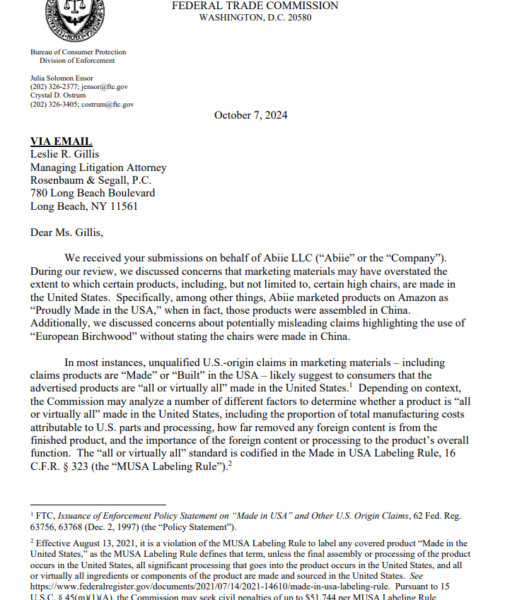
A newly surfaced Federal Trade Commission letter sheds light on how federal regulators pressured children’s product company Abiie LLC to remove marketing claims suggesting its products were made in America and Europe, even though regulators say the products were actually manufactured in China.
The recently surfaced Oct. 7, 2024 letter — addressed to attorney Leslie R. Gillis of Rosenbaum & Segall, P.C. — formally closed the FTC’s investigation after Abiie agreed to revise its advertising and product descriptions.
Abiie LLC designs its baby products, like the Beyond Junior High Chair, in Austin, Texas, but manufactures them in China. The company previously used “Made in USA” labels, but updated its marketing to remove these claims following an FTC compliance review.
Gillis, identified in the letter as Abiie’s legal representative, had submitted materials to the FTC on behalf of the company during the investigation. The agency’s response outlines several concerns investigators raised regarding the company’s online marketing practices and explains why the FTC ultimately decided not to pursue penalties.
At the center of the investigation were Amazon listings and other promotional materials that described Abiie products as “Proudly Made in the USA,” despite regulators stating the products were assembled in China.
The FTC also scrutinized references to “European Birchwood” used in marketing for Abiie’s high chairs. Regulators said the language could have implied European manufacturing origins even though the chairs themselves were made in China.
In the letter, FTC staff attorneys Julia Solomon Ensor and Crystal Ostrum explained the legal standard behind U.S.-origin advertising claims. The agency noted that unqualified phrases such as “Made in USA” or “Built in the USA” generally signal to consumers that products are “all or virtually all” manufactured domestically.
The letter goes further, warning companies that consumers may interpret broad patriotic branding statements as applying to an entire product line — not just individual items.
The Federal Trade Commission (FTC) is charged with preventing deception and unfairness in the marketplace. The FTC Act gives the Commission the power to bring law enforcement actions against false or misleading claims that a product is of U.S. origin. Traditionally, the FTC has required that a product advertised as Made in USA be “all or virtually all” made in the U.S.
In 1997, following consumer research and public comments, the FTC published an Enforcement Policy Statement on U.S. Origin Claims (the Made in USA Policy Statement) to guide marketers who want to make an unqualified Made in USA claim under the “all or virtually all” standard and those who want to make a qualified Made in USA claim. In this context, an “unqualified” claim is a claim without conditions or caveats. A “qualified” claim is a claim with limitations or other explanations.
In August 2021, the FTC finalized the Made in USA Labeling Rule, (the Labeling Rule), available at 16 C.F.R. Part 323. The Labeling Rule codified the “all or virtually all” standard for labels on products. Marketers are now subject to civil penalties if they use an unqualified Made in USA label on a product that is not “all or virtually all” made in the U.S., including in catalogs or online.
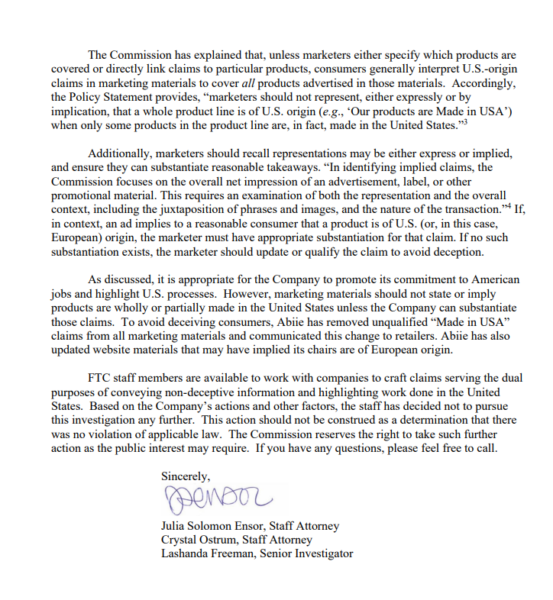
“The Commission has explained that, unless marketers either specify which products are covered or directly link claims to particular products, consumers generally interpret U.S.-origin claims in marketing materials to cover all products advertised in those materials,” the FTC wrote.
Regulators also emphasized that advertising can be considered deceptive even when claims are implied rather than directly stated. The agency said it evaluates the “overall net impression” of advertisements, including wording, images, and presentation.
The FTC acknowledged that Abiie had taken corrective action after discussions with investigators. According to the letter, the company removed unqualified “Made in USA” claims from marketing materials, informed retailers about the changes, and updated website language that may have implied European origin claims.
Because of those changes, FTC staff said they decided not to pursue the investigation further.
Still, the agency included a cautionary statement making clear the closure was not an exoneration for the Texas based baby product company.
“This action should not be construed as a determination that there was no violation of applicable law,” the FTC warned.
The letter also references the FTC’s Made in USA Labeling Rule, which allows the agency to seek civil penalties of up to $51,744 per violation for deceptive origin labeling claims.
The investigation reflects the FTC’s broader enforcement push targeting companies accused of overstating American manufacturing ties in advertising and e-commerce listings.