
Republicans called the MVC breakdown a threat to election integrity, while Democrats said the error did not demonstrate widespread voter fraud or alter election results.
WASHINGTON — A congressional hearing Tuesday exposed a sharp partisan divide over New Jersey’s disclosure that approximately 6,600 people who identified themselves as noncitizens at the Motor Vehicle Commission were nevertheless added to the state’s voter rolls.
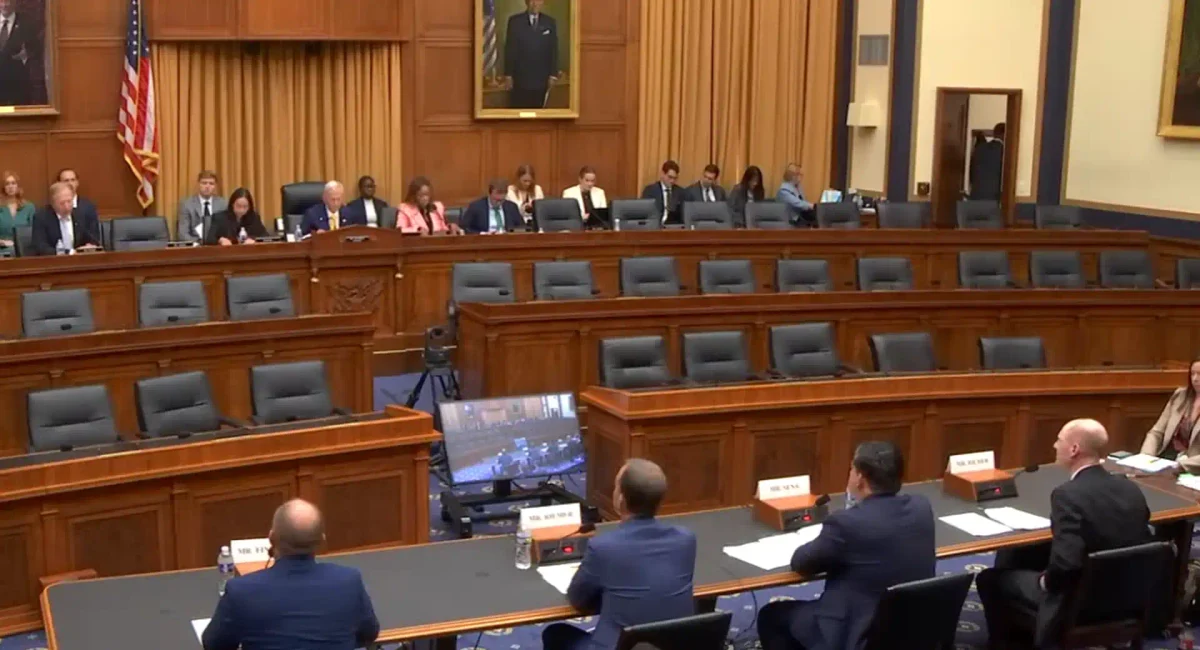
The House Judiciary Subcommittee on Oversight examined how the registrations entered the system, why the problem was not publicly disclosed sooner and whether federal documentary proof-of-citizenship requirements would prevent similar failures.
Republicans described the incident as evidence of structural weaknesses in automatic voter registration. Democrats characterized it as a serious but limited administrative error that did not affect any known election result.
The full Sept. 15 proceeding was broadcast through the House Judiciary Committee’s official hearing stream.
What Happened in New Jersey
Gov. Mikie Sherrill disclosed in July that approximately 6,600 registrations were improperly processed between June 2023 and June 2024.
The affected applicants had reportedly indicated that they were not citizens while obtaining driver’s licenses or identification cards. Their information was nevertheless transmitted through the MVC voter-registration process and added to the rolls.
A preliminary state review found that fewer than 400 people connected with those registrations subsequently cast ballots.
That figure does not necessarily mean every ballot was illegally cast by a noncitizen. State officials have said some people identified during the review may have been eligible citizens, including individuals who became citizens after their MVC transactions or whose records required additional examination.
New Jersey subsequently began canceling registrations tied solely to the processing error while referring other records for further review. The state published official guidance for people affected by the MVC voter-registration error.
Van Drew Questions Whether Error Was Concealed
Rep. Jeff Van Drew, R-N.J., chairman of the Oversight Subcommittee, argued that the registrations represented more than an isolated software malfunction.
Republicans focused heavily on the timeline. The processing problem was corrected in June 2024, but the registrations were not publicly disclosed until July 2026.
Lawmakers questioned whether officials in the administration of former Gov. Phil Murphy knew about the problem and why the affected registrations apparently remained on the rolls after the system settings changed.
Murphy has said through a spokesperson that he had no knowledge of the problem before Sherrill’s announcement. No public evidence presented at the hearing established that Murphy personally knew about it.
Congressional Republicans have requested records from the New Jersey Department of State, the MVC and IDEMIA, the technology vendor involved in the registration system.
IDEMIA has disputed the state’s description of a software failure. The company maintains that its system correctly recorded applicants who answered “yes” to registering and “no” to citizenship and that those answers remained available to state agencies.
New Jersey officials have countered that records identifying an applicant as a noncitizen should never have been transmitted to the Division of Elections.
Witness Calls Registrations “Voter Suppression”
Josh Findlay, an election-policy official affiliated with the America First Policy Institute, argued that any ballot cast by an ineligible voter diminishes the influence of lawful ballots.
“Any vote cast by a noncitizen dilutes the vote of an American citizen,” Findlay said. “That is voter suppression.”
Findlay contended that the New Jersey case demonstrated weaknesses in registration systems that rely on applicants’ attestations and government databases without requiring citizenship documents.
“In some instances, it seems that registering noncitizens to vote may have been a feature of the system and not a glitch,” he said.
Republicans used that argument to support federal legislation requiring documentary proof of citizenship when registering to vote.
Democrats Say Hearing Exaggerated Scope
Rep. Jasmine Crockett, D-Texas, the subcommittee’s ranking member, accused Republicans of using the New Jersey incident to promote a predetermined national election agenda.
“It seems like we continue to have hearings that are offering solutions in search of a problem,” Crockett said.
Democrats did not defend the erroneous registrations but argued that the disclosed numbers remained extremely small compared with New Jersey’s total registered-voter population. They also emphasized that the state had not identified an election in which the questioned ballots changed the outcome.
Rep. Jamie Raskin, D-Md., rejected suggestions that the error demonstrated a coordinated conspiracy.
“A clerical error is not structural corruption, much less is it a criminal conspiracy,” Raskin said.
Raskin credited Sherrill with publicly disclosing the problem, ordering an investigation and initiating corrective action after taking office in 2026.
Shore News Network previously reported that Sherrill blamed the failure on systems operating during the Murphy administration.
Former Republican Election Official Urges Perspective
Stephen Richer, a Cato Institute legal fellow and former Republican recorder of Maricopa County, Arizona, told lawmakers that available evidence shows noncitizen voting remains rare nationally.
“To date, all evidence suggests that noncitizen voting in American elections is a minute phenomenon,” Richer said.
He said professional audits have not found noncitizens approaching even one-tenth of 1% of statewide voter populations.
That argument challenged the broader conclusion that New Jersey’s failure proved widespread intentional fraud. The registration breakdown established that ineligible records passed through state safeguards, but the hearing did not produce evidence that 6,600 people deliberately lied about citizenship or knowingly attempted to vote illegally.
Witnesses Debate Whether 6,600 Is the Full Count
New Jersey attorney Jason Sena questioned whether the state’s review captured every questionable registration.
Sena cited public-records research involving counties including Hudson and Bergen and raised the possibility that similar registrations occurred outside the June 2023-to-June 2024 period identified by the state.
The witness panel also included Justin Riemer, president and CEO of Restoring Integrity and Trust in Elections, who argued that stronger eligibility verification is necessary to protect voter rolls.
The panel said that most of the noncitizen voters in New Jersey voluntarily removed themselves from the voter rolls for fear of losing their citizenship. Illegally registering to vote and illegally voting can harm a person’s path to legal citizenship.
The hearing did not produce a definitive count beyond the approximately 6,600 records disclosed by Sherrill. Determining whether other registrations were affected will depend on the state investigation, requested government records and any broader audit of voter data.
SAVE Act Divides the Two Parties
Much of the hearing became a debate over federal legislation commonly known as the SAVE Act, which would require applicants to provide documentary proof of citizenship when registering for federal elections.
Supporters say attestation alone cannot prevent ineligible registrations and point to New Jersey as evidence that administrative safeguards can fail.
Opponents argue that documentary requirements could make registration more difficult for eligible citizens who lack immediate access to passports, birth certificates or updated records reflecting name changes.
The disagreement reflects the central question left unresolved by the hearing: whether New Jersey experienced a contained administrative failure requiring targeted corrections or exposed a broader weakness demanding nationwide changes.
The state has acknowledged that the registrations should not have occurred. What remains disputed is who knew about the breakdown, why the records remained active after June 2024 and whether the 6,600 registrations represent the full extent of the problem.
The issue has already prompted congressional document demands and renewed scrutiny of New Jersey elections. It also comes as federal prosecutors pursue separate cases involving individuals accused of falsely claiming citizenship and voting—conduct distinct from the MVC processing error, in which applicants reportedly identified themselves as noncitizens.
Shore News Network recently examined that distinction in its coverage of individual noncitizen voting prosecutions and the 6,600 MVC registrations.
More coverage of New Jersey, politics, government and state news is available from Shore News Network.



NJ schools put on notice over bias and harassment protections
