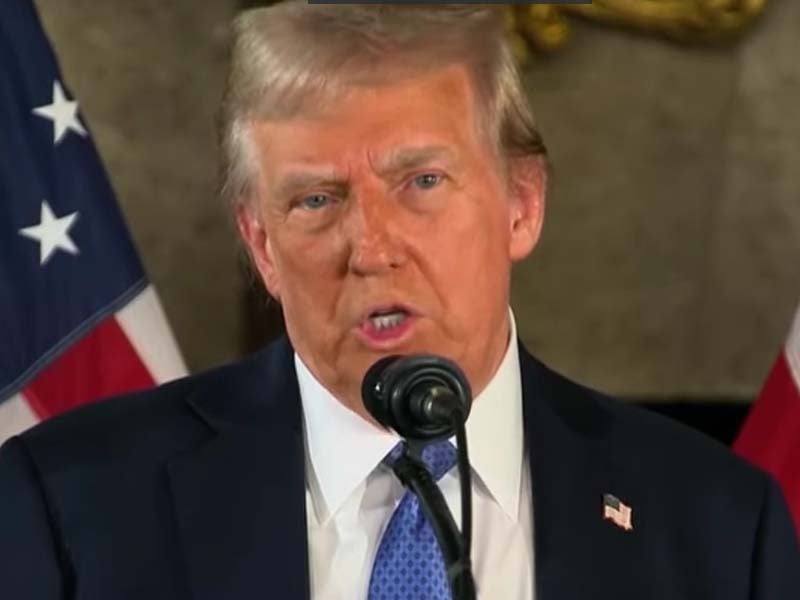
President Donald Trump is proposing a sweeping $163 billion reduction in non-defense discretionary spending for the upcoming fiscal year, while significantly increasing funding for the U.S. military and border security, according to a letter sent Friday to Senate Appropriations Committee Chair Susan Collins.
The proposal outlines a 22.6 percent decrease from current non-defense discretionary spending levels, targeting programs the administration says “serve niche interests” and promote “radical gender and climate ideologies.” The letter also emphasizes shifting responsibilities for many services to state and local governments.
“These recommendations result from a rigorous, line-by-line review of FY 2025 spending,” the letter stated, describing the cuts as a step toward restoring “confidence in America’s fiscal management” and achieving a balanced federal budget over time.
While reducing overall federal outlays in key domestic areas, Trump is recommending a 13 percent increase in defense spending, raising the Department of Defense budget to $1.01 trillion in FY26. The proposal also calls for $175 billion in homeland security funding, with a significant portion of that targeted at border security initiatives.
The administration plans to push at least $325 billion of this increased defense and homeland funding through the reconciliation process, which would allow Congress to bypass filibuster rules and expedite passage.
Budget reflects Trump administration’s focus on military and border enforcement
The White House said the increased resources are necessary to “clean up the mess” left by the previous administration and address what it describes as an “invasion” at the U.S. southern border. By using reconciliation, the administration aims to ensure that these funds are not delayed or blocked during budget negotiations.
The letter indicated that discretionary cuts would exclude programs serving veterans, seniors, and law enforcement, while prioritizing infrastructure investments. It also includes detailed tables outlining specific reductions by agency, which are expected to be incorporated into appropriations bill language in the coming weeks.
At the State Department and USAID, the budget proposes eliminating or consolidating nearly $20 billion in foreign aid programs, including humanitarian relief, refugee assistance, and contributions to international organizations. Programs targeting global health, disaster response, and democratic development are restructured under a new $2.9 billion “America First Opportunity Fund” focused on security and strategic interests.
Funding for global family planning and health programs would be reduced by $6.2 billion, with further cuts of $3.2 billion to humanitarian assistance and peacekeeping missions. The proposal also eliminates U.S. contributions to the UN’s regular budget, the World Health Organization, and climate-focused funds, citing national sovereignty and budget priorities.
In domestic education, the Department of Education would see a $4.5 billion consolidation of K-12 programs into a simplified state grant structure, with full Title I funding preserved. However, the proposal eliminates or reduces funding for TRIO, GEAR UP, Federal Work-Study, and English Language Acquisition, citing redundancy, inefficiency, and ideological concerns.
Health and human services face deep reductions
At the Department of Health and Human Services, the Trump administration proposes eliminating the Low Income Home Energy Assistance Program (LIHEAP), cutting $4 billion, and reducing refugee and unaccompanied minor support programs by nearly $2 billion. Other reductions include $1.7 billion in HRSA program consolidations and $3.6 billion in CDC funding, with a reorientation toward disease surveillance and emergency preparedness.
The Centers for Disease Control and Prevention would undergo a major structural overhaul, with chronic disease prevention, injury control, and global health programs eliminated or merged into new grant formats. The administration argues this shift would allow more flexibility for states while removing what it characterizes as “duplicative” or “ideologically driven” programs.
The budget also reduces funding for the Department of Education’s Office for Civil Rights by 35 percent, explicitly aiming to redirect its focus away from Title IX cases related to transgender students and diversity initiatives. It cuts funding to Howard University, Equity Assistance Centers, and a variety of teacher training and institutional development grants criticized for promoting DEI and social justice education.
Meanwhile, the administration increases funding for charter schools by $60 million and allocates $500 million to the “Make America Healthy Again” initiative, focusing on lifestyle, nutrition, and drug quality reforms.
Trump’s budget reshapes federal priorities by shifting billions from social programs and global aid to defense, border enforcement, and select domestic initiatives.
The letter concluded with a pledge to work with Congress to advance the administration’s budget goals and enact “significant budgetary savings” in FY26.
Trump seeks deep cuts to domestic programs while shifting federal funds toward defense and immigration enforcement.