
NJ Transit has spent more than $25 million on planning and design for its Meadowlands Transitway project, yet World Cup transportation is currently relying on trains, shuttle buses, and temporary traffic management rather than the dedicated transit corridor originally envisioned.
As FIFA World Cup matches get underway at MetLife Stadium, one of New Jersey’s most prominent transportation projects remains unfinished despite years of planning and more than $25 million in approved design spending.
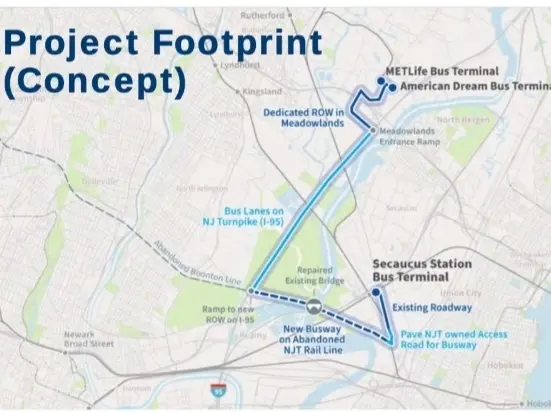
The Secaucus-Meadowlands Transitway was promoted as a major transportation solution intended to improve access to the Meadowlands Sports and Entertainment Complex and increase capacity for large-scale events.
It was specifically created and targeted to be finished in time to transport fans for the 2026 FIFA World Cup. The system augmenting the Meadowlands rail line relies on large articulated buses moving on exclusive roadways and was built to manage the massive influx of spectators descending on the New York/New Jersey host region.
It never happened. So, what’s the scoop?
Today, transportation operations during the tournament have largely depended on existing NJ Transit rail service, shuttle buses, and temporary traffic controls.
More than $25 million approved for planning and design
NJ Transit first advanced the project in 2021 when its Board of Directors approved a $3.54 million contract with engineering firm HNTB for conceptual development and preliminary design work.
Four years later, on Dec. 11, 2025, the Board approved an additional $22.28 million contract extension with HNTB to complete engineering and design work for the segment between Secaucus Junction and Jersey City.
“Today, the NJ Transit Board of Directors approved $22.2 million, plus 10% for contingencies, to complete the engineering and design work for the segment between Secaucus Junction and Jersey City,” the agency announced.
Combined, the two approvals total approximately $25.8 million before contingencies.
Project remained in design phase months before tournament
The timing of the December 2025 approval raises questions about project readiness heading into the World Cup.
According to NJ Transit, the newly approved funding was intended to complete “the next design stage of Phase 2.”
The agency described Phase 2 as involving “design of a dedicated right of way between Secaucus and Jersey City with multiple stops along the route.”
That announcement came roughly six months before World Cup matches began at MetLife Stadium.
The proposed corridor would utilize portions of the former Boonton rail line and the Bergen Arches while creating a dedicated transit route capable of supporting multiple vehicle types.
Transportation system relies on existing infrastructure
Rather than utilizing a completed transitway system, transportation operations for World Cup events have depended heavily on the existing rail network.
Following Tuesday’s match, NJ Transit reported delays tied to congestion and an Amtrak switch issue near Secaucus. The agency also temporarily terminated some New York-bound rail service at Newark stations, requiring passengers to use PATH connections.
Officials have emphasized rail service through Secaucus Junction as the primary transportation option for fans traveling to MetLife Stadium.
Large-scale bus operations and temporary traffic management measures have also been used to move crowds.
Agency continues pursuing long-term vision
NJ Transit has consistently described the transitway as a long-term transportation investment rather than a project limited to World Cup operations.
“The goal of the overall Transitway project is two-fold,” the agency said in its December announcement. “The project increases service capacity to more efficiently move more customers between the Meadowlands Sports and Entertainment Complex and Secaucus Junction Station.”
NJ Transit also said the project would create “a brand-new service corridor in one of the most densely populated areas of North Jersey.”
Key question remains
The central question for policymakers and taxpayers is not whether the transitway remains a worthwhile project.
Instead, it is whether a project associated with improving access to one of the largest sporting events in the world should still have been in the engineering and design phase just months before the tournament began.
That’s the accountability angle supported by NJ Transit’s own records.
Press release published in December
NEWARK, NJ – NJ TRANSIT is taking the next major step in advancing the extension of the Secaucus-Meadowlands Transitway, which, when complete, will provide environmentally friendly transit access between the Meadowlands Sports and Entertainment Complex, Secaucus Junction and Jersey City. Today, the NJ TRANSIT Board of Directors approved $22.2 million, plus 10% for contingencies, to complete the engineering and design work for the segment between Secaucus Junction and Jersey City.
“Advancing this innovative project is an important step in providing the kind of superior service befitting our customers and the Meadowlands Sports and Entertainment Complex, a world-class entertainment venue,” said NJDOT Commissioner and NJ TRANSIT Board Chair Fran O’Connor.
“I am pleased to see the progress on such an important, environmentally friendly public transportation solution. This critical initiative supports New Jersey’s economic growth while providing new transportation options for residents and visitors as they enjoy the state’s premier sports and entertainment destinations,” said NJ TRANSIT President and CEO Kris Kolluri.
During its monthly meeting today, the agency’s Board of Directors approved extending its existing contract with engineering firm HNTB to complete the next design stage of Phase 2—Transitway Jersey City, for no more than $22,283,241.90, plus 10% for contingencies.
Phase I of Transitway kicked off in 2021 when the Board of Directors authorized entering a contract with HNTB for $3,542,944.75 to complete conceptual development and preliminary design. Phase 2 includes design of a dedicated right of way between Secaucus and Jersey City with multiple stops along the route. This right-of-way will accommodate multiple vehicle forms excluding rail. The route will use the former Boonton rail line and the Bergen Arches.
The goal of the overall Transitway project is two-fold. The project increases service capacity to more efficiently move more customers between the Meadowlands Sports and Entertainment Complex and Secaucus Junction Station. Beyond the benefits of Phase 1 of the project, which will increase capacity to some of the world’s largest events at MetLife Stadium, Phase 2 creates a brand-new service corridor in one of the most densely populated areas of North Jersey through the adaptive reuse of existing right-of-way owned by NJ TRANSIT.
As part of the overall project, transit modes considered as a part of this work shall be configured such that they are capable of either being implemented with zero emission vehicles or be readily transitioned to zero emission vehicles in the future, with the capability of being scalable to fully autonomous vehicle operation as demonstrated advances in the industry allow.