JACKSON TOWNSHIP, NJ – Hours after the Cheder School opened at the former McAuliffe Middle School on Wednesday, an application for 148 high-density town homes was heard before the Jackson Zoning Board. There are $3.5 million in owed back taxes on the property, but the developer wants to push forward and ask the township to build a project that is not allowed to be built there under township zoning laws.
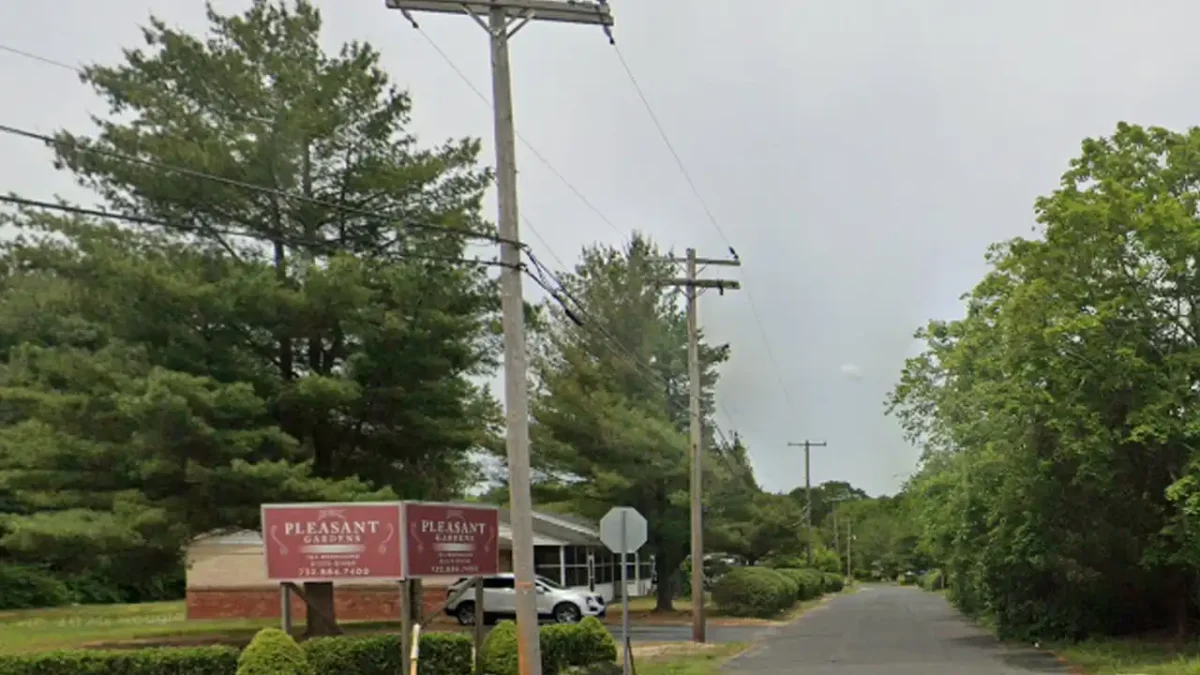
The proposed redevelopment of a partially built residential project at Pleasant Gardens on South Hope Chapel Road generated significant scrutiny from the Jackson Township Zoning Board, particularly over density, the use of townhouses, a roughly $3.5 million property-tax delinquency and the applicant’s repeated references to development approvals dating to the 1970s.
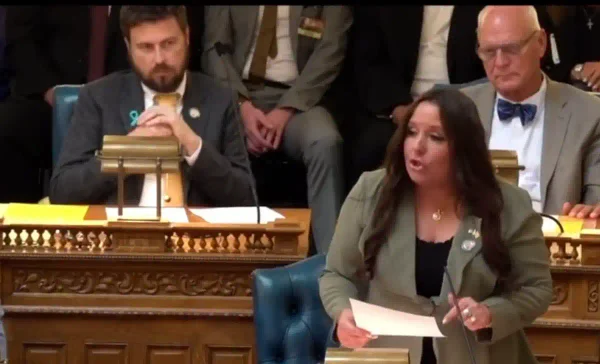
Earlier in the day, Jackson council candidates Brian McCarron and John Pejoski, who are running with Interim Mayor Jen Kuhn said they were ready to fight the project. However, neither the men nor the interim mayor showed up to speak against the project at the meeting.
“The last thing Jackson needs is more reckless overdevelopment,” they said in a Facebook video earlier in the day. “That is why our team is taking action to STOP a proposal before the Zoning Board tomorrow night to build another new high density development in town.”
Several residents spoke against the application, but Pojoski and McCarron did not take to the lectern to speak.

Next hearing scheduled after the election
In fact, no vote was taken. After hearing extensive questions from board members and residents, the applicant asked that the hearing be carried so its professionals could address the concerns and potentially modify the proposal.
That next hearing was moved to after the November election and will most likely be approved at that time.
The application is scheduled to return before the board on December 2, 2026, without additional notice to surrounding property owners.
What the Developer Wants to Build
The property is Block 20901, Lot 3, a roughly 17.6-acre tract along South Hope Chapel Road near West Veterans Highway. It was originally approved in 1971 and again in 1976 for a 148-unit multifamily development, but only 28 units were ultimately constructed. Those 28 individually owned residences remain today.
The new applicant is a contract purchaser rather than the current property owner. Details of the ownership were made vague during testimony.
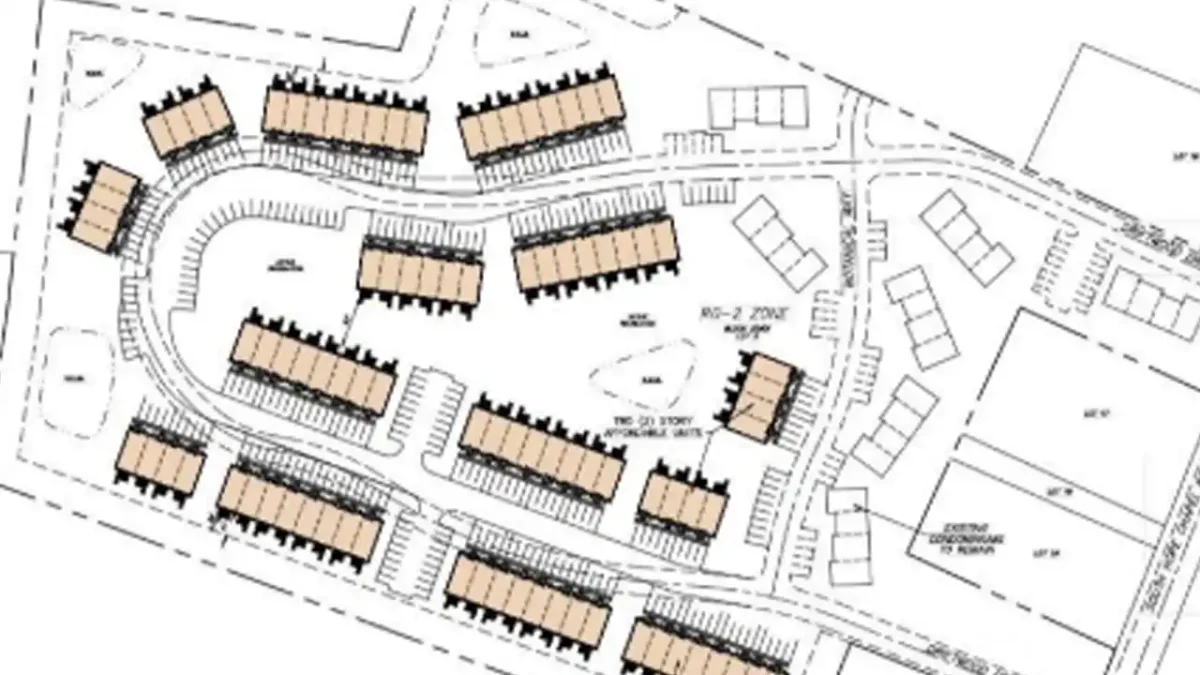
It initially presented a plan for 98 new residences — 82 market-rate townhomes and 16 affordable apartment units — in addition to the existing 28 homes. That would produce 126 total residences on the tract.
The affordable-housing calculation became a moving issue during the hearing. The applicant ultimately acknowledged that it would comply with a 20-percent requirement based on the total number of new units, meaning the market-rate/affordable split could change while the proposed total remains 98 new units.
The proposed development would use a loop roadway roughly following the old development plan, with two accesses to South Hope Chapel Road. The applicant said roads, parking, stormwater facilities, landscaping, lighting and recreational areas would be privately maintained through an HOA rather than turned over to Jackson Township.
The developer also proposes upgrading portions of the aging existing development, including pavement and parking areas, and has discussed integrating the existing residents into the amenities and potentially the HOA structure of the completed development.
But the application before the board was deliberately bifurcated. The applicant was asking first for permission for the use and density. It had not yet submitted a complete site plan. Had the variances been approved, it would subsequently have returned for preliminary and final major site-plan approval.
Why Isn’t the Proposed Development Already Allowed?
This was probably the most important issue of the night.
The property is currently in Jackson’s RG-2 zone. Under the current zoning discussed at the hearing, the maximum density is three units per acre. Market-rate townhouses are also not a permitted use.
The board made the distinction explicit:
“The market units are not permitted to be townhouse units.”
Affordable multifamily housing can be permitted under the ordinance, but market-rate townhouses cannot. That is why the applicant is seeking a D(1) use variance. It also needs a density variance to increase the permitted density from three units per acre to as much as eight.
The numerical difference is substantial.
Under the present zoning, testimony indicated the 17.6-acre tract could accommodate approximately 52 total units at three units per acre. Because 28 units already exist, that translates to roughly 24 additional units if the existing development remains.
The applicant wants 98 new units instead.
That means 126 total units after adding the existing 28. The board specifically clarified those numbers during the hearing.
One resident later distilled the issue during questioning, and the applicant’s planner confirmed that the current three-unit-per-acre density would produce a maximum of approximately 52 units, including the 28 already there.
So this isn’t a case in which the developer merely needs routine site-plan approval. The developer wants to greatly exceed what is allowed on the property and change the original intent of the 1971 approvals.
The applicant is asking the Zoning Board to authorize both a housing type and a density that the existing ordinance does not permit on this property.
The 50-Year-Old Approval — Why Doesn’t It Control Today?
This became another central point because the applicant repeatedly discussed the property’s unusual history.
The site was approved approximately 50 years ago for 148 units at a density of approximately 8.4 units per acre. Only 28 were built. The applicant is now proposing fewer total units — 126 — and used that history as part of its planning argument for why approximately eight units per acre is appropriate.
But the old approval does not give today’s developer a right to finish building the remaining units. That approval has long since expired.
Board professionals went out of their way to establish that distinction.
When asked directly whether the old approvals remained operative, the answer was that the approvals had expired and, importantly, the zoning governing the property had changed since the 1970s.
A board member then summarized the point:
“That 8.4 doesn’t exist anymore. We’re now RG2 and that’s what it is.”
The applicant agreed that it was not relying upon the old approvals as a legal entitlement.
That distinction matters enormously.
The 1971/1976 approvals can be used as evidence of the site’s development history and existing character. They do not automatically grandfather another roughly 120 units of construction half a century later.
The current application therefore has to satisfy today’s zoning requirements or obtain variances from them.
What About the “50-Year-Old Certification”?
There are actually two different concepts being discussed, and they should not be conflated.
The first is the old Jackson development approval. According to the testimony, that approval has expired and the zoning subsequently changed.
The second is Pinelands approval.
The property is within the Pinelands, and the applicant acknowledged that a new Certificate of Filing will be required before it can return for site-plan approval if it receives the zoning variances.
During public questioning, the applicant’s planner testified that current Pinelands Certificates of Filing are valid for approximately five years under recently adopted regulations. The applicant has not yet sought one because this is a bifurcated application — it wants to know whether Jackson will grant the use and density variances before spending resources pursuing the other approvals.
So a 1970s development approval should not be described as a currently valid “50-year-old certification.” The hearing record supports the opposite conclusion: the old municipal approvals have expired, current RG-2 zoning governs the property, and a new Pinelands Certificate of Filing would be required as the development process advances.
The Developer’s Argument: Why Eight Units Per Acre?
The applicant’s case essentially rests on the proposition that this is an unusual property where strict application of the present RG-2 standards doesn’t make planning sense.
Its planner argued that the property has no wetlands, flood-hazard areas or other environmental constraints; that it already contains multifamily development; that another multifamily development exists immediately to the north; and that concentrating residences in townhouses could actually produce more open space and less building coverage than a conventional subdivision of large single-family homes.
The planner also argued that private roads and infrastructure would mean less maintenance expense for Jackson taxpayers.
And then there is the economic argument.
The current owner reportedly owes approximately $3.5 million in municipal property taxes. The applicant’s position was essentially that the property has languished for decades because its current development potential doesn’t economically justify acquiring the property, satisfying the tax liability and completing a project.
That argument did not appear to persuade some board members.
One board member bluntly told the applicant that financial considerations are “shaky ground when you come to a zoning board,” emphasizing that the board’s responsibility is land-use planning rather than guaranteeing a developer sufficient profitability.
That may be one of the most consequential exchanges of the hearing.
The $3.5 Million Tax Problem
Before substantive testimony even began, the board put approximately $3.5 million in delinquent municipal property taxes on the record.
The applicant maintained that unpaid taxes are not a checklist requirement preventing the Zoning Board from hearing this particular variance application. The applicant’s attorney argued that preventing an applicant from appearing before the board because taxes were unpaid could implicate due-process concerns.
More importantly, the applicant isn’t yet the delinquent taxpayer. It is the contract purchaser. That makes the entire application tricky for both the township and the applicant.
Its position is essentially: it does not want to purchase the property, satisfy millions of dollars in liabilities and then discover that Jackson will not permit a development dense enough to make the transaction viable.
They are essentially holding the township hostage over the delinquent $3.5 million tax bill, saying they will pay the taxes and purchase the property, but only if the town is willing to play ball.
Town officials do not seem to want to play ball back and file a $3.5 million lein on the property or even seize the property to satisfy the owed back taxes, which it then can convert into open space.
That produced skepticism because the financial burden attached to acquiring the property is not necessarily a zoning hardship associated with the land itself.
A Major Board Concern: Is This Effectively Rezoning One Property?
One of the sharpest exchanges concerned the enormous difference between the ordinance and the requested density.
The board asked whether Jackson’s 2025 Master Plan identifies eight units per acre as appropriate for this site.
The applicant’s planner answered:
“Not to my knowledge.”
That led directly to the question of whether granting the variance would effectively amount to rezoning this particular 17-acre property rather than granting an ordinary variance.
The applicant countered that the parcel represents only a small portion of the overall RG-2 zone and therefore, in its planner’s opinion, the variance would not constitute rezoning.
Another exchange captured the board’s broader concern: Jackson allows higher-density development elsewhere, but, as one participant observed, “Just not on this property.”
That is potentially the fundamental land-use question the applicant will have to overcome in December: why should the Zoning Board permit approximately eight units per acre when the governing ordinance permits three?
Environmental Questions and the Pinelands
Environmental issues also surfaced.
The applicant testified that there are no wetlands, wetland buffers or flood-hazard areas on the tract. However, the property lies within the Pinelands Regional Growth area.
Adam Haidi of the Jackson’s Environmental Commission questioned the applicant’s planner about how current environmental conditions could simply be equated with conditions existing when the project was approved in 1971.
The planner said the property remains forested upland and asserted that its soils and vegetation had not materially changed over the period.
Haidi responded:
“As a biologist that’s just not true.”
The applicant has not yet obtained its Pinelands Certificate of Filing, so the Pinelands review remains ahead if the zoning application advances.
Concerns About Existing Residents
The 28 families already living within the old development were another major consideration.
Board members questioned what happens to their quality of life when a development that has remained largely unfinished and quiet for decades suddenly receives nearly 100 additional residences.
Questions included whether existing residents would become members of a new HOA, whether the old and new associations could legally be combined, who would control the association, whether existing owners would gain access to new recreational amenities and what physical improvements would be made to their portion of the property.
Those issues were not fully resolved at this stage because the applicant has not yet reached site-plan review.
There was also factual pushback from a resident regarding the applicant’s description of surrounding properties. One resident told the planner that addresses he had been characterizing as businesses were actually residences and that nearby housing he was using for comparison consisted of smaller retirement-community residences rather than the proposed townhouses.
The planner apologized for incorrectly identifying the properties.
Another Problem: The Board Didn’t Have the Same Plans
A procedural issue emerged when board professionals discovered confusion over an updated variance plan.
The applicant said updated plans containing additional dimensions had been provided, but discussion revealed discrepancies over when electronic copies were distributed and whether everyone actually possessed the revised version.
One participant summed up the frustration:
“It always seems we have version control problems.”
That became more important because a board professional said the drawings before him lacked enough dimensional information to determine whether portions of the conceptual layout could actually satisfy Residential Site Improvement Standards.
Since this is a bifurcated application, those detailed engineering questions ordinarily come later. Nevertheless, the board appeared concerned about granting a substantial density and use variance without sufficient confidence that the conceptual development could actually work.
The Key Conflict
The hearing can ultimately be reduced to two competing positions.
The developer says this is a peculiar, half-built 1970s development that has sat unfinished for decades. It already contains attached housing, sits near other multifamily and commercial development, has infrastructure remnants from the old project, has no identified major environmental constraints and carries millions of dollars in unpaid taxes. The applicant says allowing a modern townhouse project at roughly the historical density will finally complete and rehabilitate the property.
The skeptical view from the board is much simpler: the current ordinance allows roughly three units per acre, the property can still be developed under that ordinance, and the applicant’s need to make the acquisition financially worthwhile does not itself establish a land-use justification for increasing the permitted density to approximately eight units per acre.
The applicant itself conceded that the old approvals are history, not an existing development right.
What Happened? There Was No Denial
This point is important for reporting the meeting accurately.
The Zoning Board did not deny the application.
It did not approve it either.
After roughly two hours of discussion and questioning, the board took a ten-minute break. When the meeting resumed, the applicant’s attorney asked to carry the application because of the comments from the board and public.
The stated purpose was to address the issues and potentially modify the plans. The applicant’s team said it would need at least a month to make revisions and then allow township professionals time to review them.
The hearing was carried to December 2.
What’s Next?
The applicant now has an opportunity to rethink the project before returning.
The most important thing to watch will be whether the developer reduces the requested density or substantially changes the layout. The board’s questioning strongly suggests that simply returning with the identical proposal and arguing that the property was once approved at 8.4 units per acre may not resolve the board’s concerns.
The applicant could also provide stronger proofs addressing why this particular property is uniquely suitable for townhouses and approximately eight units per acre, demonstrate that the conceptual layout can satisfy applicable site standards, clarify the affordable-housing mix, resolve questions involving the existing HOA and residents, and better distinguish legitimate land-use justifications from the economics of paying the property’s delinquent taxes.
If variances are ultimately granted, that still would not authorize construction. The applicant would have to return with the detailed preliminary and final major site-plan application contemplated by the bifurcated process and pursue required outside-agency approvals, including Pinelands review.
For residents, the critical date is December 2, 2026. The board specifically announced that the matter was being carried to that date and that no additional mailed notice would be provided to homeowners who received notice of the current hearing.