Toms River Taxpayers Foot Growing Bill as School Board Funnels Millions to Lakewood Busing Network
As local taxpayers grapple with rising school costs and shrinking state aid, the Toms River Regional School District is sending millions of dollars each year to a Lakewood-based transportation network—raising serious questions about oversight, priorities, and long-term sustainability.
For the third consecutive year, the district has partnered with the Lakewood Student Transportation Authority (LSTA) to bus private school students—many of whom travel from Toms River to Lakewood-area schools. What began as a workaround has quickly ballooned into a multi-million-dollar obligation, with costs now estimated to exceed $7 million annually, roughly doubling in just a few years.
This week, the Toms River School Board, led by Ocean County Deputy Clerk Ashley Lamb, voted to continue their contract with the Lakewood-based board. Instead of the state-mandated busing funds going to Toms River residents directly, under the agreement, the money goes to the LSTA, which then disperses the money to private bus companies like Jay’s Bus Service.
Outsourcing While Owning a Bus Fleet
The arrangement has drawn scrutiny because Toms River already operates its own bus fleet for public school students. Instead of expanding that system, the district has opted to outsource transportation for private school students to LSTA—a nonprofit designed to handle Lakewood’s massive private school population.
Critics argue the move effectively outsources taxpayer dollars to a separate municipality’s infrastructure, even as Toms River faces its own financial strain. Others argue that the agreement sends money to private school bus companies with reputations and criticism for unsafe practices, some under investigation by the state.
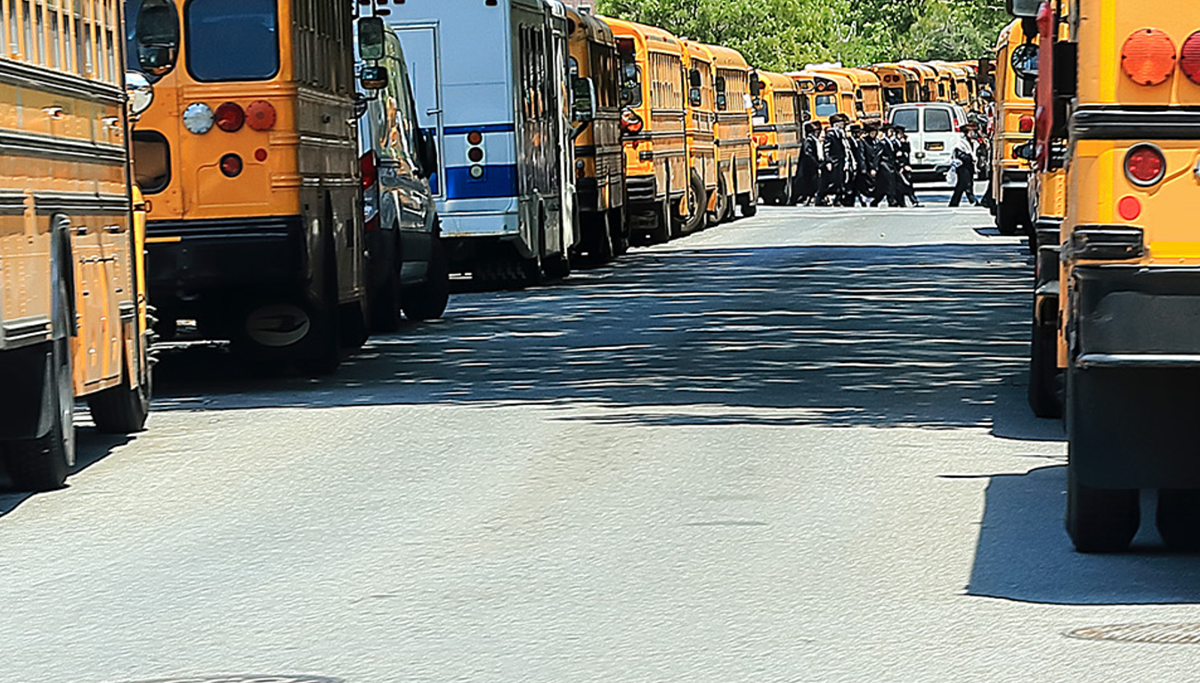
Instead of Toms River Regional School buses and drivers, streets are clogged with multiple buses, often operating the same routes because of the required gender segregation required for Orthodox Jewish customs.
District officials point to state law requiring transportation (or aid-in-lieu payments) for nonpublic students. But the decision to rely heavily on LSTA—rather than developing internal routes—has raised concerns about whether the district is ceding control over a rapidly growing expense category and the township and district lose control of managing safety and bus routes under the arrangement. The state law requires the school board to pay for busing, but does not require the district to send the money to an out-of-town consortium, but to the individual families who need the transportation.
Very little is known about the LSTA. According to what is known, the LSTA is run by Executive Director Avraham Krawiec and Assistant Director Shlomo Pichey. The quasi-public consortium was specifically established by state legislation to manage transportation for the tens of thousands of nonpublic school students in the region.
Financial records show the Lakewood Student Transportation Authority (LSTA) is operating with significant structural deficits despite handling tens of millions in public and program revenue. In 2022, the nonprofit reported $28.5 million in revenue but $30.8 million in expenses, resulting in a $2.35 million annual loss. More concerning, the organization carried $12.6 million in liabilities against just $3.7 million in assets, resulting in negative net assets of nearly $9 million.
The vast majority of its revenue—over 95%—comes from program services, meaning taxpayer-funded transportation contracts like those from Toms River and Jackson are its financial backbone. While executive compensation topped $400,000 combined for top officials, the agency’s overall balance sheet raises red flags about long-term sustainability and whether local districts are funneling money into a system already operating deep in the red.
No records are available online for the authority since its 2022 filing. Director Avraham Krawiec was paid $257,028 and Assistant Director Shlomo Pichey earned $113,539, according to the organization’s 2022 tax filings. An IRS non-profit tax return search showed their last filing in 2022.
Rapid Growth, Rising Costs
The surge in transportation demand is tied to a growing number of private school students living in Toms River, many from Orthodox Jewish families relocating near the Lakewood border.
Estimates suggest thousands of Toms River students are now transported through LSTA, with numbers increasing each year. That growth has directly translated into higher costs—costs that are ultimately borne by local taxpayers.
Meanwhile, the district’s overall budget has climbed significantly, rising by roughly $40 million over the past three years, even as state funding has declined. The result: increasing reliance on local property taxes.
Board Leadership Under Pressure
The issue now sits squarely in front of Board of Education President Ashley Lamb, who was recently hired as a deputy clerk with Ocean County, isupported the plan to continue with the LSTA.
Residents and watchdogs are beginning to ask:
- How high will these transportation costs climb?
- Why is a district with its own buses relying so heavily on an external system?
- And what safeguards are in place to ensure accountability for millions in taxpayer funds once they reach the LSTA?
So far, clear long-term answers have been limited.
Who Benefits?
The LSTA primarily serves Orthodox Jewish private school students, with the majority attending Lakewood-area yeshivas and other nonpublic institutions. While the service fulfills a legal obligation, critics argue the scale of the arrangement has created a system where public funds are increasingly directed outside the district. The LSTA does not cover private school students from other religious schools such as RBC, Donovan Catholic or other Christian academies. Gender segregation has also been a source of public contention and rising costs. The gender segregation issue is also facing legal and civil rights questions from residents who question the redundancy in routes and additional school bus traffic in residential neighborhoods.
A Growing Flashpoint
The Toms River–Lakewood transportation partnership is quickly becoming one of the most contentious fiscal issues facing the district. With costs rising, enrollment patterns shifting, and taxpayers already feeling the burden, the question is no longer whether the system works—but whether it is sustainable.
For now, Toms River continues to write checks to a Lakewood-based authority, even as its own financial challenges deepen—leaving many to wonder how long the current model can last.