
New Jersey – Motion pictures were invented in New Jersey and the first commercial movie studio was built in New Jersey. Then the entire industry moved to Hollywood.
Now, it’s coming back.
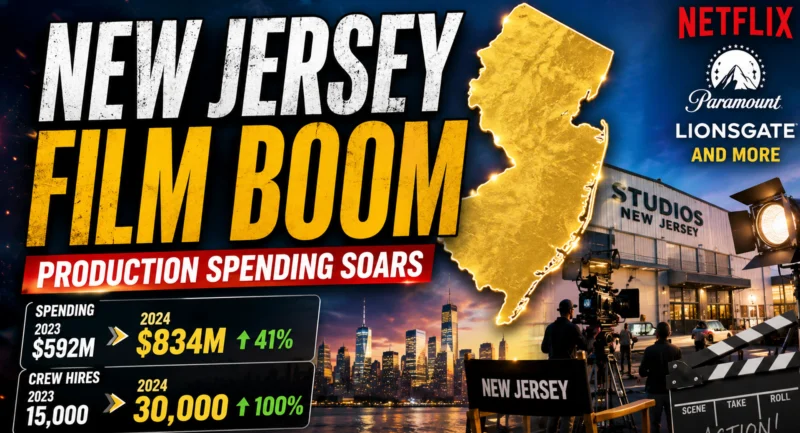
While film and television production has slowed in many parts of the country, New Jersey is experiencing a boom unlike anything seen in decades, attracting billions of dollars in studio investments from companies including Netflix, Paramount, Lionsgate and other major players in the entertainment industry.
According to a report by Cheddar, production spending in New Jersey jumped from $592 million in 2023 to $834 million in 2024, a 41 percent increase. During the same period, crew hires doubled from approximately 15,000 to 30,000 workers.
“Less than a month ago, The Hollywood Reporter had a big article and the headline was production is down across the country except New Jersey. So, we’re booming,” one industry official said in the report.
The birthplace of American filmmaking
Long before Hollywood became synonymous with the movie business, New Jersey played a central role in the birth of American cinema.
The report notes that Thomas Edison patented the first motion picture camera while living in West Orange in 1891 before building the world’s first movie studio, known as the Black Maria.
“The filmmakers back at the turn of the last century said, ‘I’m not paying a tax.’ So they ran. And when they hit the Pacific Ocean, that was the furthest they could get away from Edison,” one official explained. “There’s an irony, right, that taxes drove filmmakers away and tax incentives are bringing them back again. So we’ve come full circle.”
The report also highlights New Jersey’s long history as a filming location, noting that scenes from The Godfather were filmed at Liberty State Park, while the Bob Dylan biopic A Complete Unknown used New Jersey for roughly 95 percent of its production. Steven Spielberg’s Disclosure Day also relied on New Jersey locations, while The Sopranos helped introduce audiences around the world to the state’s identity.
Tax incentives fuel rapid expansion
Industry leaders interviewed by Cheddar credited the state’s film tax incentive program with helping reverse years of declining production.
Governor Phil Murphy reinstated New Jersey’s film tax credits in 2018 after the program had been dormant since 2010. According to the report, qualified production spending increased from approximately $67 million in 2017 to $834 million in 2024, and the incentive program has since been extended through 2049.
“Tax incentives are the door opener,” one official said. “But it’s all the other things that we talk about—the experienced crew, the variety of locations and knowing the infrastructure is there. That’s why you start attracting business to come out here.”
The New Jersey Film and Television Commission also provides location assistance, permitting guidance, crew databases and production support to filmmakers considering the state.
Officials said the commission has expanded its “film-ready” municipality program from just 22 certified communities two years ago to 65 today, with a goal of reaching 90 municipalities by the end of the year.
Studios are investing for the long term
One of the busiest production facilities in the region is 10 Basin Studios in Kearny, an 89,000-square-foot complex that includes sound stages, production offices, carpentry shops, wardrobe storage and set construction facilities.
The studio currently hosts the CBS series Sertino and has previously welcomed productions including Jennifer Lopez’s Kiss of the Spider Woman and The Rip, starring Ben Affleck and Matt Damon.
The report explains that modern sound stages require millions of dollars in specialized construction, including reinforced roofing, soundproof HVAC systems, high-capacity electrical service and custom-built flooring capable of supporting large productions.
Massive 1888 Studios taking shape in Bayonne
Perhaps the largest project underway is 1888 Studios, a 1.6-million-square-foot production campus rising on a former refinery site in Bayonne.
Developers envision 23 sound stages ranging from 18,000 to 60,000 square feet, more than 340,000 square feet of mill space, parking for hundreds of production trucks and a unique 20-acre water backlot capable of supporting waterfront filming.
The project received a $400 million Aspire tax credit award from the New Jersey Economic Development Authority, while Bayonne issued a $65 million bond to support redevelopment of the site. According to the report, Paramount has already signed a minimum 10-year lease covering more than 285,000 square feet, making it the campus’s anchor tenant.
According to Variety, the studio is expected to begin operations during the fourth quarter of 2028.
Industry sees cooperation, not competition
Rather than viewing Netflix, Lionsgate and Paramount as competitors, developers interviewed in the report described the investments as complementary pieces of a much larger ecosystem.
“It’s very much a rising tide lifts all boats,” one executive said, noting that New Jersey already has the workforce and creative talent but has historically lacked the studio infrastructure needed to support sustained production.
The report also explores how artificial intelligence may affect filmmaking, with studio executives arguing AI is more likely to increase demand for controlled soundstage environments than replace traditional productions.
“The technology is really going to become supplementary to the physical capturing of human beings on screen,” one executive said. “It’s never going to remove that human touch element.”
By 2026, New Jersey is projected to become the nation’s third-largest state for film and television production, trailing only New York and Los Angeles (California), according to the report. Some industry leaders reject the label “Hollywood East,” arguing instead that Hollywood itself grew from innovations pioneered in New Jersey.
“You will never ever hear me say New Jersey is Hollywood East,” one official said. “Hollywood is New Jersey West.”