
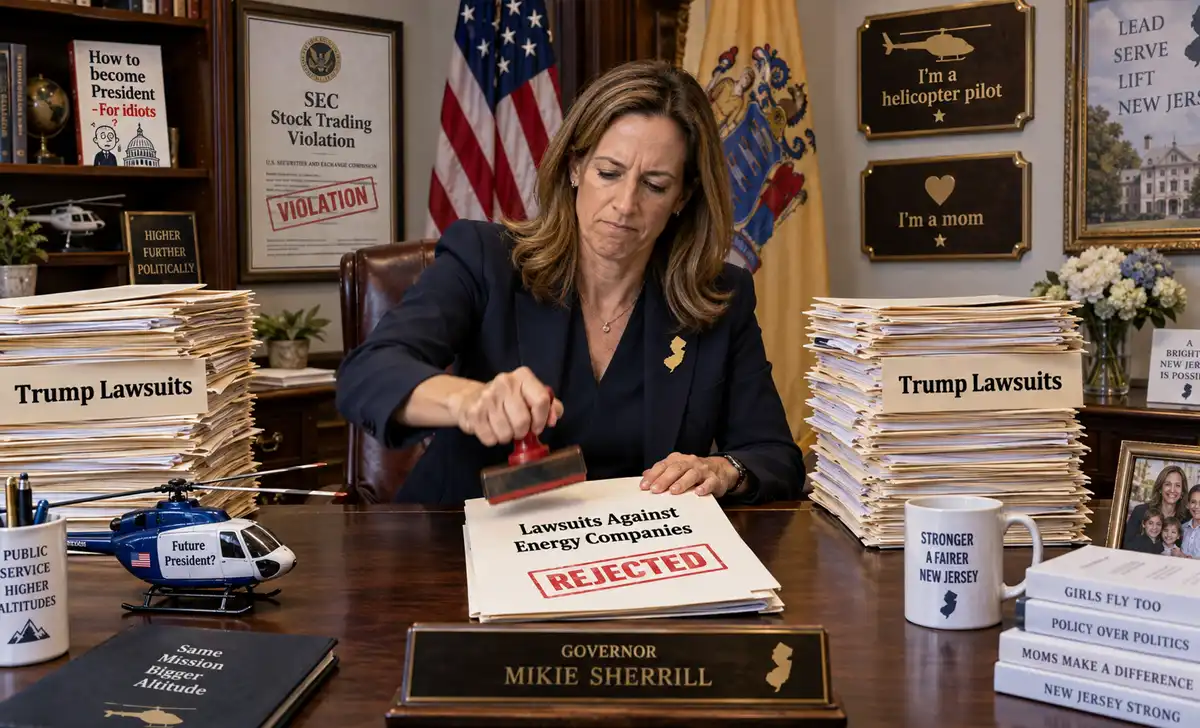
New Jersey has devoted substantial legal resources to challenging the Trump administration while residents continue paying historically high electricity costs despite Gov. Mikie Sherrill’s promise to stop rate hikes.
TRENTON, NJ — New Jersey has demonstrated over the past 20 months that when state leaders believe residents are being harmed by unlawful government action, they know exactly where the courthouse is.
Since President Donald Trump returned to office in January 2025, New Jersey has filed or joined roughly 75 legal challenges involving his administration, according to a recent Shore News Network review of state filings and contemporaneous lawsuit counts.
Those cases cover everything from immigration and elections to tariffs, health care, environmental regulations, federal grants and the Gateway Tunnel.
At the same time, another problem has been hitting New Jersey residents far closer to home: the electric bill arriving every month.
Electricity prices surged sharply in 2025. Rates remain elevated in 2026. Customers continue seeing an assortment of supply charges, distribution charges, riders, adjustment clauses and other line items that can make a residential electric bill increasingly difficult to understand.
That raises a legitimate public-policy question.
If New Jersey is willing to repeatedly deploy its lawyers against Washington when officials believe residents are being harmed, what is the state doing with that same sense of urgency to challenge costs imposed through New Jersey’s own regulated utility system?
About 75 challenges against the Trump administration
Shore News Network reported Friday that New Jersey has taken the Trump administration to court approximately 75 times since January 2025.
Roughly 45 to 46 challenges were filed or joined during the final year of the Murphy administration, while about 29 followed after Sherrill took office.
The state Attorney General’s Office openly describes challenging the federal government as one of its major priorities. Its “Protecting NJ from Attacks out of DC” initiative catalogs litigation over federal funding, immigration, health care, tariffs, consumer protection and numerous other issues.
Some of those cases have produced significant victories for New Jersey, including litigation involving federal money and the Gateway Tunnel. Others remain unresolved.
There is nothing inherently unusual about a state attorney general challenging the federal government. Attorneys general of both parties have routinely used multistate litigation against presidential administrations controlled by the opposing party.
But 75 cases represent a substantial commitment of attention, legal personnel and government resources.
Meanwhile, New Jersey residents have spent the same period watching electricity become an increasingly serious affordability problem.
Sherrill promised a freeze
Sherrill made electric rates one of the central affordability issues of her campaign for governor.
During her Jan. 20 inaugural address, she said she would give the Board of Public Utilities authority to pause new requests for rate increases and declared, “I will freeze rate hikes to finally provide families with real relief on their energy bills.”
Her administration subsequently promoted Executive Order No. 1 as action that would “freeze rate hikes” while using state funds and BPU authority to offset or modify certain increases.
But Shore News Network has documented the gap between that broad promise and the way utility pricing actually works.
In March, SNN reported that JCP&L customers were headed toward another approximately 1.6% increase tied to the 2026 Basic Generation Service auction, while Atlantic City Electric customers faced a smaller 0.11% increase. PSE&G customers saw a projected 1.8% decrease from the auction component. Those figures were confirmed by the BPU.
That followed much larger increases in 2025, when typical residential electricity bills jumped roughly 17% to 20% depending on the utility.
Sherrill’s administration has since used bill credits, offsets and regulatory actions intended to soften increases. Those measures matter.
They are not the same thing as making electricity inexpensive again.
Why can’t New Jersey simply sue JCP&L, PSE&G or Atlantic City Electric?
That question has a more complicated answer than the politics surrounding it.
JCP&L, PSE&G, Atlantic City Electric and Rockland Electric operate as regulated utilities. They generally cannot simply decide one morning to increase regulated rates.
A utility seeking many types of rate changes must file a case with the New Jersey Board of Public Utilities and justify the requested increase.
The state Division of Rate Counsel exists specifically to represent utility customers in those proceedings. Rate Counsel says utilities cannot increase regulated rates without BPU approval and must demonstrate that a requested change is justified. Rate Counsel participates in proceedings involving proposed changes to utility rates and services.
That makes the BPU hearing room, rather than a traditional civil lawsuit, one of the primary battlegrounds for electricity costs.
There are active proceedings involving these utilities right now.
BPU records show 2026 cases involving PSE&G electric adjustments, Atlantic City Electric charges and JCP&L’s EnergizeNJ infrastructure program, among others.
The BPU has also initiated an enforcement proceeding against JCP&L over reliability standards following widespread outages this summer.
So it would be inaccurate to say New Jersey is doing nothing.
The more useful question is whether the state is using its regulatory and legal powers as aggressively on affordability as it is using litigation against Washington.
High prices alone are not necessarily illegal
There is another important distinction.
The state cannot simply sue a utility because customers believe its prices are too high.
A successful lawsuit generally requires an identifiable legal violation — fraud, deceptive billing, unlawful fees, statutory violations, breach of regulatory requirements or some other legally actionable conduct.
Many electric-bill charges that customers understandably view as “junk fees” are actually tariffed charges, riders or adjustment mechanisms that have been reviewed through the state regulatory process.
That does not make those charges wise or affordable.
It means the place to challenge them may be a BPU rate case, a Rate Counsel proceeding, legislation or administrative reform rather than a conventional lawsuit.
If a utility were found to impose unauthorized charges, misrepresent fees or violate New Jersey consumer-protection laws, that would present a different legal question.
The BPU belongs to New Jersey, not Washington
This is where the affordability debate becomes particularly important.
The Trump administration does not appoint the New Jersey Board of Public Utilities.
Washington does not decide whether JCP&L can recover a particular infrastructure expense through New Jersey rates.
The federal government does influence energy costs substantially through PJM, federal energy regulation and national policy. Regional capacity prices were a major driver of the massive 2025 increase.
But New Jersey also controls important pieces of its own system.
The BPU oversees utility rate proceedings. Rate Counsel can contest proposed charges. State policymakers decide energy mandates, subsidies, incentives, generation policies and portions of the regulatory framework that eventually find their way onto customer bills.
Sherrill herself acknowledged the state’s responsibility when she declared an electricity affordability emergency on her first day in office.
That makes the performance of those institutions fair territory for scrutiny.
A freeze that did not literally freeze every bill
The 2026 auction illustrates the complexity.
The BPU certified results showing the average JCP&L residential bill increasing from $135.24 to $137.47 before credits or offsets, while an average Atlantic City Electric bill increased 22 cents.
PSE&G’s corresponding average bill declined $3.23.
The administration responded that bill credits and other mechanisms would offset increases.
That may protect consumers from some immediate costs.
But an offset funded elsewhere is different from eliminating the underlying expense. Eventually, New Jersey residents deserve a transparent accounting of where every dollar comes from and where every dollar on their utility bill goes.
SNN has previously examined that distinction in its coverage of Sherrill’s utility-rate promise and the broader rise in New Jersey electric costs.
The question Trenton still has to answer
The comparison between federal lawsuits and electric bills is not legally one-for-one.
Some Trump administration actions can be challenged directly in federal court. Utility rates operate through a different regulatory structure.
But the underlying accountability question remains straightforward.
New Jersey has shown extraordinary willingness to litigate when state leaders conclude federal policy threatens residents.
At home, those same residents are opening electric bills that remain far higher than they were several years ago.
The measurable questions are therefore not simply how many times New Jersey has sued Trump, but how often the state has challenged utility rate requests, how much Rate Counsel has successfully removed from proposed increases, how much consumers are paying through riders and surcharges, and whether the policies overseen by the BPU are producing electricity at an affordable price.
Those numbers would provide a clearer measure of whether Trenton’s fight over affordability matches the intensity of its battles in Washington.