
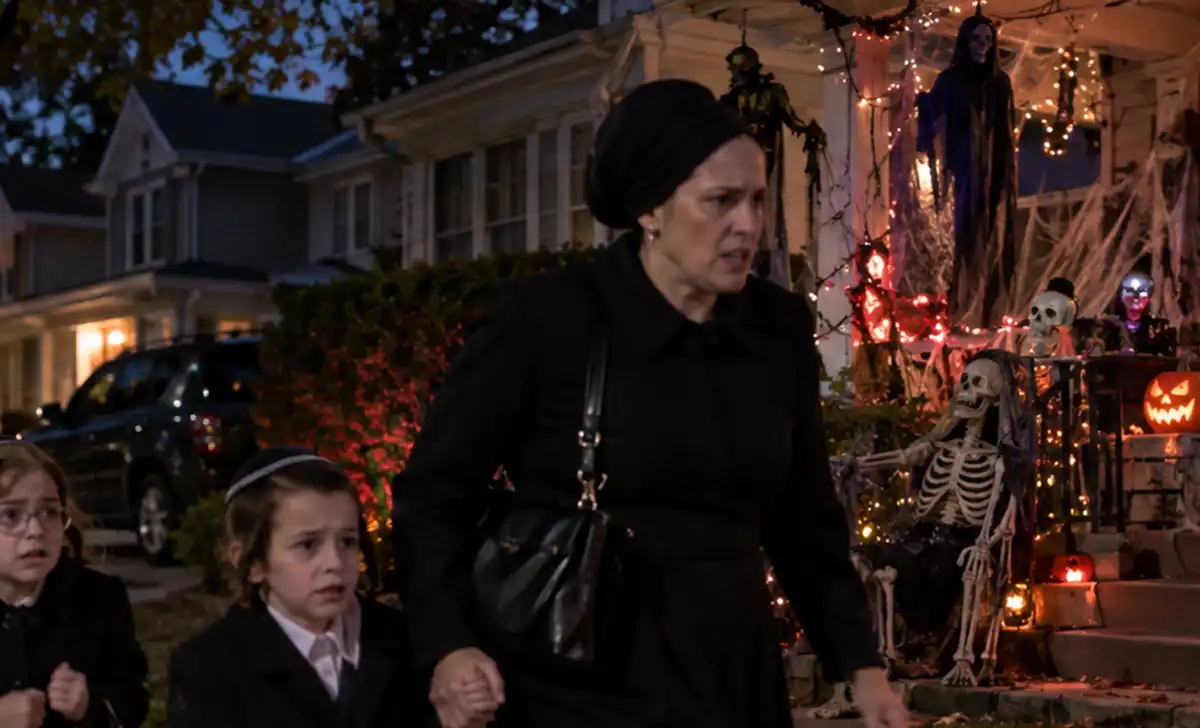
As Orthodox Jewish families continue moving into northern Ocean County, Halloween presents an unusual neighborhood question: Jewish law may prohibit celebrating the holiday, but some rabbis say handing candy to non-Jewish trick-or-treaters is not only permitted, but can help maintain good relations between neighbors.
TOMS RIVER, NJ — Halloween is approaching in northern Ocean County, where changing neighborhoods are bringing together families with very different traditions surrounding one of America’s most visible fall celebrations.
In Toms River and, increasingly, Brick Township, Orthodox Jewish families have moved into neighborhoods where Halloween has long meant decorated lawns, costumed children and doorbells ringing throughout the afternoon and evening.
Orthodox families generally do not celebrate Halloween. Children do not dress in Halloween costumes or go door-to-door collecting candy as part of the holiday.
But that does not necessarily mean the porch light has to stay off.
According to Rabbi Jack Abramowitz, an Orthodox rabbi and educational correspondent for Jew in the City, Jewish law can distinguish between participating in Halloween and giving candy to children who arrive at the door.
His conclusion is straightforward: trick-or-treating is prohibited under the religious reasoning he outlines, but giving candy to neighborhood children can be permitted.
Rabbi: Halloween celebration and handing out candy are different
In an article titled “Is There a Problem With Trick-or-Treating According to Judaism?”, Abramowitz argues that Halloween’s historical religious roots make Jewish participation problematic under the Jewish-law concept known as b’chukoseihem — a prohibition against adopting certain practices rooted in the religious customs of other peoples.
Under that interpretation, Jewish children would not go trick-or-treating simply because Halloween has become heavily commercialized or is treated as secular by many Americans.
Abramowitz reaches a different conclusion when the child standing on the doorstep is not Jewish and simply wants a candy bar.
“Perhaps surprisingly, while going out and soliciting candy is prohibited, distributing candy to those who knock on your door is actually permitted,” he wrote.
The reason, he explained, comes from the Jewish principle of mipnei darchei shalom — maintaining peaceful and positive relations with others.
Being a good neighbor without celebrating Halloween
Abramowitz points to teachings in the Talmud requiring Jews to assist and treat non-Jews with dignity in several areas of everyday life.
That principle, he argues, can extend all the way to something as ordinary as handing a Snickers bar to a child dressed as Spider-Man.
His concern is practical as much as theological.
A child walking through the neighborhood does not understand a complicated discussion of Jewish law. He or she simply knows which houses welcomed trick-or-treaters and which did not.
Abramowitz wrote that refusing neighborhood children solely because they are participating in Halloween could leave them with a negative impression of their Jewish neighbors.
He also pointed to prominent Torah authorities, including Rav Yaakov Kamenetsky and Rav Avrohom Pam, who he said prepared treats for neighborhood children who came to their doors.
The distinction is subtle but significant: the Jewish family is not celebrating Halloween by giving out candy. It is responding courteously to neighbors who are.
It has already happened in Ocean County
That concept has moved beyond rabbinical discussion and into the neighborhoods surrounding Lakewood.
As Orthodox families began moving heavily into Toms River during the last decade, accounts circulated of Jewish homeowners purchasing candy specifically for local children even though their own children would not be going trick-or-treating.
In some neighborhoods, longtime residents who initially wondered whether newly arrived Orthodox families would participate at all found those families answering their doors with bowls of candy.
The interaction can look almost contradictory from the sidewalk.
Inside the house, there may be no carved pumpkins, witches, ghosts or children preparing costumes. Outside, Batman, Wednesday Addams and a six-year-old dinosaur are still getting Hershey bars.
For the Orthodox homeowner, the distinction is that the candy is for the neighbor — not an observance of the holiday.
Toms River’s changing neighborhoods put the issue front and center
The question has particular relevance in Toms River.
Northern sections of the township closest to Lakewood have experienced a substantial influx of Orthodox Jewish families over the past decade. Neighborhoods that once had few or no Orthodox households now include Jewish families living alongside residents who have celebrated Halloween there for generations.
That means children who once knocked at nearly every house on a block may now encounter families who do not observe Halloween at all.
Some Orthodox homeowners simply do not participate. Others have taken the approach Abramowitz describes: don’t celebrate the holiday, but have something available for the neighborhood kids.
That seemingly small gesture has sometimes become an important point of interaction in communities where much larger arguments over development, schools, traffic, houses of worship and population change can dominate public discussion.
For a child, the interaction may last five seconds.
For neighbors learning how to live alongside people with unfamiliar customs, it can mean considerably more.
Brick is entering the conversation
Brick Township is at an earlier stage of the same demographic change.
Unlike Toms River and Jackson, Brick does not yet have an Orthodox population on the same scale. But Orthodox families have increasingly begun looking at neighborhoods in Brick as housing prices and population growth continue pushing outward from Lakewood.
That means more Brick neighborhoods are encountering the same everyday cultural questions that emerged in Toms River years earlier.
Halloween is one of them.
Brick has a particularly visible Halloween culture, from elaborately decorated homes to neighborhood trick-or-treating and community events.
For an Orthodox family moving onto such a street, the choice is not necessarily between celebrating Halloween and rejecting their neighbors.
Under the approach described by Abramowitz, there is a third option: don’t observe Halloween, but answer the door.
A different view from inside the same neighborhood
The distinction also helps explain something that can otherwise be confusing to non-Jewish neighbors.
An Orthodox family giving away candy should not necessarily be interpreted as gradually adopting Halloween.
The family may consider participating in the holiday religiously impermissible while simultaneously considering kindness toward the children at the door religiously appropriate.
Abramowitz makes that dividing line explicit.
“Celebrating Halloween by trick-or-treating or in other ways” is prohibited under the position he describes, while giving candy to trick-or-treaters is permitted “in order to foster positive relations with our non-Jewish neighbors.”
Not every Jewish authority necessarily approaches every aspect of Halloween identically, and individual Orthodox families may follow the guidance of their own rabbi.
But the candy-at-the-door approach has already provided one practical answer for families navigating life in mixed neighborhoods.
Sometimes the culture clash ends with a candy bar
Northern Ocean County has experienced serious disagreements as Lakewood’s population has expanded into surrounding communities.
Religion, development and changing neighborhood character have at times produced heated public confrontations.
Halloween provides a much smaller example of those cultural differences — but also an unusually simple way of navigating them.
The Orthodox children may not be joining the parade of superheroes and princesses moving down the sidewalk.
Their parents may not have a jack-o’-lantern glowing beside the front door.
But when their neighbor’s child knocks and says “trick or treat,” there may still be a candy bar waiting.
As Orthodox families move into Toms River and Brick, a rabbi explains why Jewish children may not celebrate Halloween while families can still give candy to trick-or-treaters.