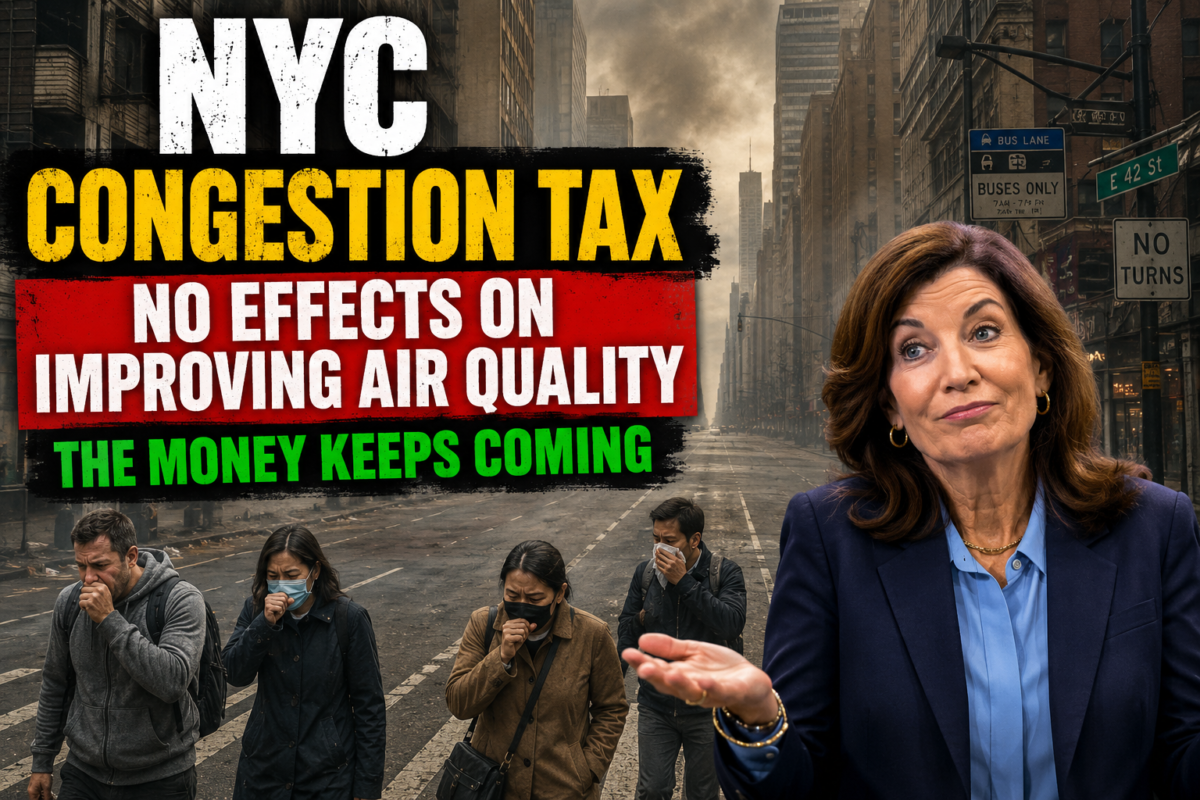
NEW YORK — A comprehensive first-year evaluation by the New York City Health Department found that the city’s congestion pricing program had little measurable impact on air quality, despite reducing vehicle traffic entering Manhattan’s central business district.
The report concluded that air quality across New York City “remained stable or improved slightly” during the first year of congestion pricing, continuing a long-term trend of declining pollution rather than showing a statistically significant improvement directly attributable to the tolling program.
Researchers also found that environmental justice communities located near major highway corridors did not experience increased air pollution after congestion pricing took effect.
Health officials say no neighborhoods saw pollution increase
The Health Department expanded its Community Air Survey monitoring network and analyzed concentrations of fine particulate matter (PM2.5), nitrogen dioxide, nitric oxide, and black carbon before and after tolling began.
Using data collected for one year before and one year after implementation, researchers adjusted for weather, seasonal variations, wildfire smoke, and other outside influences.
“This report gives us the clearest picture to date of how air quality has changed during the first year of congestion pricing, and we now know that air quality across New York City was not any different because of congestion pricing,” Health Commissioner Dr. Alister F. Martin said.
The report also found that neighborhoods near highways including the Cross Bronx Expressway, Major Deegan Expressway, Brooklyn-Queens Expressway, Staten Island Expressway, FDR Drive, and Trans-Manhattan Expressway did not experience increased pollution attributable to the program.
Traffic declined while transit funding increased
Although the study found little direct effect on measured air pollution, officials pointed to other benefits from congestion pricing.
The Metropolitan Transportation Authority reported that vehicle entries into Manhattan’s congestion zone declined by roughly 11 percent during the program’s first year, while revenue generated by the tolls has been directed toward transit improvements and environmental projects.
- New York City’s first-year study found congestion pricing did not produce statistically significant changes in citywide air quality.
- Researchers found no increase in pollution in environmental justice communities near major highways.
- Officials say traffic fell about 11 percent while congestion pricing continues funding transit and environmental improvements.
“Before we turned the cameras on, there was concern about the potential for increased pollution caused by drivers looking to avoid the toll,” MTA Chair and CEO Janno Lieber said. “As this study confirms, that didn’t happen, and congestion pricing is already funding additional investments to further improve air quality.”
New York City Department of Transportation Commissioner Mike Flynn said the reduction in traffic has encouraged more people to use public transportation, bicycle, or walk.
“Health’s findings, combined with the program’s investment of over $120 million into the city’s air quality and public health initiatives like NYC DOT’s Clean Trucks Program, mean that congestion pricing will help communities across the city breathe cleaner,” Flynn said.
Long-term air quality trend continues
The report notes that New York City’s air quality has steadily improved for nearly two decades, making it difficult to isolate any immediate changes caused solely by congestion pricing during its first year.
Officials said continued monitoring will determine whether longer-term environmental benefits emerge as the program matures.
The city also highlighted a separate $20 million MTA investment announced earlier this year to improve childhood asthma outcomes in the Bronx through expanded asthma treatment and case management programs.
FAQ
- Did congestion pricing improve air quality?
The city’s study found air quality remained stable or improved slightly, but changes were not statistically significant enough to attribute directly to congestion pricing. - Did any neighborhoods experience worse pollution?
No. Researchers found no increase in air pollution in environmental justice communities or neighborhoods near major highway corridors. - Did traffic decrease?
Yes. Officials said vehicle entries into Manhattan’s congestion zone declined by about 11 percent. - How was the study conducted?
Researchers analyzed one year of air quality data before tolling and one year afterward while accounting for weather, seasonal changes, and wildfire smoke. - Will the city continue monitoring the program?
Yes. Officials said air quality monitoring will continue to evaluate long-term effects.
Sources: New York City Health Department first-year Congestion Relief Zone Tolling Program air quality report; New York City Community Air Survey; Metropolitan Transportation Authority; New York City Department of Transportation.